If someone searches “gym near me,” “fitness center near me,” or “best gym in [city],” you don’t want your competitors appearing while your gym stays buried below the map results. That’s where local SEO for gyms becomes a serious growth channel.
In my SEO work, I’ve seen gym owners focus heavily on Instagram, paid advertising, and promotional offers while overlooking one of the highest-intent discovery channels available: Google Maps. Someone searching for a nearby gym isn’t simply browsing. They’re often looking for a location they can visit, compare, call, or join.
The opportunity is even bigger because Google Maps visibility can connect a search directly to a phone call, website visit, direction request, trial booking, or membership inquiry.
Google says local results are primarily influenced by relevance, distance, and prominence. Businesses can’t simply pay Google to receive a better organic local ranking. So, how do you actually build a stronger local gym SEO?
You optimize the entire local search ecosystem around your gym: your Google Business Profile, website, reviews, location signals, citations, content, backlinks, and customer experience. This guide explains exactly how to do it.
What Is Local SEO for Gyms?
Local SEO for gyms is the process of improving a gym’s visibility when people search for fitness businesses in a specific geographic area.
Unlike traditional SEO, which may target broad searches such as “strength training programs,” local SEO for gyms focuses heavily on searches with local intent.
Examples include:
| Search | Search Intent |
| gym near me | Immediate local intent |
| gyms in Austin | Location-specific |
| best gym in Dallas | Commercial investigation |
| CrossFit gym near me | Service + location |
| personal training near me | Service-focused |
| 24-hour gym near me | Attribute + location |
| fitness center in Miami | Local discovery |
The goal isn’t simply to generate website traffic. The goal is to get found by nearby prospects who are likely to become members. That’s why effective local search optimization for gyms combines visibility with conversion optimization.
A gym can rank well but still generate few leads if its profile has poor photos, confusing information, weak reviews, or an ineffective website. The best strategy connects all of these elements.
How Does Google Maps Ranking Work for Gyms?
Before trying to rank a gym on Google Maps, you need to understand what Google is actually evaluating. Google identifies three primary local ranking factors:
Relevance, distance, and prominence.
1. Relevance
Relevance measures how closely your business matches what the searcher wants. For example, if someone searches:
“boxing gym near me”
Google needs to determine which local businesses actually provide boxing-related services. This is why your gym business information, categories, services, description, website content, and other local signals matter.
A complete and accurate business Profile helps Google understand what your business offers.
2. Distance
Distance is straightforward but frequently misunderstood. Google considers how far the business is from the person searching or from the location specified in the query.
This means you can’t realistically force a gym in downtown Austin to rank first for every search across the entire Austin metro. Local SEO has geographic limitations that’s actually good news.
You don’t need to dominate an entire city. You need to become highly visible in the geographic areas that matter to your membership base.
3. Prominence
Prominence relates to how well-known and established a business is. Google says prominence can be influenced by information across the web, including links and directories, as well as review quantity and ratings.
This makes Google gym rankings more than a business Profile optimization exercise. Your website, reviews, citations, backlinks, brand presence, and overall reputation can all contribute to the broader local search ecosystem.
Why Local SEO for Gyms Matters for Membership Growth
Think about the difference between these two searches:
“best workout routine for beginners”
and
“gym near me.”
The first search is informational. The second has strong commercial and local intent. The person searching for a gym may be comparing memberships, checking opening hours, reading reviews, looking at photos, or trying to find directions.
That’s why local gym marketing should capture prospects at the exact moment they are considering a nearby facility. A strong local search visibility strategy can help gyms generate:
- Phone calls
- Direction requests
- Website visits
- Trial bookings
- Consultation requests
- Membership inquiries
- Local brand awareness
- Organic gym leads
The real objective isn’t “rankings.”
It’s qualified local demand.
9 Steps to Improve Local SEO for Gyms
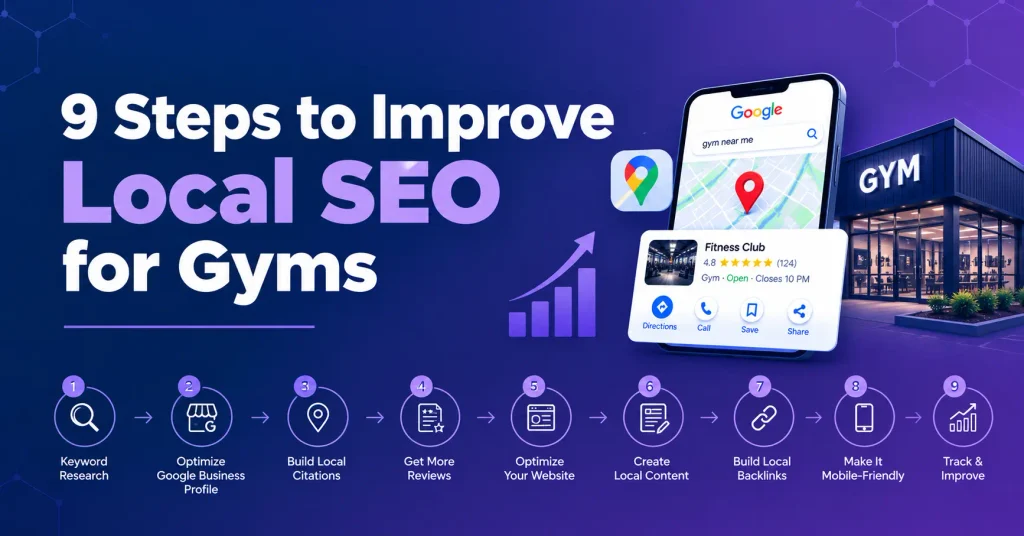
1. Fully Optimize Your Google Business Profile
Your Google Business Profile for gyms is the foundation of your Maps strategy. If your gym has a physical location and is eligible for a business Profile, start by claiming and verifying it. Then make the information accurate, complete, and consistent.
Google specifically recommends keeping business Profile information complete and accurate to improve the chances of appearing in relevant local searches.
Your profile should accurately communicate:
- Gym name
- Address
- Phone number
- Website
- Opening hours
- Holiday hours
- Business category
- Services
- Photos
- Relevant attributes
Don’t treat the profile like a static directory listing. Treat it like a local landing page. Optimize the Primary Category Carefully Your primary category helps communicate what your business is.
Choose the category that most accurately represents the actual business rather than selecting categories simply because you believe they have higher search volume.
You can use appropriate additional categories where they genuinely describe the business. The principle is simple: Optimize for accuracy, not keyword manipulation.
Don’t stuff “best gym,” city names, neighborhoods, or services into the business name unless they’re legitimately part of the real-world business name.
2. Build a Strong Gym Website Around Local Intent
Your gym website SEO supports your Google Maps presence. Google explains that local information can come from multiple sources, including public web content, third-party data, users, and business owners.
That means your website should reinforce the information Google sees elsewhere. At minimum, your website should clearly communicate:
Who you are → What you offer → Where you’re located → Who you serve → How people can contact you.
Create a dedicated location page for each legitimate physical location.
For example:
/gym-austin/
could target relevant searches around that actual location. A useful location page could include:
Gym Location Information
Include the actual address, phone number, hours, parking information, nearby landmarks, and directions.
Membership Information
Explain membership options, trial offers, classes, and onboarding.
Services
Describe legitimate services such as
- Personal training
- Strength training
- Group fitness
- HIIT
- Yoga
- Boxing
- CrossFit
- Weight training
Don’t create pages for services you don’t actually offer.
Local Context
Mention genuinely relevant neighborhoods or nearby areas where appropriate. The objective isn’t to create a page stuffed with city names. It’s to make the page genuinely useful to someone deciding whether your gym is convenient.
3. Target “Gym Near Me” and Local Intent Keywords
One of the biggest mistakes I see in fitness center SEO is targeting only broad keywords.
For example:
“gym”
is incredibly broad. A better keyword architecture might include:
Primary:
“gym in [city]”
Secondary:
“fitness center in [city]”
“gym near [neighborhood]”
“personal training in [city]”
“24-hour gym in [city]”
Long-tail:
“best gym near [neighborhood]”
“strength training gym near me”
“women’s gym near [location]”
“personal trainer near [location]”
The important concept is local search intent. Don’t force the phrase “near me” repeatedly onto your website. Google can interpret geographic intent based on the searcher’s location and other signals. Instead, build content that naturally establishes your location, services, and relevance.
4. Build a Genuine Google Review Strategy
Reviews are one of the most important components of gym reputation management. They also influence how prospective members perceive your business.
Google states that reviews can help businesses stand out and that reviews appear alongside business Profiles in search and maps. The best review strategy isn’t
“Get as many five-star reviews as possible.”
It’s:
“Consistently create great customer experiences and make it easy for genuine customers to share them.”
You can ask real customers to leave honest feedback. Google provides tools for generating a review link or QR code, including sharing it through email, chat, receipts, or in-store displays.
Don’t Buy Reviews
This is important. Google prohibits fake or incentivized reviews. Businesses shouldn’t offer discounts, free services, or other incentives in exchange for reviews or manipulate customers into posting particular content. That means your gym’s Google reviews strategy should focus on authentic customer feedback.
Respond to Reviews
Don’t ignore reviews after receiving them. Respond professionally to positive feedback. For negative feedback, avoid emotional arguments. A thoughtful response can demonstrate that the business listens and takes customer experience seriously.
5. Use High-Quality Photos to Improve Your Local Presence
Your Google Business Profile photos can influence how potential members perceive your facility. When someone searches for your gym, they may immediately look at:
- Training floor
- Equipment
- Reception
- Group classes
- Personal training areas
- Locker rooms
- Exterior signage
- Parking
- Trainers
- Community events
Your photos should represent the actual facility. Don’t rely entirely on stock photography. For a gym, authenticity matters. Someone considering a membership wants to know:
“What will this place actually feel like when I walk in?” That’s why real gym photos on Google can contribute to a stronger customer experience.
6. Maintain Consistent Local Citations
Local citations for gyms are online mentions of your business information.
They can appear on:
- Local directories
- Fitness directories
- Chamber websites
- Industry websites
- Business directories
- Social profiles
- Local publications
The key concept is NAP consistency:
Name + Address + Phone number.
If your gym’s information differs significantly across important sources, it can create unnecessary ambiguity.
For example:
Website:
Peak Fitness Center, 123 Main Street
Directory:
Peak Fitness, 125 Main St.
Facebook:
Peak Fitness Center, 123 Main Avenue
Clean these inconsistencies wherever practical. Citations aren’t a shortcut to the top of Google Maps. They’re part of building a coherent local business identity.
7. Build Local Backlinks and Community Authority
Local backlinks can strengthen your broader gym search engine optimization strategy. Look beyond generic backlink packages think locally. A gym might earn legitimate links from:
- Local news websites
- Community organizations
- Sports associations
- Local event websites
- School partnerships
- Charity events
- Fitness organizations
- Local business associations
- Relevant neighborhood publications
For example, if your gym sponsors a legitimate community fitness event, the event organizer may mention your gym on its website. That’s a much stronger relationship than buying hundreds of random directory links.
Google’s local guidance notes that prominence can incorporate information from across the web, including links, articles, and directories.
8. Create Local Content That Answers Real Member Questions
Content is where SEO for gyms becomes more than maps optimization. Create useful content around questions your local audience actually asks.
Examples include:
Beginner Fitness Content
“How many days a week should beginners work out?”
Local Fitness Guides
“Best workouts for busy professionals in [city]”
Service Content
“What to expect from personal training at our [city] gym”
Comparison Content
“Personal training vs group fitness: Which is better?”
Membership Content
“What should you look for in a local gym?” This content can support your local search marketing for gyms while also attracting informational searches. More importantly, it can establish topical relevance around your services.
9. Optimize for Conversions, Not Just Rankings
Here’s where many local SEO campaigns fail. A gym might achieve better local search rankings but still struggle to generate memberships.
Why?
Because rankings don’t pay the bills. Members do your Google Business Profile and website should make the next step obvious. Use strong calls to action such as
Book a Free Trial
Schedule a Gym Tour
Start Your Membership
Talk to a Trainer
Claim Your Trial
View Membership Options
Don’t force visitors through five pages before they can contact you. For high-intent local traffic, simplicity wins.
Google Maps SEO for Gyms: What Actually Matters?
Here’s a practical comparison of major local SEO components.
| Local SEO Element | Importance | What to Do |
| Google Business Profile | Very High | Complete, accurate, verified profile |
| Business category | High | Choose the most accurate category |
| Distance | High | Geographic factor you can’t directly manipulate |
| Reviews | High | Build authentic review volume and respond |
| Website | High | Build locally relevant, useful pages |
| NAP consistency | High | Keep core business information consistent |
| Local backlinks | Medium–High | Earn relevant local authority |
| Photos | Medium | Upload genuine, high-quality facility photos |
| Local content | Medium–High | Answer useful local and fitness questions |
| Citations | Medium | Build accurate relevant listings |
| Schema | Supporting | Help search engines understand business details |
One important distinction:
You cannot optimize your way out of distance. If someone is searching from five miles away, a competitor located two blocks from them may have a geographic advantage.
That’s normal. The goal of Google Maps SEO for gyms isn’t to manipulate Google’s geographic system. It’s to maximize relevance and prominence while serving the areas where your gym can realistically attract members.
Local SEO for Gyms vs Paid Ads
Should gyms invest in local SEO or Google Ads? In many cases, the answer is both.
| Factor | Local SEO | Paid Ads |
| Immediate traffic | Lower | Higher |
| Long-term visibility | Strong | Depends on budget |
| Cost per click | No direct CPC | Pay per click |
| Google Maps visibility | Strong potential | Different mechanism |
| Compounding value | Yes | Limited |
| Brand authority | Builds over time | Less organic authority |
| Speed | Gradual | Fast |
| Best use | Sustainable acquisition | Immediate demand |
I wouldn’t frame SEO and paid advertising as enemies.
A gym launching a new location may use paid ads to generate immediate awareness while simultaneously building its local SEO for gyms foundation. Once organic visibility strengthens, the business can evaluate which channel produces the best gym marketing ROI.
Common Local SEO Mistakes Gyms Should Avoid
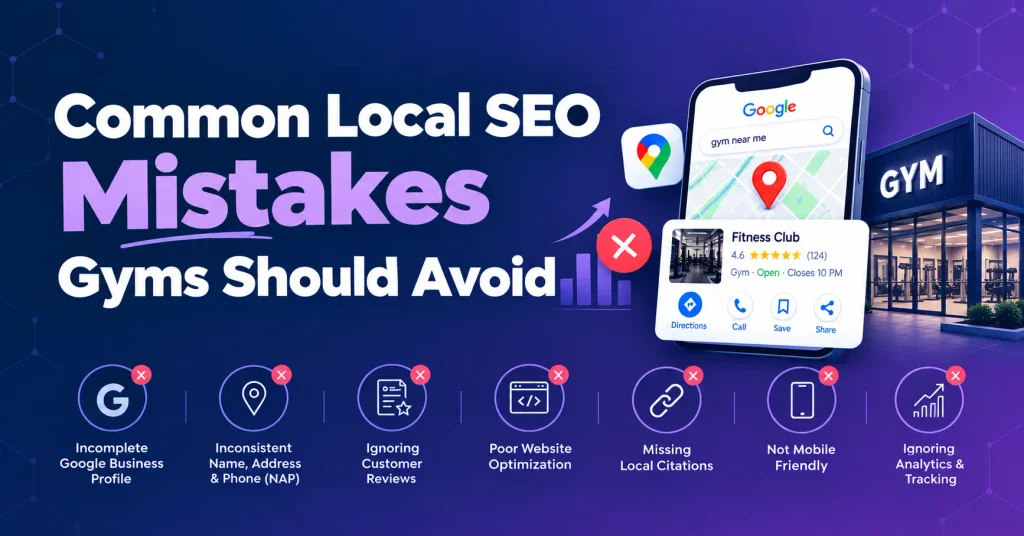
Keyword Stuffing
Repeating phrases such as:
“best gym in Austin, Austin gym, Austin fitness center, gym Austin”
doesn’t create useful content. Write for humans first.
Fake Reviews
Never purchase reviews or incentivize customers to manipulate ratings. Google explicitly prohibits fake and incentivized review activity.
Creating Fake Locations
Don’t create Business Profiles or location pages for places where you don’t legitimately operate. Local SEO works best when the digital footprint reflects a real-world business.
Ignoring Negative Reviews
A negative review isn’t automatically a disaster. Ignoring every complaint can be worse. Respond professionally and focus on resolving legitimate concerns.
Using an Incorrect Business Name
Don’t add keywords or city names to your business name simply because you want better rankings. Your profile should accurately represent the real business.
Neglecting the Website
Your Business Profile shouldn’t be your entire fitness business SEO strategy. Your website provides additional context, services, content, and conversion opportunities.
A Practical Local SEO Checklist for Gyms
Use this checklist when auditing a gym.
Google Business Profile
☐ Profile claimed and verified
☐ Business name accurate
☐ Correct address
☐ Correct phone number
☐ Accurate opening hours
☐ Correct primary category
☐ Relevant secondary categories
☐ Services added where appropriate
☐ Business description completed
☐ High-quality photos uploaded
☐ Review strategy established
☐ Reviews answered consistently
Website
☐ Location page created
☐ NAP information visible
☐ Mobile-friendly design
☐ Fast loading experience
☐ Local keywords mapped
☐ Service pages created
☐ Strong internal linking
☐ Clear calls to action
☐ Contact information easy to find
☐ LocalBusiness schema implemented where appropriate
Authority
☐ Local citations reviewed
☐ Directory information consistent
☐ Relevant local backlinks earned
☐ Community partnerships developed
☐ Local content published
☐ Brand mentions monitored
Conversion
☐ Free trial CTA
☐ Membership CTA
☐ Gym tour CTA
☐ Click-to-call functionality
☐ Easy contact form
☐ Online booking option
☐ Conversion tracking installed
How to Measure Local SEO for Gyms
Don’t judge your campaign exclusively by checking where your own gym appears on Google Maps. Local results can vary depending on searcher location and context. Instead, track business outcomes.
Important metrics include:
Google Business Profile interactions
Website organic traffic
Local keyword visibility
Phone calls
Direction requests
Website clicks
Trial bookings
Membership inquiries
Lead-to-member conversion rate
Cost per acquisition
Revenue from organic leads
Google’s Business Profile ecosystem provides visibility into customer interactions, while your website analytics and CRM can help connect those interactions with actual leads and memberships.
The final question isn’t
“Did we move from position 7 to position 4?”
It’s:
“Did our improved local visibility create more qualified membership opportunities?”
That’s the metric that matters.
How Long Does Local SEO Take for a Gym?
There isn’t a universal timeline. A new gym with limited authority, few reviews, and weak website signals may need considerably more work than an established fitness center with a strong local presence.
A realistic progression might look like this:
| Period | Potential Focus |
| Month 1 | GBP audit, technical SEO, NAP cleanup |
| Months 2–3 | Reviews, local content, citations, website optimization |
| Months 3–6 | Authority building, rankings, conversion optimization |
| Months 6–12 | Scaling content, local links, stronger visibility |
These aren’t guaranteed ranking milestones. Google doesn’t provide a fixed timetable for local rankings.
Your results can depend on competition, location, website authority, reviews, business history, and the strength of competing gyms.
How AI, GEO, and AEO Change Local SEO for Gyms
Local search is becoming increasingly conversational. People may ask AI systems questions such as:
“What’s the best strength training gym near me?”
“Find a gym with personal trainers near downtown.”
“Which gyms nearby offer beginner-friendly classes?”
This creates a broader opportunity beyond traditional Google Maps visibility. Your business needs to be clearly understood across its digital ecosystem. That’s where GEO, or Generative Engine Optimization, becomes relevant.
Build a Clear Business Entity
Your gym should have consistent information across:
- Website
- Google Business Profile
- Social profiles
- Directories
- Local publications
- Industry listings
Create Answer-Focused Content
Instead of writing generic SEO articles, answer specific questions.
For example:
“Does your gym offer personal training?”
“Do you offer beginner classes?”
“What are your membership options?”
“Is parking available?”
“What are your opening hours?”
This content can support AEO, or Answer Engine Optimization, because it provides concise information that search systems can interpret.
Use Structured Data
Where appropriate, implement relevant LocalBusiness schema and other valid structured data. Structured data can help search engines understand entities, attributes, and relationships on a webpage.
However, don’t expect schema alone to make a gym rank in Maps. It’s a supporting signal, not a magic ranking button.
Pros and Cons of Local SEO for Gyms
Pros
High-intent traffic: People searching locally often have strong commercial intent.
Long-term value: Organic visibility can continue producing opportunities without paying for every click.
Local trust: Reviews, photos, and consistent business information can reduce uncertainty.
Multiple conversion paths: Searchers can call, visit the website, request directions, or book a trial.
Compounding authority: Strong content, links, reviews, and brand visibility can reinforce one another.
Cons
Results aren’t instant: SEO requires consistent work.
Competition varies dramatically: A gym in a crowded urban market may face many established competitors.
Distance matters: You cannot eliminate geographic limitations.
Reviews require real customers: You can’t ethically manufacture authentic customer experiences.
Maintenance is ongoing: Hours, services, photos, reviews, content, and business information need regular attention.
Internal Linking Opportunities for a Gym SEO Website
If you’re building a content cluster around local SEO for gyms, connect this article to supporting pages using descriptive anchors.
Potential internal links include:
Gym Lead Generation
Anchor: gym lead generation strategies
Gym Lead Follow-Up
Anchor: automate gym lead follow-up
Gym Website SEO
Anchor: gym website SEO
Gym Marketing
Anchor: digital marketing for gyms
Gym Membership Conversion
Anchor: increase gym membership conversions
Google Business Profile Guide
Anchor: Google Business Profile optimization
Gym Content Marketing
Anchor: content marketing for gyms
This creates a stronger topical architecture and helps visitors move from informational content toward commercial pages.
FAQ: Local SEO for Gyms
How do I rank a gym on Google Maps?
To rank a gym on Google Maps, build and verify an accurate Google Business Profile, use the most relevant business categories, maintain complete information, collect genuine customer reviews, publish strong local website content, maintain consistent business citations, and develop legitimate local authority. Google says local rankings primarily consider relevance, distance, and prominence.
How do I optimize Google Business Profile for a gym?
Complete every relevant section of your Business Profile with accurate information. Choose the appropriate primary category, maintain correct hours and contact details, add authentic photos, describe your services accurately, and actively manage genuine customer reviews. Avoid keyword stuffing because your profile should represent the real-world business.
How long does local SEO take for a gym?
There is no guaranteed timeline. A gym may see early improvements within several months, while competitive markets can require substantially longer. Results depend on competition, geographic proximity, website strength, reviews, prominence, and overall local SEO quality. Focus on sustained improvements in visibility, calls, website visits, trial bookings, and memberships rather than a fixed ranking deadline.
How can a gym rank for “gym near me”?
A gym can’t directly control where it appears for every “near me” search because distance is a major local ranking factor. However, you can strengthen relevance and prominence through an accurate Business Profile, strong website, genuine reviews, consistent business information, local authority, and excellent customer experience.
Do Google reviews help gyms rank higher?
Google states that review count and review scores can contribute to local prominence, and reviews also help potential customers evaluate businesses. However, gyms should request genuine reviews rather than purchasing or incentivizing them. Google prohibits fake and incentivized review activity.
Should gyms create separate pages for every neighborhood?
Only when those pages provide genuinely useful information for legitimate service areas or locations. Creating dozens of thin pages that simply replace a city or neighborhood name isn’t a strong SEO strategy. Instead, create useful location pages that explain the actual gym, services, accessibility, surrounding area, and membership experience.
Can SEO generate gym membership leads?
Yes. Local SEO for gyms can put your business in front of people actively searching for nearby fitness services. However, rankings alone don’t guarantee memberships. Your Google Business Profile, website, reviews, offers, calls to action, booking process, and sales follow-up all influence whether local search visibility becomes revenue.
What are the most important Google Maps ranking factors for gyms?
Google identifies relevance, distance, and prominence as the primary factors for local results. Relevance reflects how well the business matches the search, distance reflects geographic proximity, and prominence relates to how well-known the business is. Reviews and information from across the web can contribute to prominence.
Does posting on Google Business Profile improve rankings?
Regularly maintaining a Business Profile can keep information current and provide useful updates to customers, but you shouldn’t assume that publishing posts alone will produce higher Maps rankings. Prioritize accurate business information, relevance, proximity, prominence, genuine reviews, and a strong overall local presence.
Can AI help with local SEO for gyms?
AI can assist with keyword research, content planning, review-response drafts, local content ideas, reporting, and workflow automation. However, AI shouldn’t replace genuine expertise or customer experience. The strongest strategy combines automation with accurate business information, original insights, real customer experiences, and useful content.
Final Thoughts: Build Local Visibility That Produces Members
Local SEO for gyms isn’t simply about putting a gym on Google Maps. It’s about building a trustworthy local entity that Google can understand and potential members can confidently choose. Start with the fundamentals.
Claim and optimize your Google Business Profile. Keep your business information accurate. Build genuine reviews. Create a useful location-focused website. Strengthen your local citations. Earn legitimate backlinks. Publish helpful content. Improve conversion paths.
Then connect those efforts to measurable business outcomes. Because the real goal isn’t to brag that your gym ranks in the Google Local Pack. The goal is to turn local searches into:
Calls → Trials → Visits → Memberships → Revenue.
If I were building a local SEO for gyms strategy from scratch today, I wouldn’t try to manipulate every ranking signal at once.
I’d build a clean local foundation, establish relevance, strengthen prominence, create useful content, and continuously connect organic visibility with membership conversions. That’s how local SEO becomes more than an SEO project. It becomes a predictable gym growth channel.
About the Author
[jawaria toufiq] is an SEO strategist at HQ Growth Lab, helping small and mid-sized businesses improve organic visibility, generate qualified leads, and build scalable digital growth systems.
Their work focuses on SEO, technical optimization, content strategy, web development, AI automation, and conversion-focused digital marketing.