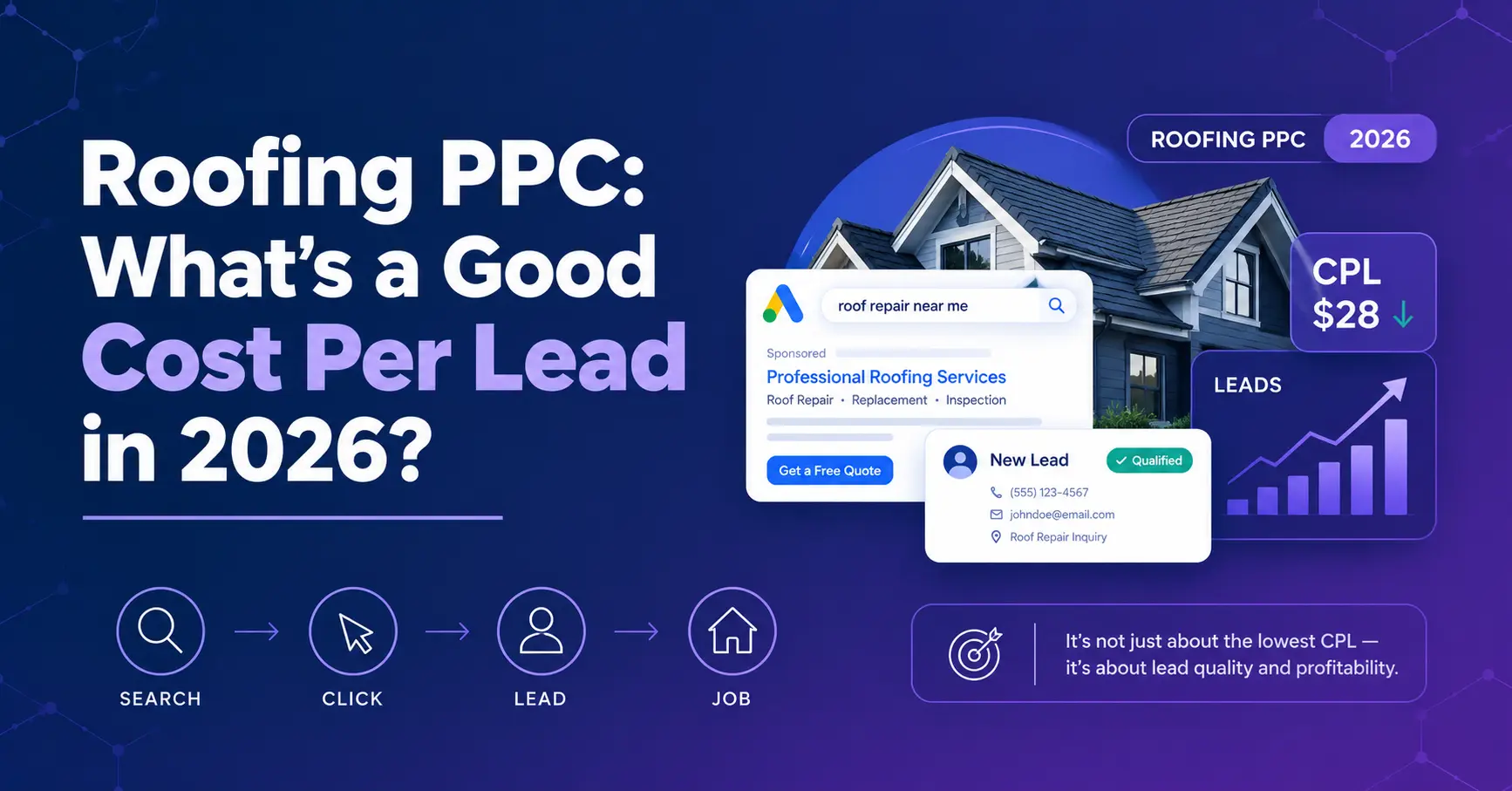
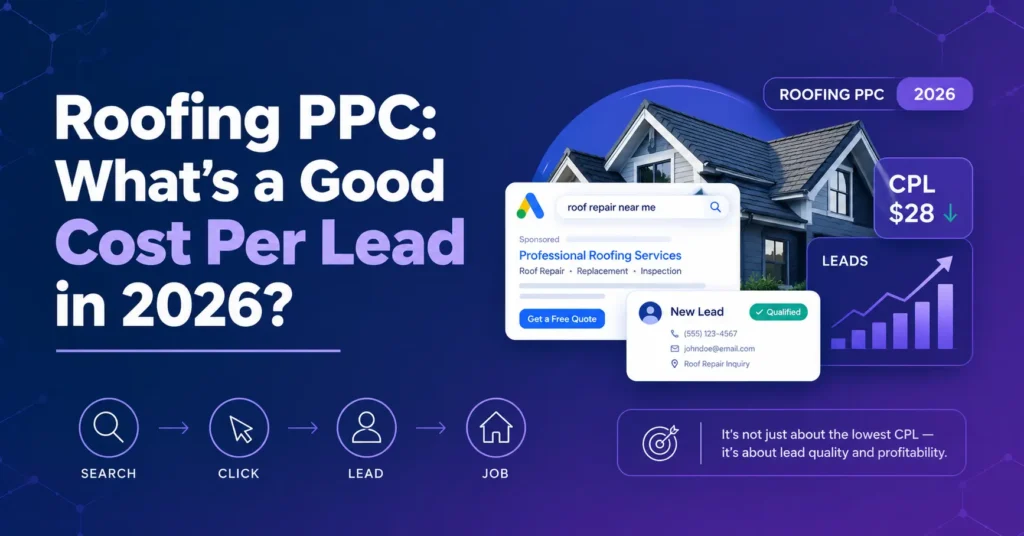
Roofing leads are expensive. According to LocaliQ, the average cost per lead for roofing & gutters was $228.15. But that benchmark is not universal. Your actual roofing PPC cost per lead depends on your market, services, keywords, landing page, lead quality, and sales process.
So, what should roofing PPC cost in 2026?
In this guide, we’ll look at what a good roofing PPC cost per lead looks like, how to calculate your maximum profitable CPL, and how to lower your cost per lead without sacrificing lead quality.
What Is a Good Roofing PPC Cost Per Lead in 2026?
A reasonable starting reference for roofing PPC is around $200–$250 per lead. According to LocaliQ’s benchmark data, the Roofing & Gutters category had:
| Metric | Roofing & Gutters |
|---|---|
| Cost Per Lead | $228.15 |
| Cost Per Click | $10.70 |
| Conversion Rate | 3.70% |
| Click-Through Rate | 5.66% |
These numbers provide a useful benchmark, but they should not be treated as a fixed price for every roofing company. A roofing company in a highly competitive market may pay more, while a company with strong landing pages, good reviews, effective targeting, and a strong follow-up process may achieve better results.
The better question is not simply, “Is $228 per lead expensive?” The better question is
“Can I turn that lead cost into a profitable customer acquisition cost?”
Why Is Roofing PPC So Expensive?
Roofing PPC can be expensive because roofing is a high-value and highly competitive service.
People search for terms such as
- roof replacement near me
- roofing contractor near me
- emergency roof repair
- roof repair company
- roofing company near me
- commercial roofing contractor
Many of these searches have strong buying intent. Roofing companies are competing for customers who may be worth thousands or even tens of thousands of dollars. For example, imagine a roofing company sells a $15,000 project.
If one lead costs $200:
- 20 leads cost $4,000.
- If 5 of those leads become customers, the advertising cost is $4,000
- Customer acquisition cost becomes $800 per customer.
- Revenue generated is $75,000.
The $200 CPL may look expensive at first, but it can be highly profitable if the leads are qualified and the company closes enough of them. This is why roofing PPC should be evaluated based on the entire sales process rather than CPL alone.
How Much Does Roofing PPC Cost?
There is no single fixed price for roofing PPC. Your actual cost can change based on several factors, including:
- Geographic market
- Keyword competition
- Roofing service
- Search intent
- Cost per click
- Landing page conversion rate
- Ad relevance
- Account structure
- Lead quality
- Seasonality
- Reviews
- Conversion tracking
- Lead follow-up
- Close rate
Two roofing companies can target similar keywords and still have completely different results.
A company with a high-converting landing page and fast follow-up may generate better leads at a lower cost, while another company may spend more because its landing page, targeting, or sales process is not converting efficiently.
Roofing PPC Cost vs. Cost Per Lead
Roofing PPC cost and roofing PPC cost per lead are not the same thing. Your total PPC cost is the amount you spend on advertising. Your cost per lead tells you how much you spend to generate each lead.
The basic formula is:
CPL = Total Ad Spend ÷ Number of Leads
For example:
- Ad spend = $6,000
- Leads = 30
- CPL = $200
That means the company spent an average of $200 to generate each lead. However, not every lead is necessarily valuable. If only 18 of those 30 leads are genuine opportunities, your qualified cost per lead becomes:
$6,000 ÷ 18 = $333.33
This is why qualified leads matter more than raw lead volume.
What Is the Average Roofing PPC Cost Per Lead?
LocaliQ reported an average CPL of $228.15 for the Roofing & Gutters category. The benchmark data came from more than 3,200 search campaigns and covered the period from April 2024 through March 2025.
The reported metrics included:
| Metric | Roofing & Gutters |
|---|---|
| CPL | $228.15 |
| CPC | $10.70 |
| Conversion Rate | 3.70% |
| CTR | 5.66% |
This gives roofing companies a useful starting point when evaluating their own campaigns. But averages are not targets. Your profitable CPL depends on your own revenue, profit margins, close rate, lead quality, and customer acquisition goals.
What Should Roofers Pay Per Lead?
Roofers should determine what they can afford to pay based on the economics of their business.
For example, suppose:
- Average revenue per customer = $15,000
- Gross profit per customer = $5,000
- Lead-to-sale rate = 20%
- Target CPL = $200
At a 20% close rate, you would need approximately 100 leads to generate 20 customers.
At $200 per lead:
100 leads × $200 = $20,000 ad spend
Those 20 customers would generate:
20 × $5,000 = $100,000 gross profit
The important number is not simply the cost of each lead. It is whether those leads turn into profitable customers.
How to Calculate Your Maximum Profitable Roofing CPL
You can calculate your maximum profitable roofing CPL by working backward from your customer economics.
Step 1: Calculate Average Gross Profit
Determine how much gross profit you make from an average roofing customer.
Step 2: Determine Your Lead-to-Sale Rate
Look at how many leads become paying customers. For example, if 20 out of 100 leads become customers, your close rate is 20%.
Step 3: Determine Your Allowable Customer Acquisition Cost
Decide how much you can afford to spend to acquire one new customer while remaining profitable.
Step 4: Calculate Your Maximum CPL
Your maximum profitable CPL can be estimated by multiplying your allowable customer acquisition cost by your lead-to-sale rate.
For example:
$1,000 allowable CAC × 20% close rate = $200 maximum CPL
This gives you a more useful target than simply copying an industry average.
Roofing PPC CPL by Lead Quality
Not every roofing lead has the same value.
| Lead Type | Example | Relative Value |
|---|---|---|
| Unqualified | Wrong service or location | Low |
| Low intent | General pricing question | Low |
| Repair inquiry | Small repair request | Medium |
| Inspection request | Homeowner requesting an inspection | Medium–High |
| Replacement inquiry | Homeowner considering a roof replacement | High |
| Emergency roofing lead | Urgent roofing problem | High |
| Commercial opportunity | Commercial roofing project | Very High |
A $100 lead is not necessarily better than a $300 lead. If the $100 lead has low intent and never becomes a customer, while the $300 lead becomes a profitable $15,000 project, the more expensive lead may be the better investment.
Roofing PPC vs. Other Lead Generation Channels
Roofing PPC is only one part of a lead generation strategy.
PPC
Pros:
- Immediate traffic
- Strong control over targeting
- High-intent searches
- Measurable results
- Can generate leads quickly
Cons:
- Requires ongoing ad spend
- Competitive keywords can be expensive
- Results can stop when spending stops
SEO
Pros:
- Long-term organic visibility
- Can generate consistent traffic
- Builds authority
- Can reduce dependence on paid traffic over time
Cons:
- Takes time
- Requires ongoing optimization
- Competitive markets can be difficult
Referrals
Pros:
- High trust
- Often strong lead quality
- Lower direct acquisition costs
Cons:
- Less predictable
- Difficult to scale consistently
The strongest roofing companies often build a diversified acquisition system rather than depending on one channel.
Roofing PPC vs. Local Services Ads
Traditional Google Search Ads and Local Services Ads work differently. Traditional Search Ads generally send users to a website or landing page, and advertisers pay for clicks.
Local Services Ads are based on customer leads rather than website clicks. Google provides bidding options such as Maximize Leads, Target CPL, and Max Per Lead.
Local Services Ads can also generate calls and messages directly from the listing. Ranking can depend on factors such as responsiveness, relevance, reviews, profile quality, and other signals.
For roofing companies, both PPC and Local Services Ads can be useful depending on the market, budget, service type, and lead generation goals.
How Much Should Roofers Spend on Google Ads?
Your Google Ads budget should be based on how many new customers you want. For example, suppose you want:
- 10 new customers per month
- 20% close rate
- $200 target CPL
At a 20% close rate, you would need approximately 50 leads.
50 leads × $200 = $10,000 monthly ad budget
This gives you a starting point. Your actual budget may need to change depending on your market, lead quality, close rate, and campaign performance.
What Factors Increase Roofing PPC Costs?
Highly Competitive Locations
Some geographic markets have more roofing companies competing for the same searches. Higher competition can increase CPCs and overall acquisition costs.
High-Value Keywords
Keywords related to roof replacement, emergency roofing, and other high-value services can attract strong competition. High-intent searches can be valuable, but they can also cost more.
Weak Landing Pages
If your landing page does not clearly communicate your offer, trust, service area, and next step, you may pay for clicks that do not become leads. A strong landing page can improve conversion rates and make your advertising spend more efficient.
Poor Conversion Tracking
Poor conversion tracking can make your reported CPL unreliable, especially when phone calls, forms, and qualified leads are not measured consistently. If you do not know which leads came from your campaigns, it becomes difficult to understand your actual PPC performance.
Slow Lead Response
A lead can lose value quickly if nobody responds. If a roofing company takes hours to respond to a new inquiry, the potential customer may contact another company first. Fast follow-up can make a major difference in the number of leads that become appointments and customers.
How to Lower Roofing PPC Cost Per Lead
Target High-Intent Searches
Focus your budget on searches that indicate strong buying intent.
Examples include:
- roof replacement
- roofing contractor
- roof repair
- emergency roof repair
- roofing company near me
Avoid spending heavily on searches that are unlikely to produce qualified customers.
Improve Your Roofing Landing Page
Your landing page should make it easy for visitors to understand:
- What you offer
- Where you operate
- Why they should trust you
- What they should do next
Use clear calls to action, relevant messaging, reviews, project examples, and an easy contact process.
Use Strong Negative Keywords
Negative keywords can help prevent your ads from appearing for irrelevant searches. Depending on the business, examples may include searches related to:
- jobs
- careers
- training
- DIY
- materials
- free services
The goal is to reduce wasted clicks and keep your budget focused on potential customers.
Track Phone Calls
Roofing companies often receive leads through phone calls. If calls are not being tracked, you may not have a complete picture of campaign performance. Track calls alongside form submissions and other lead sources.
Improve Your Offer
A strong offer can improve conversion rates. Your offer should give potential customers a clear reason to contact your company.
Improve Follow-Up Speed
The faster you respond to a qualified lead, the more opportunities you have to turn that lead into an appointment and eventually a customer.
Automation can help with immediate responses, reminders, and follow-up while your team handles the human conversation.
How to Improve Roofing PPC ROI
The goal of roofing PPC should not simply be generating more leads. The goal is generating profitable customers. Think about the funnel like this:
Impression → Click → Lead → Qualified Lead → Appointment → Estimate → Sale → Revenue
Each stage matters.
For example:
| Metric | Example |
|---|---|
| Ad Spend | $10,000 |
| Leads | 50 |
| CPL | $200 |
| Qualified Leads | 35 |
| Appointments | 25 |
| Estimates | 20 |
| Closed Jobs | 8 |
| Revenue | $120,000 |
If you only track the $200 CPL, you are missing most of the story. The real question is how much revenue and profit those 50 leads produced.
Roofing PPC Metrics You Should Track
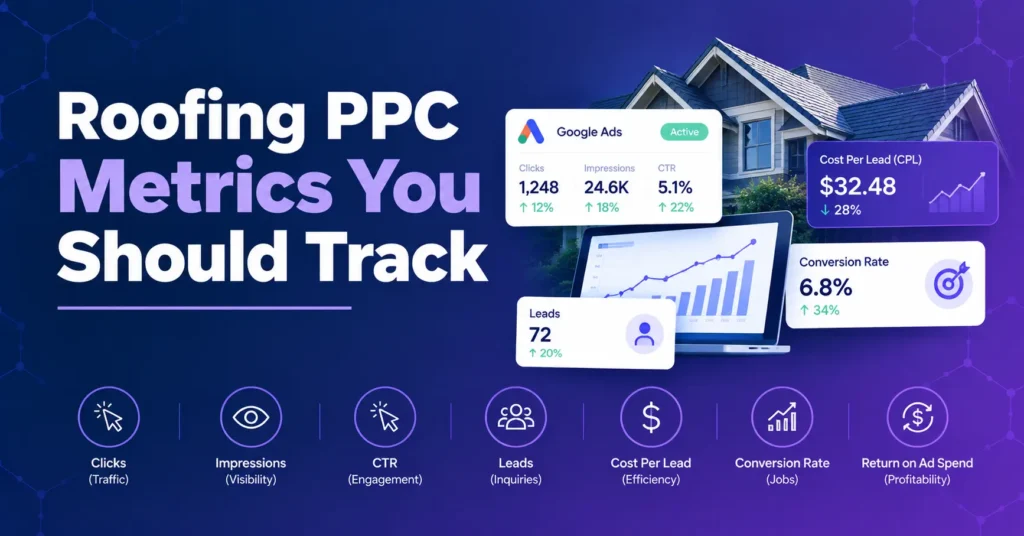
Roofing companies should track three main groups of metrics.
Advertising Metrics
- Impressions
- Clicks
- CTR
- CPC
- Ad spend
- Conversion rate
Lead Metrics
- Total leads
- Cost per lead
- Qualified leads
- Qualified CPL
- Appointment rate
- Lead response time
Sales Metrics
- Estimates
- Closed jobs
- Close rate
- Customer acquisition cost
- Revenue
- Revenue per ad dollar
- Cost per sold job
One metric many roofing companies miss is cost per sold job.
Consider two campaigns:
Campaign A
- CPL = $150
- Close rate = 10%
- CAC = $1,500
Campaign B
- CPL = $250
- Close rate = 25%
- CAC = $1,000
Campaign B has a higher CPL but a lower customer acquisition cost. This is why the cheapest lead is not always the most profitable lead.
What Is a Good Roofing PPC Conversion Rate?
LocaliQ reported a 3.70% conversion rate for Roofing & Gutters. This can provide a useful benchmark, but conversion rates can vary significantly.
Your conversion rate depends on:
- Keyword intent
- Ad relevance
- Landing page quality
- Offer
- Location
- Device
- Service
- Tracking setup
- Lead form
- Call experience
A higher conversion rate can help reduce CPL when traffic quality remains strong. However, conversion rate should not be improved at the expense of lead quality.
How to Build a Profitable Roofing PPC Campaign
Step 1: Define Your Profitable Services
Identify which roofing services generate the strongest margins and customer value.
Step 2: Separate Campaigns by Intent
Separate campaigns based on service and search intent when appropriate. This gives you more control over your budget, keywords, ads, and landing pages.
Step 3: Create Dedicated Landing Pages
Send traffic to pages that match the service and search intent. A roof replacement search should not necessarily land on a generic roofing homepage.
Step 4: Track Conversions
Track phone calls, forms, appointments, and other meaningful conversion actions.
Step 5: Connect Leads to Revenue
Whenever possible, connect your PPC leads to your CRM and sales outcomes. You want to know which campaigns produce actual customers.
Step 6: Optimize for Profit
Do not optimize only for clicks or leads. Optimize toward qualified leads, appointments, customers, revenue, and profit.
Roofing PPC Checklist for 2026
Campaign Checklist
- Target high-intent keywords
- Use relevant ad messaging
- Review search terms regularly
- Add negative keywords
- Separate campaigns by service and intent
- Monitor CPC
- Monitor CPL
Landing Page Checklist
- Clear headline
- Strong call to action
- Relevant service information
- Service area
- Reviews
- Trust signals
- Easy contact options
- Mobile-friendly design
- Fast loading speed
Tracking Checklist
- Form tracking
- Phone call tracking
- Appointment tracking
- Qualified lead tracking
- CRM integration
- Revenue tracking
Sales Checklist
- Fast lead response
- Consistent follow-up
- Appointment tracking
- Estimate tracking
- Close-rate tracking
- Customer acquisition cost tracking
Is Roofing PPC Worth It in 2026?
Yes, if the economics work. A $300 qualified replacement lead can be valuable. A $50 bad lead can be expensive. The price of the lead alone does not determine whether roofing PPC is worth it.
You should evaluate:
- Profit per lead
- Customer acquisition cost
- Revenue per ad dollar
- Qualified lead rate
- Close rate
- Profit per customer
If the numbers work, roofing PPC can be a measurable and scalable customer acquisition system.
What Roofing Companies Should Do With a $228 CPL Benchmark
Do not automatically decide that $228 is good or bad.
Instead, ask:
- Are these real leads?
- Are the leads qualified?
- How many become appointments?
- How many become estimates?
- How many become profitable jobs?
The $228.15 benchmark gives you context. Your own numbers tell you whether your campaign is working.
Roofing PPC vs. SEO: Which Should You Choose?
PPC and SEO can serve different purposes.
PPC can provide immediate visibility and traffic when you are willing to pay for clicks or leads.
SEO can build long-term organic visibility and reduce dependence on paid advertising over time.
For local roofing companies, other elements can also contribute to visibility and trust, including:
- Google Business Profile optimization
- Local SEO
- Reviews
- Conversion-focused web design
- Marketing automation
- Fast lead follow-up
Rather than treating PPC and SEO as competing channels, many roofing companies can benefit from using them together.
How Much Should a Roofing Company Spend on PPC?
Start with your customer goal. The basic formula is:
Required Monthly Leads = Desired Customers ÷ Close Rate
Then:
Monthly PPC Budget = Required Leads × Target CPL
For example:
If you want 10 customers per month and your close rate is 20%:
10 ÷ 20% = 50 leads
At a $200 CPL:
50 × $200 = $10,000 monthly budget
If your close rate improves to 30%:
10 ÷ 30% = approximately 34 leads
At a $200 CPL:
34 × $200 = approximately $6,800 monthly budget
Improving your sales process and lead quality can therefore have a major effect on the budget required to achieve your customer goals.
Frequently Asked Questions About Roofing PPC
What is a good roofing PPC cost per lead?
A reasonable starting benchmark is around $200–$250 per lead, with LocaliQ reporting $228.15 for Roofing & Gutters. However, your profitable CPL depends on your own business economics.
How much does a roofing lead cost on Google Ads?
Roofing leads can vary significantly in price. A useful benchmark is around $228.15 per lead, but your actual cost depends on competition, location, keywords, landing pages, conversion rates, and lead quality.
How much should a roofing company budget for PPC?
Your budget should be based on the number of customers you want, your close rate, and your target CPL. For example, 10 customers at a 20% close rate requires approximately 50 leads. At $200 per lead, that would require around $10,000.
Why is roofing PPC so expensive?
Roofing PPC can be expensive because roofing services have high customer value and many companies compete for high-intent searches such as roof replacement, roofing contractor, and emergency roof repair.
How can I lower my roofing PPC cost per lead?
Focus on high-intent searches, improve your landing pages, use negative keywords, track calls and forms, improve your offer, and respond quickly to new leads.
Is a $300 roofing lead too expensive?
Not necessarily. A $300 qualified lead can be profitable if it has a strong chance of becoming a high-value customer. The right question is whether the lead produces a profitable customer acquisition cost.
What is the difference between roofing PPC and Local Services Ads?
Traditional PPC Search Ads generally charge advertisers for clicks and send users to a website or landing page. Local Services Ads are based on customer leads and can generate calls and messages directly.
Should roofing companies use PPC or SEO?
PPC can provide faster visibility, while SEO is designed for long-term organic visibility. For many roofing companies, using both can create a stronger and more diversified lead generation strategy.
How do I calculate roofing PPC ROI?
Track your advertising spend, leads, qualified leads, appointments, estimates, closed jobs, and revenue. The goal is to connect advertising spend to actual customer revenue and profit.
What is the best roofing PPC strategy?
The best strategy is one that focuses on profitable services, high-intent searches, strong landing pages, accurate tracking, qualified leads, fast follow-up, and customer acquisition cost rather than lead volume alone.
Key Takeaways
- A useful roofing PPC CPL benchmark is around $200–$250.
- LocaliQ reported $228.15 for Roofing & Gutters.
- Industry averages are benchmarks, not fixed prices.
- Qualified leads are more valuable than raw lead volume.
- Your maximum CPL should be based on your own business economics.
- Landing page quality can affect conversion rates and CPL.
- Negative keywords can reduce wasted ad spend.
- Conversion tracking is essential for understanding campaign performance.
- CRM and sales tracking help connect leads to revenue.
- Fast lead response can improve the chance of converting opportunities into customers.
- PPC and SEO can work together as part of a diversified acquisition system.
- The most important metric is not always CPL; cost per sold customer and profit matter more.
- A more expensive lead can be more profitable if it produces better customers.
Final Thoughts: What Is a Good Roofing PPC Cost Per Lead in 2026?
So, what is a good roofing PPC cost per lead in 2026? There is no single number that works for every roofing company. The $228.15 benchmark gives you useful context, and $200–$250 can be a reasonable starting range. But the real answer depends on what happens after the lead comes in.
Does the lead become a qualified opportunity?
Does it become an appointment?
Does it turn into an estimate?
Does it become a customer?
And most importantly, is that customer profitable?
The best way to evaluate roofing PPC is to work backward from profit. Understand your average customer value, gross profit, close rate, allowable customer acquisition cost, and target CPL. Then build your campaigns around those numbers.
When roofing PPC is treated as a measurable customer acquisition system rather than simply an advertising expense, you can make better decisions about budget, lead quality, campaign optimization, and growth. The goal is not to get the cheapest leads.
The goal is to generate profitable customers.
About the Author
Jawaria is an SEO and digital marketing professional focused on helping small and mid-sized businesses improve organic visibility, lead generation, website performance, and digital growth. Through HQ Growth Lab, she focuses on practical SEO, web development, AI automation, and digital marketing strategies designed to help businesses build, rank, and scale.