Construction company websites not generating leads can hurt a business even when the company has years of experience, impressive projects, skilled crews, and a professional-looking website.
I see this problem often: the website looks good, but it does not function like a lead-generation system. That is the real issue behind many construction company websites not generating leads.
The problem is rarely just “bad design.” A website can fail because it attracts the wrong visitors, lacks clear service pages, hides important trust signals, loads slowly, performs poorly on mobile, has weak calls to action, or gives potential customers no obvious reason to contact the company.
In other words, getting construction website traffic is only one part of the equation. The website must turn relevant visitors into calls, estimate requests, consultations, project inquiries, or qualified opportunities.
Google also recommends creating helpful, reliable, people-first content and making pages useful for the audience rather than writing primarily for search engines.
In this guide, I’ll explain why construction company websites not generating leads are so common, how to diagnose the problem, and what I would change to build a website that supports real construction lead generation.
Construction Company Websites Not Generating Leads: What Are the Main Causes?
The simplest answer is this:
Most construction websites are designed to showcase the company rather than move a potential customer toward a decision.
A typical contractor website might include:
- Home
- About Us
- Services
- Projects
- Contact
That structure is not necessarily bad. The problem starts when every page talks about the company but does not answer the visitor’s buying questions.
A potential customer wants to know:
- Can you handle my type of project?
- Do you work in my area?
- Have you completed similar projects?
- Can I trust your company?
- What services do you provide?
- What happens after I contact you?
- How quickly will someone respond?
- How can I request an estimate or consultation?
If the website does not answer these questions quickly, visitors have little reason to take the next step. That is why construction website lead generation requires more than attractive design. It requires the right combination of search visibility, messaging, trust, conversion elements, and follow-up.
1. Is Your Construction Website Getting the Wrong Traffic?
One of the first problems I investigate is traffic quality. A website may receive visitors but still produce almost no construction company leads.
Why?
Because traffic does not automatically equal buying intent. Imagine a construction company specializing in commercial buildings. Its website ranks for broad searches such as
- construction information
- building materials
- construction jobs
- construction costs
- construction tips
These searches may generate visitors, but many users are not looking to hire the company. Compare that with searches such as
- commercial construction company near me
- general contractor for commercial projects
- commercial building contractor in [city]
- warehouse construction company
- office construction contractor
These searches are much closer to a buying decision.
Traffic quality matters more than traffic volume.
I would rather see a construction website generate 500 highly relevant visitors than 10,000 visitors who have no intention of becoming customers.
This is one reason SEO for construction companies needs to focus on search intent rather than simply increasing organic traffic. Google explains that SEO helps search engines understand content while helping users find and evaluate websites.
What to fix
Build pages around commercial and local search intent.
For example:
Instead of one generic services page:
Construction Services Create dedicated pages such as
- Commercial Construction
- Residential Construction
- General Contracting
- Design-Build Services
- Remodeling
- Industrial Construction
- Project Management
- Construction Consulting
Each page can target a specific service and customer need.
2. Does Your Construction Website Clearly Explain What You Do?
This sounds obvious, but it is one of the biggest construction website mistakes. When someone lands on your homepage, they should understand three things almost immediately:
What you do.
Where you do it.
Who do you do it for.
A vague headline such as
Building Dreams Since 1998 may sound professional, but it does not clearly communicate your offer.
A stronger headline might be:
Commercial Construction Company Serving Houston and Surrounding Areas
Then support it with a short explanation:
We help property owners, developers, and businesses plan and complete commercial construction projects with experienced project management and dependable execution. Now the visitor understands the business.
Use the “who, what, where” test.
| Question | The website should answer |
| Who are you? | Construction company / contractor |
| What do you do? | Specific construction services |
| Where do you work? | Cities or service areas |
| Who do you serve? | Homeowners, developers, businesses, etc. |
| Why choose you? | Experience, proof, specialization |
| What should I do next? | Call, request estimate, book consultation |
If visitors need to scroll through three sections to understand what you offer, your positioning needs work.
3. Does Your Construction Website Have Strong Calls to Action?
A visitor cannot become a lead if you never clearly ask them to take action. This is another common reason construction company websites not generating leads fail to convert.
Many construction websites use generic CTAs such as
- Learn More
- Contact
- Submit
- Click Here
These buttons do not communicate enough value. Instead, match your CTA to the customer’s intent.
Better construction website CTAs
Use action-oriented phrases such as
- Request a Project Estimate
- Discuss Your Construction Project
- Schedule a Consultation
- Request a Quote
- Start Your Project
- Talk to a Construction Expert
- Submit Your Project Details
- Request a Commercial Bid
Your CTA should also appear throughout the customer journey.
For example:
Homepage: Request a Project Estimate
Service page: Discuss Your Project
Project page: Start a Similar Project
Contact page: Request Your Consultation
The goal is not to place 30 buttons on the page. The goal is to make the next step obvious.
4. Does Your Website Build Enough Trust?
Construction is a high-trust purchase. A potential client may be considering a project worth thousands or millions of dollars. They are not simply buying a product. They are evaluating risk that means your website needs to answer:
“Why should I trust this company with my project?”
Trust signals construction companies should show
Your website should consider including:
- Completed projects
- Project photography
- Case studies
- Client testimonials
- Reviews
- Certifications
- Licenses where applicable
- Insurance information
- Years of experience
- Industry memberships
- Awards
- Safety credentials
- Team information
- Project statistics
- Service areas
- Relevant qualifications
However, do not simply create a wall of logos. Explain why each credential matters.
Your project portfolio should sell.
A portfolio is not just a gallery. A strong project case study can explain:
Project: Commercial Office Development
Challenge: The client needed a modern office facility within a defined timeline.
Solution: Our team managed construction planning, coordination, and execution.
Result: The project was completed according to the agreed requirements.
This gives the visitor context. It also demonstrates experience instead of simply claiming it.
5. Is Your Project Portfolio Strong Enough?
Construction companies have one major advantage over many other industries:
They can show their work visually.
Yet many contractor websites waste this opportunity. A portfolio page might contain ten images with captions such as
Commercial Project
Residential Project
Building Project
That does not provide enough information. Instead, create detailed project pages.
What each project page should include
- Project type
- Location
- Scope
- Client requirements
- Challenges
- Services provided
- Project photos
- Materials or techniques where relevant
- Timeline
- Results
- Client testimonial
- Related services
- CTA
This turns your portfolio into a sales asset. It also creates additional opportunities for construction website traffic through project-specific and location-specific searches.
6. Is Your Website Optimized for Local SEO?
Construction is often location-dependent someone searching for:
general contractor near me does not want a company hundreds of miles away. This makes local SEO for construction companies extremely important.
Google says local results are primarily influenced by relevance, distance, and prominence. It also recommends keeping business Profile information complete and accurate.
Your local SEO foundation
Start with your Google Business Profile.
Make sure your:
- Business name
- Category
- Phone number
- Website
- Hours
- Service information
- Photos
- Business description
are accurate and consistent then build location relevance on your website.
Create useful location pages.
For example:
- Construction Company in Dallas
- Commercial Contractor in Fort Worth
- General Contractor in Arlington
But avoid creating dozens of nearly identical city pages. Each location page should provide genuinely useful local information.
Discuss:
- Services available
- Areas served
- Local project examples
- Relevant building types
- Local customer needs
- Project process
- FAQs
- Contact options
Google specifically recommends complete and detailed business information to help it understand relevance for local searches.
7. Are Your Service Pages Too Generic?
A single “Our Services” page usually cannot effectively target every service a construction company provides. This is a major construction website optimization opportunity.
Suppose you offer:
- Commercial construction
- Residential construction
- Remodeling
- Design-build
- General contracting
Each service has a different customer, search intent, sales process, and value proposition. Create individual pages where appropriate.
A high-converting service page structure
H1: Commercial Construction Services in [City]
Introduction: Explain who you help and what you provide.
Services: Explain the specific scope.
Benefits: Explain why the service matters.
Process: Show what happens next.
Portfolio: Demonstrate relevant experience.
Proof: Add testimonials, credentials, and case studies.
FAQs: Address objections.
CTA: Give visitors a clear next step.
This structure helps both users and search engines understand the page. Google recommends using words people actually search for in prominent locations such as titles, headings, alt text, and link text.
8. Is Your Construction Website Slow or Difficult to Use on Mobile?
A beautiful website is useless if it frustrates visitors. Construction customers may discover your company while using:
- Smartphones
- Tablets
- Desktop computers
Your website needs to work well across devices.
Common UX problems
I regularly look for issues such as
- Slow page loading
- Tiny text
- Difficult navigation
- Oversized images
- Broken buttons
- Poor mobile layouts
- Intrusive pop-ups
- Long forms
- Confusing menus
- Unclear contact information
The visitor should not have to fight the website to contact you.
Mobile conversion matters.
Imagine someone searches for:
home builder near me.
They click your website.
The page takes several seconds to load.
The phone number is hidden.
The CTA is below a huge image.
The menu is difficult to use.
That visitor may simply return to Google and choose another contractor.
This is not only a technical problem.
It is a revenue problem.
9. Is Your Construction Contact Form Too Complicated?
Another common reason construction company websites not generating leads fails is an unnecessarily complicated form.
A construction company may ask for:
- Name
- Phone
- Company
- Address
- Project type
- Budget
- Timeline
- Square footage
- Detailed description
- File uploads
- Several other fields
Some of these questions may be useful. But asking for too much information too early can reduce conversions.
Use progressive qualification
Start with the information you genuinely need.
For example:
Name
Phone or email
Project type
Project location
Brief project description
Then qualify the lead further during the conversation. For high-value commercial projects, a more detailed form may make sense. The correct form depends on the sales process.
10. Does Your Website Explain the Next Step?
People often hesitate because they do not know what happens after submitting a form.
A CTA saying:
Contact Us
creates uncertainty.
A CTA saying:
Request an Estimate
is better.
But you can go further.
For example:
Submit your project details. Our team will review your requirements and contact you to discuss the next steps. That simple explanation reduces uncertainty.
Show your process.
You can create a section such as
How It Works
1. Tell Us About Your Project
Share your project type, location, and basic requirements.
2. Discuss Your Requirements
We review your project and discuss scope, timeline, and goals.
3. Receive the Next-Step Recommendation
We explain the appropriate next step based on your project. This is both conversion-friendly and useful for AEO-style content.
11. Does Your Website Have a Strong Content Strategy?
Construction companies often publish very little educational content. That creates missed opportunities. Potential clients search for questions before they are ready to contact a contractor.
Examples include:
- How much does commercial construction cost?
- How long does a commercial project take?
- What does a general contractor do?
- How do I choose a construction company?
- What should I ask a contractor before hiring?
- What is design-build construction?
- How much does a home addition cost?
- What permits are required for construction?
These searches can introduce your company earlier in the buying journey.
Build content around the customer journey.
| Funnel stage | Example content |
| Awareness | Construction planning guide |
| Research | How to choose a general contractor |
| Comparison | General contractor vs. design-build |
| Commercial intent | Commercial construction services |
| Decision | Construction company case study |
| Conversion | Request a project estimate. |
This creates a stronger construction customer acquisition system.
12. Are You Targeting High-Intent Keywords?
Not every keyword deserves the same priority. Consider these searches:
Low commercial intent:
construction ideas
Informational:
How does commercial construction work?
Commercial investigation:
best commercial construction companies
Transactional:
commercial contractor near me The last search has much stronger hiring intent. Your SEO strategy should therefore combine informational content with service and local pages.
Keyword mapping example
| Keyword | Recommended page |
| construction company near me | Homepage / local page |
| commercial contractor | Commercial service page |
| residential construction company | Residential service page |
| general contractor [city] | Local service page |
| construction company [city] | Location page |
| how to choose a contractor | Blog |
| commercial construction cost | Blog / guide |
| construction project management | Service page |
This is how SEO for construction companies can support actual lead generation instead of producing traffic without business value.
13. Does Your Website Clearly Differentiate Your Company?
Another major reason construction websites fail to convert is generic messaging. If your homepage could belong to 50 other contractors, you have a positioning problem.
Compare:
Quality construction services you can trust.
with:
Commercial construction partner for healthcare, retail, and office projects across Phoenix. The second statement is more specific. Specificity creates relevance.
Identify your competitive advantage.
Your differentiator could be Specialized project types
- Geographic coverage
- Faster project communication
- Design-build expertise
- Complex commercial projects
- Sustainable construction
- Specialized facilities
- Large-scale project management
- Renovation expertise
- Industry experience
Do not invent a differentiator. Find the real reason clients choose you and make it visible.
14. Is Your Construction Website Tracking Conversions?
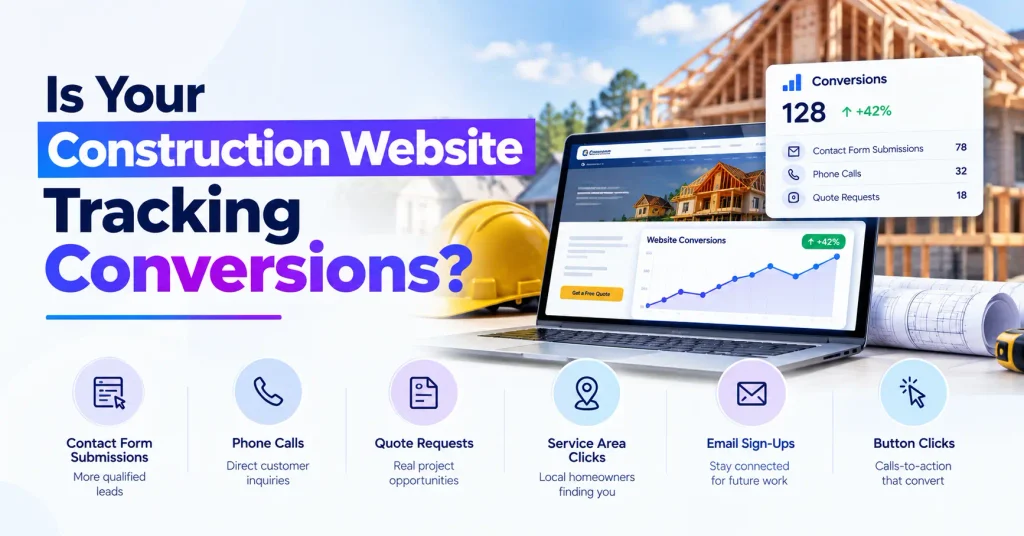
This is one of the most overlooked problems.
A company may say:
“Our website doesn’t generate leads.”
But has anyone actually checked the data?
You should know:
- Organic traffic
- Paid traffic
- Phone calls
- Form submissions
- Quote requests
- Consultation requests
- Landing-page conversions
- Conversion rate
- Qualified leads
- Appointments
- Estimates
- Closed projects
- Revenue by source
Without tracking, you are guessing.
Track the complete funnel.
The important journey is
Impression → Click → Visit → Lead → Qualified Lead → Appointment → Estimate → Closed Project → Revenue
That final step matters. A page that generates 20 low-quality leads may be less valuable than a page generating five serious opportunities.
15. Is Your Lead Follow-Up Too Slow?
Sometimes the website actually works. The real problem happens after the lead arrives. A potential client submits a form. Then nobody responds for hours.
Or the inquiry goes into an inbox that nobody monitors. Or the salesperson calls once and never follows up. That is not a website problem.It is a lead-management problem.
Build a simple follow-up system.
When someone submits an inquiry:
- Confirm the submission immediately.
- Notify the sales team.
- Call the lead as soon as practical.
- Send a confirmation email or text.
- Record the lead in a CRM.
- Qualify the project.
- Schedule the next conversation.
- Continue appropriate follow-up.
For high-value construction projects, lead nurturing can be especially important because buying decisions may involve multiple people and longer timelines.
Construction Company Websites Not Generating Leads: How Can You Fix Them?
A strong construction website should function as a digital sales system. Here is the framework I recommend.
| Website element | Purpose |
| Clear positioning | Explain what you do. |
| Service pages | Capture commercial searches. |
| Location pages | Build local visibility. |
| Portfolio | Demonstrate experience. |
| Case studies | Show outcomes |
| Reviews | Build trust. |
| Strong CTAs | Encourage action. |
| Short forms | Reduce friction. |
| Click-to-call | Capture mobile leads. |
| FAQs | Address objections |
| Educational content | Capture research traffic. |
| Analytics | Measure performance. |
| CRM | Manage leads. |
| Fast follow-up | Increase opportunities. |
The strongest construction website lead generation strategies connect these elements rather than treating them as separate tasks.
Construction Website Optimization Checklist
Before investing more money into advertising or SEO, I recommend auditing the website itself.
Homepage
- Clear headline
- Service and location immediately visible
- Strong CTA above the fold
- Trust signals
- Project proof
- Testimonials
- Clear navigation
- Mobile-friendly design
Service Pages
- One clear primary service
- Search intent matched
- Benefits explained
- Relevant project examples
- FAQs
- Internal links
- Strong CTA
Local SEO
- Verified Google Business Profile
- Accurate business information
- Consistent NAP information
- Relevant reviews
- Location-specific content
- Local project examples
Conversion
- Phone number visible
- Request estimate CTA
- Simple contact form
- Clear next steps
- Conversion tracking
- Call tracking where appropriate
Trust
- Case studies
- Portfolio
- Testimonials
- Credentials
- Team information
- Relevant certifications
Construction Website vs. Lead-Generating Construction Website
The difference is bigger than design.
| Standard website | Lead-generating construction website |
| Talks about the company | Talks about customer needs |
| Generic services | Dedicated service pages |
| Basic project gallery | Detailed case studies |
| “Contact Us” | Specific conversion CTAs |
| General traffic | Intent-focused traffic |
| Few trust signals | Strong proof |
| No clear funnel | Defined customer journey |
| Basic analytics | Lead and revenue tracking |
| Passive brochure | Active sales asset |
This is the mindset shift I want construction companies to make. Your website should not simply prove that your company exists. It should help someone decide to contact you.
Should Construction Companies Focus on SEO, Google Ads, or Both?
There is no universal answer. The right mix depends on your market, budget, competition, sales cycle, and existing visibility.
SEO
Best for:
- Long-term organic visibility
- Local searches
- Educational content
- Building authority
- Reducing reliance on paid traffic
Potential downside:
SEO usually requires consistent work before competitive keywords produce meaningful results.
Google Ads
Best for:
- Immediate search visibility
- High-intent searches
- Specific services
- Location targeting
- Testing offers
Potential downside:
You pay for traffic, and weak landing pages can waste that traffic.
A combined strategy
For many construction companies, the strongest model is
SEO + Local SEO + Paid Search + Conversion Optimization + Follow-Up
This gives you both short-term demand capture and long-term organic growth. A stronger construction marketing strategy combines search visibility, paid traffic, conversion-focused landing pages, and lead tracking rather than treating each channel independently.
What Should Construction Companies Do If Their Website Gets Traffic but No Leads?
If traffic exists but leads do not, I would not immediately publish more content. First, diagnose the funnel.
Step 1: Check traffic quality.
Look at:
- Search queries
- Landing pages
- Locations
- Devices
- Engagement
- Traffic sources
Step 2: Check conversion points.
Look at:
- Forms
- Calls
- CTA clicks
- Estimate requests
- Consultation bookings
Step 3: Check the landing pages.
Ask:
Does this page match the search that brought the visitor here? If someone searches for commercial construction services and lands on a generic homepage, the experience is weaker than sending them to a dedicated commercial construction page.
Step 4: Check trust
Ask:
Would I trust this company with a $500,000 project after visiting this page? If the answer is no, identify what is missing.
Step 5: Check follow-up
If leads exist but sales are low, inspect what happens after submission. The problem may be sales follow-up rather than construction website conversion.
How to Turn a Construction Website Into a Lead Generation System
I recommend approaching the website as a funnel.
Stage 1: Attract
Use:
- SEO
- Local SEO
- Google Business Profile
- Google Ads
- Content marketing
- Referrals
- Social media
Stage 2: Educate
Provide:
- Service pages
- Project guides
- FAQs
- Case studies
- Pricing information where appropriate
- Process explanations
Stage 3: Build trust
Show:
- Reviews
- Projects
- Credentials
- Experience
- Testimonials
- Team
- Results
Stage 4: Convert
Offer:
- Estimate request
- Consultation
- Project assessment
- Bid request
- Phone call
- Project inquiry
Stage 5: Follow-up
Use:
- CRM
- Phone
- SMS where appropriate
- Automated confirmations
- Sales reminders
Stage 6: Measure
Track:
- Leads
- Qualified leads
- Appointments
- Estimates
- Closed projects
- Revenue
This is the complete construction lead generation system.
How AI Can Improve Construction Website Lead Generation
AI can support the website and marketing workflow, but it should not replace the expertise and proof that construction buyers need.
For example, AI can help with:
- Lead qualification
- Form responses
- FAQ assistance
- Lead routing
- Follow-up reminders
- Content research
- Customer segmentation
- Reporting
- CRM automation
Imagine a potential customer submits:
“We need a commercial renovation for a 12,000-square-foot office. The project is in Dallas, and we want to start within three months.”
An automated system could categorize the inquiry, notify the appropriate salesperson, and trigger a confirmation message. The important point is that automation should support the sales process rather than create generic responses.
How GEO and AI Search Change Construction SEO
Construction companies should also think beyond traditional blue-link rankings.
Google says its AI features, including AI Overviews and AI Mode, continue to rely on foundational SEO practices. Google does not require special AI markup or a separate “AI SEO” file to appear in these features.
That means your content should be:
- Clear
- Direct
- Well structured
- Factually accurate
- Helpful
- Easy to understand
- Supported by relevant evidence
- Organized around real customer questions
For example, instead of writing a 1,000-word introduction before answering:
How much does commercial construction cost?
Give the reader a direct answer first. Then explain the factors that influence the cost. This structure is useful for traditional search, voice search, featured answers, and AI-driven search experiences.
What Construction Companies Should Include in Their FAQ Section
A good FAQ section should answer genuine customer questions.
How do I choose a construction company?
Look for relevant project experience, clear credentials, strong references, transparent communication, and evidence of successfully completed projects similar to yours.
How can a construction company get more leads from its website?
Focus on high-intent SEO, local visibility, dedicated service pages, strong project proof, clear calls to action, simple inquiry forms, and fast lead follow-up.
Why is my construction website getting traffic but no leads?
The problem may be poor traffic quality, weak messaging, insufficient trust signals, confusing navigation, weak CTAs, slow performance, or a difficult conversion process.
Does SEO work for construction companies?
Yes. SEO can help construction companies appear for relevant service, location, and informational searches. Its effectiveness depends on competition, search demand, website quality, content, authority, and execution.
How important is local SEO for contractors?
Local SEO can be highly important when customers search for contractors in specific cities or service areas. Google says local ranking is influenced by relevance, distance, and prominence.
Should a construction company have separate service pages?
Usually, yes, when services have different audiences, search intent, or value propositions. Dedicated pages can make the offer clearer and give each important service a stronger opportunity to rank.
How long does construction SEO take?
There is no universal timeline. Results depend on competition, website authority, content quality, technical health, local visibility, and the resources invested. SEO should be evaluated through improving visibility, qualified traffic, leads, and revenue rather than a fixed deadline.
Should construction companies use Google Ads?
Google Ads can help capture existing search demand quickly, particularly for high-intent service searches. However, advertising works best when the landing page, offer, tracking, and follow-up process are strong.
What makes a construction website trustworthy?
Relevant project experience, detailed case studies, authentic reviews, credentials, team information, clear service descriptions, transparent contact details, and evidence of completed work all contribute to trust.
Why do construction websites fail to convert?
Most failures come from a combination of weak positioning, poor search intent targeting, limited proof, unclear CTAs, difficult forms, poor mobile UX, slow performance, and weak lead follow-up.
Final Thoughts: Why Most Construction Company Websites Don’t Generate Leads
When I review a construction website, I don’t start by asking whether it looks modern.
I ask a more important question:
Can this website move the right visitor from a Google search to a qualified conversation?
If the answer is no, a redesign alone will not solve the problem. A construction company needs more than a polished homepage. It needs relevant search visibility, strong service pages, local authority, project proof, persuasive messaging, clear CTAs, easy conversion paths, accurate tracking, and reliable follow-up.
That is what turns construction website traffic into qualified construction leads. If your construction company website’s lead generation problem continues despite receiving traffic, start by auditing the entire customer journey rather than simply publishing more content.
At HQ Growth Lab, our approach is built around the same principle:
Build. Rank. Scale.
About the Author
Jawaria is an SEO and digital marketing professional focused on helping small and mid-sized businesses improve organic visibility, lead generation, website performance, and digital growth. Through HQ Growth Lab, she focuses on practical SEO, web development, AI automation, and digital marketing strategies designed to help businesses build, rank, and scale.