If your construction company website isn’t appearing when people search for services in your area, you’re probably missing more than just a few keywords.
A potential customer may search for “general contractor near me,” “commercial contractors in [city],” “home remodeling contractor in [city],” or a specific construction service. If your website and Google Business Profile aren’t optimized for those searches, competitors can capture the leads before customers ever discover your business.
That’s where construction company local SEO comes in. In my SEO practice, I’ve seen construction companies invest heavily in websites, paid advertising, social media, and branding while overlooking the search visibility that can bring customers to them when they’re actively looking for construction services.
The goal of a construction company’s local SEO isn’t simply to generate more website traffic. It’s to make your company visible to the right people, in the right locations, when they have a real need for your services.
In this guide, I’ll explain how to rank a construction company website locally, including Google Business Profile optimization, local keyword research, service pages, location-based SEO, reviews, citations, backlinks, technical SEO, content, and AI search optimization.
What Is Construction Company Local SEO?
Construction company local SEO is the process of optimizing a construction company’s website, Google Business Profile, online listings, content, and reputation so the business can appear prominently in geographically relevant searches.
For example, a construction company might want to appear for searches such as
- Construction company near me
- General contractors in [city]
- Commercial contractors in [city]
- Residential contractors in [city]
- Home builders in [city]
- Concrete contractors in [city]
- Remodeling contractors in [city]
- Roofing contractors in [city]
- Construction services near me
Local SEO is different from traditional SEO because location plays a major role in the search experience. Google says local results are primarily influenced by relevance, distance, and prominence. Relevance concerns how well a business matches the search, distance concerns the searcher’s location, and prominence reflects how well-known the business is based on signals such as reviews and links. (Google Help)
That means ranking locally isn’t about repeating your city name 50 times on your homepage. It’s about building a consistent, trustworthy digital presence that clearly communicates:
Who you are → What you do → Where you operate → Why customers should trust you.
Why Local SEO Matters for Construction Companies
Construction services are naturally location-driven. Someone looking for a construction company generally doesn’t want a provider 500 miles away. They want someone who serves their city, county, neighborhood, or surrounding service area this makes local SEO for construction companies particularly valuable.
Consider two searches:
“How much does commercial construction cost?”
versus:
“Commercial contractor in Dallas”
The first is primarily informational. The second has much stronger local and commercial intent. The person searching for a commercial contractor may already be comparing providers and preparing to contact someone.
That’s why successful construction company SEO should focus on more than traffic. It should connect search visibility with actual business opportunities.
The Local Construction Lead Funnel
A strong local search strategy can move a prospect through this process:
Google Search → Website/Google Business Profile → Service information → Trust signals → Contact → Estimate → Project
Your job is to remove friction at every stage.
Your website should answer:
- What construction services do you provide?
- Where do you work?
- What types of projects do you handle?
- Why should someone trust you?
- How can someone request an estimate?
- What does your process look like?
- What projects have you completed?
- How can customers contact you?
When those answers are clear, local SEO lead generation becomes much more useful.
10 Steps to Rank a Construction Company Website Locally
Step 1: Start With Local Keyword Research
Before optimizing pages, determine what your potential customers actually search for. This is the foundation of construction company local SEO.
Don’t only research broad keywords such as
- Construction company
- Construction contractor
- General contractor
Instead, combine:
Service + location + intent
For example:
- general contractor in Austin
- commercial construction company in Austin
- residential contractor in Austin
- home remodeling contractor in Austin
- construction company near me
- warehouse construction contractor in Austin
- office renovation contractor in Austin
Build Keyword Groups
Organize your contractor keyword research into clusters.
| Keyword Type | Example | Intent |
| Core service | construction company | Commercial |
| Local service | construction company in Austin | Local |
| Specific service | commercial construction Austin | Buyer |
| Near-me | contractors near me | High local intent |
| Informational | construction cost guide | Informational |
| Problem-based | How much does remodeling cost? | Informational |
| Comparison | best contractors in Austin | Commercial investigation |
Your local keyword research should also identify the locations that actually matter to the company. Don’t create pages for every city you can find. Focus on areas the company genuinely serves.
Step 2: Optimize the Google Business Profile
A website alone isn’t enough for construction company local SEO. Your Google Business Profile is one of the most important assets for appearing in Google Search and Maps.
Google recommends verifying the profile and keeping business information complete and accurate. It also recommends maintaining relevant details such as business hours, business category, address or service area, and other business information. (Google Help)
Optimize Your Profile
Make sure your profile includes:
- Correct business name
- Accurate primary category
- Relevant secondary categories where appropriate
- Correct phone number
- Website URL
- Accurate business hours
- Service areas
- Business description
- Services
- High-quality project photos
- Videos where appropriate
- Customer reviews
- Review responses
This is the foundation of Google Business Profile optimization.
Don’t Stuff Keywords Into Your Business Name
One common mistake is changing a legitimate business name to something like: ABC Construction – Best Construction Company in Dallas if that’s not the company’s actual name.
Local SEO isn’t about manipulating the profile. It’s about making the legitimate business information clear and consistent.
Step 3: Improve Your Google Maps Visibility
Many construction customers discover businesses through Google Maps rather than traditional organic results. That’s why Google Maps SEO for contractors deserves its own strategy.
Your Maps presence is influenced by factors including relevance, distance, and prominence. Google specifically notes that there is no way to pay for a better organic local ranking. (Google Help)
To improve your Google Maps ranking, focus on:
- Accurate Business Profile information
- Correct business category
- Relevant services
- Genuine customer reviews
- Review responses
- Quality photos
- Consistent business information
- Relevant local links
- A strong construction website
- A legitimate local presence
The goal isn’t simply to rank in Maps. It’s to make the listing persuasive enough that someone chooses to visit the website, call, request an estimate, or contact the company.
Step 4: Build Dedicated Construction Service Pages
One of the biggest mistakes I see in construction website SEO is putting every service on one generic page.
For example:
Services: Commercial Construction, Residential Construction, Remodeling, Renovation, Concrete, Roofing, Design-Build. That may be convenient for the business owner, but it gives search engines and users less focused information. Instead, create dedicated construction service pages when each service is genuinely substantial.
For example:
- /commercial-construction/
- /residential-construction/
- /design-build/
- /office-renovation/
- /warehouse-construction/
- /home-remodeling/
Each page should explain:
- What the service includes
- Who it’s for
- Areas served
- Project types
- Process
- Typical considerations
- Relevant experience
- Photos or examples
- FAQs
- Testimonials
- Clear CTA
This is service page optimization with actual user value behind it.
What Makes a Strong Construction Service Page?
A strong page doesn’t just say:
“We provide commercial construction services in Austin.”
It explains what commercial construction involves, what types of projects the company handles, how the process works, what differentiates the company, and how someone can start a project. That’s the difference between a keyword page and a useful business page.
Step 5: Create Location Pages Carefully
If a construction company serves multiple cities, location pages for contractors can help establish geographic relevance.
For example:
- Construction Company in Austin
- Construction Company in Round Rock
- Construction Company in Cedar Park
But there’s an important warning.
Don’t create 50 nearly identical city pages where you simply replace “Austin” with another city. Google’s spam policies specifically identify doorway abuse, including creating multiple similar regional or city pages designed primarily to funnel users toward another page.
Make Every Location Page Useful
A legitimate location page should contain unique information such as:
- Services offered in that area
- Actual projects completed there
- Local regulations or considerations
- Relevant neighborhoods
- Service-area details
- Local testimonials
- Project photos
- Directions or office information where relevant
- Specific FAQs
- Genuine local expertise
Think:
“What would a customer in this city actually want to know?”
Not:
“How many times can I insert the city name?”
Step 6: Keep NAP Information Consistent
NAP stands for:
Name + Address + Phone Number
NAP consistency means your core business information should be accurate and consistent across important websites and platforms.
Check:
- Google Business Profile
- Website
- Bing
- Apple Maps
- Industry directories
- Local directories
- Construction directories
- Social profiles
- Review platforms
Local citations can contain information such as business name, address, phone number, services, hours, and website information. If one directory lists an old phone number while another lists a different address, you’re creating unnecessary confusion.
Citation Audit Checklist
Check:
- Business name
- Address
- Phone
- Website
- Hours
- Business category
- Service areas
Prioritize authoritative and relevant directories rather than trying to submit your company to every directory on the internet.
Step 7: Build a Review Generation System
Reviews are important for both reputation and local visibility. Google states that reviews and positive ratings can contribute to prominence in local results, and it recommends responding to customer reviews. (Google Help)
For contractors, reviews can be especially persuasive because construction projects often involve substantial budgets. A potential customer may want evidence that you:
- Finish projects professionally
- Communicate clearly
- Meet expectations
- Handle problems responsibly
- Deliver quality work
- Treat customers fairly
Ask for Genuine Reviews
After completing a project, create a simple process for requesting feedback.
For example:
Project completed → Customer follow-up → Review request → Thank customer → Respond to review.
Never manufacture reviews. And don’t pressure customers to use specific wording. Authentic feedback is more useful for your reputation than artificial keyword-rich reviews.
Step 8: Optimize Your Website for Local Search
Your website is the foundation connecting your local presence with organic search. Your construction company website optimization should include both technical and content improvements.
Important On-Page Elements
Optimize:
- Title tags
- Meta descriptions
- H1
- H2/H3 headings
- URLs
- Internal links
- Image ALT text
- Service pages
- Location information
- Contact information
- Calls to action
For example:
Weak title:
Home
Better:
Construction Company in Austin | ABC Construction The title should accurately describe the page rather than simply stuffing keywords.
Put Location Information Where It Makes Sense
Your homepage can naturally communicate: ABC Construction provides commercial and residential construction services throughout Austin and surrounding communities.
Then link to relevant service and location pages. This creates a clear topical and geographic structure.
Step 9: Improve Technical SEO
A visually impressive construction website can still perform poorly if search engines struggle to crawl or understand it.
Your technical SEO for construction websites should cover:
- Crawlability
- Indexability
- XML sitemap
- Robots.txt
- Canonical URLs
- HTTPS
- Mobile usability
- Page speed
- Core Web Vitals
- Broken links
- Redirects
- Duplicate content
- Image optimization
- JavaScript rendering
Mobile Performance Matters
Many local searches happen on phones. If someone searches:
“construction company near me”
and lands on a slow website with tiny text and difficult navigation, they may leave immediately. Your website should make these actions easy:
Call → Request Estimate → View Services → See Projects → Contact
Don’t hide your CTA at the bottom of a 2,000-word page.
Step 10: Publish Useful Local Construction Content
A strong local SEO content strategy helps your company build topical authority and target searches beyond direct service keywords. Instead of publishing generic articles every week, create content around the questions your customers actually ask.
Construction Content Ideas
Cost-focused content
- How Much Does Commercial Construction Cost?
- How Much Does a Home Addition Cost in [City]?
- Construction Budget Planning Guide
Local content
- Construction Permit Requirements in [City]
- Commercial Construction Trends in [City]
- What to Know Before Building in [City]
Buyer-focused content
- How to Choose a General Contractor in [City]
- Questions to Ask a Construction Company Before Hiring
- General Contractor vs. Construction Manager
Problem-solving content
- How Long Does a Commercial Construction Project Take?
- What Delays Construction Projects?
- How to Prepare Your Property for Renovation
This type of construction blog SEO can attract prospects before they’re ready to request an estimate.
Build Local Authority With Backlinks
Backlinks remain an important part of building online authority. For construction company local SEO, don’t chase random links from unrelated websites. Look for legitimate opportunities such as
- Local business associations
- Chambers of commerce
- Construction associations
- Industry organizations
- Local publications
- Community organizations
- Supplier relationships
- Architecture firms
- Real estate companies
- Local project coverage
- Sponsorships
- Relevant construction directories
Local Link Building Example
Suppose a construction company completes a major community project. Instead of simply uploading photos to its website, it could potentially earn coverage from:
- Local news
- Community organizations
- Industry publications
- Project partners
- Architects
- Local business organizations
That creates a much stronger story than buying hundreds of unrelated backlinks.
Create a Construction Project Portfolio
One of the most underused SEO assets for contractors is the project portfolio.
A project page can demonstrate:
Experience + Service + Location + Evidence
For example:
Commercial Office Renovation in Austin
Then explain:
- Client/project type
- Location
- Scope
- Services performed
- Challenges
- Solution
- Results
- Project photos
- Timeline
- Relevant services
This creates useful content while simultaneously strengthening credibility. It also gives you natural opportunities to link to service pages.
Construction SEO vs. Google Maps SEO
These two strategies work together but aren’t identical.
| Factor | Construction Website SEO | Google Maps SEO |
| Main asset | Website | Google Business Profile |
| Main goal | Organic search visibility | Local/Maps visibility |
| Keywords | Service + location + informational | Local service searches |
| Reviews | Helpful | Particularly important |
| Backlinks | Important | Can contribute to prominence |
| Service pages | Essential | Support relevance. |
| Business Profile | Supporting asset | Core asset |
| Technical SEO | Essential | Indirectly supportive |
| Local citations | Helpful | Helpful |
| Content | Major opportunity | Supporting role |
A strong construction company local SEO campaign shouldn’t treat these as completely separate systems. Your website supports your business profile, while your business profile supports discovery and trust.
Common Local SEO Mistakes Construction Companies Make
Mistake 1: Targeting Only “Construction Company”
It’s too broad.
Add relevant service and geographic intent.
Mistake 2: Creating Thin City Pages
Changing one city name across dozens of identical pages isn’t a sustainable location-based SEO strategy.
Mistake 3: Ignoring Reviews
A company may have an excellent website but very little social proof.
Mistake 4: Using Stock Photos Everywhere
Real project photography is far more useful for demonstrating actual construction experience.
Mistake 5: Hiding the Service Area
Tell customers and search engines where you genuinely operate.
Mistake 6: Building Low-Quality Backlinks
More links aren’t automatically better.
Mistake 7: Publishing AI Content Without Expertise
AI can accelerate research and drafting, but generic content without original experience can become interchangeable with thousands of other websites. Google’s guidance emphasizes creating helpful, people-first content rather than producing content primarily to manipulate search rankings.
How to Use AI, GEO, AEO, and LLM SEO for a Construction Company
Local search is no longer limited to traditional blue links. Customers increasingly use conversational search experiences to ask questions such as
“Who are reliable commercial contractors near me?”
“What construction companies specialize in office renovations?”
“What should I ask a contractor before hiring them?”
This makes GEO (Generative Engine Optimization) and AEO (Answer Engine Optimization) useful extensions of traditional SEO.
The goal isn’t to “hack” an AI system. Instead, make your company information:
- Accurate
- Consistent
- Clearly structured
- Well documented
- Easy to understand
- Supported by credible sources
- Specific about services and locations
Create Answer-Friendly Content
Instead of writing:
“We are a leading construction company providing excellent services.”
Answer questions directly.
For example:
What areas does ABC Construction serve?
ABC Construction provides commercial and residential construction services throughout Austin and selected surrounding communities.
Or:
What construction services does ABC Construction provide?
The company provides commercial construction, residential construction, remodeling, renovation, and design-build services. This structure is useful for users, search engines, featured answers, and conversational systems.
A Practical Construction Company Local SEO Checklist
Use this checklist before considering your local SEO foundation complete.
Google Business Profile
- Profile verified
- Correct business name
- Correct primary category
- Relevant services added
- Accurate service area
- Phone number correct
- Website connected
- Hours updated
- Photos uploaded
- Reviews actively managed
Website
- Local keyword research completed
- Homepage optimized
- Service pages created
- Relevant location pages created
- Clear NAP information
- Strong internal linking
- Mobile-friendly design
- Fast loading
- HTTPS enabled
- XML sitemap
- No major indexing problems
Content
- Local construction topics
- Service-specific articles
- Cost guides
- FAQs
- Project case studies
- Local expertise
- Original project photography
- Author/business credibility
Authority
- Local citations
- Construction business directories
- Industry directories
- Local backlinks
- Community relationships
- Relevant PR opportunities
- Genuine customer reviews
Measurement
- Google Search Console
- Analytics
- Google Business Profile insights
- Local keyword tracking
- Organic leads tracked
- Phone calls tracked
- Form submissions tracked
- Qualified leads measured
How Long Does Construction Company Local SEO Take?
There isn’t a universal timeline.
A new construction company with little online authority may need substantially more time than an established company with years of reviews, links, projects, and branded searches. Your starting point matters.
Factors include:
- Website age and quality
- Existing rankings
- Competition
- Location
- Number of competitors
- Review profile
- Backlink authority
- Content quality
- Technical issues
- Business profile completeness
- Search demand
Google also notes that changes to business information can take time to appear, and new business profiles may take time to establish visibility. (Google Help) The right approach is therefore to measure progress continuously rather than promising a specific ranking date.
Track:
Visibility → Rankings → Website traffic → Calls → Leads → Qualified opportunities → Revenue
That is much more meaningful than watching one keyword move from position 23 to position 17.
How to Measure Construction Company Local SEO ROI
Traffic isn’t the final objective.
Imagine a construction company receives:
1,000 additional monthly visitors
but only two become qualified leads. Now imagine another campaign generates:
250 additional visitors
but produces 15 qualified project inquiries. The second campaign may be considerably more valuable to the business.
Track:
- Local organic traffic
- Google Maps interactions
- Phone calls
- Quote requests
- Contact forms
- Estimate requests
- Qualified leads
- Cost per qualified lead
- Closed projects
- Revenue attributed to organic search
Simple ROI Formula
You can calculate SEO ROI using:
SEO ROI = (Revenue Attributed to SEO − SEO Investment) ÷ SEO Investment × 100
For example, if a company invests $24,000 in SEO and eventually attributes $60,000 in gross revenue to organic search:
($60,000 − $24,000) ÷ $24,000 × 100 = 150%
This is an illustration, not a guaranteed outcome. For construction businesses, the most important measurement is ultimately whether local search visibility produces profitable projects.
What Makes a Construction Company Rank Locally?
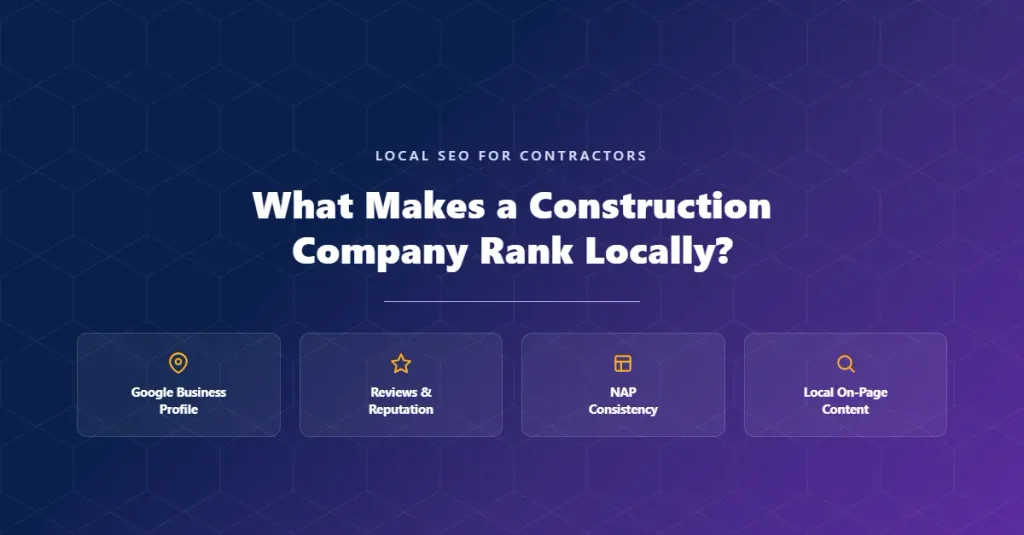
There isn’t one magic ranking factor. A strong construction company local SEO strategy combines multiple signals:
- Relevant services
- Accurate business information
- Geographic relevance
- Google Business Profile optimization
- Genuine reviews
- Strong website content
- Technical SEO
- Relevant backlinks
- Local citations
- Useful project information
- Strong user experience
- Consistent business data
Google’s own guidance emphasizes relevance, distance, and prominence rather than a single formula that businesses can manipulate. (Google Help)
That’s why sustainable local SEO is less about finding a shortcut and more about making your business easier for both customers and search engines to understand.
Frequently Asked Questions About Construction Company Local SEO
How do I rank my construction company website locally?
Start by optimizing your Google Business Profile, researching local service keywords, creating dedicated service and location pages, improving technical SEO, earning genuine reviews, building relevant local citations and backlinks, and publishing useful construction content. Track both rankings and actual leads.
What is the best SEO strategy for a construction company?
A strong strategy combines Google Business Profile optimization, local keyword research, service pages, location-based content, reviews, citations, technical SEO, project case studies, and relevant backlinks. The exact priorities depend on the company’s market, competition, services, and existing online authority.
How important is Google Business Profile for contractors?
Google Business Profile is important because it helps eligible businesses appear on Google Search and Maps with information such as services, hours, contact details, photos, and reviews. Google says complete and accurate business profile information can help local visibility. (Google Help)
Should a construction company create a page for every city?
Not necessarily. Create location pages where the company genuinely serves customers and can provide useful, unique information. Avoid creating large numbers of substantially similar city pages solely to manipulate rankings.
Do Google reviews help construction companies rank?
Google states that reviews and positive ratings can contribute to prominence in local search. Reviews also provide important social proof for potential construction customers evaluating companies. Focus on earning genuine reviews and responding professionally. (Google Help)
How many backlinks does a construction company need?
There is no universal number. A small number of relevant, authoritative local or industry links can be more useful than a large collection of unrelated low-quality links. Focus on earning links from legitimate organizations, publications, partners, associations, and relevant industry websites.
Should contractors use “near me” keywords?
You don’t need to repeat “near me” unnaturally throughout your website. Optimize your business’s actual location and service information so Google can understand where you operate. Customers can then use location-based searches such as “construction company near me.”
Does website speed affect local SEO?
Website performance contributes to the overall search and user experience. More importantly, a slow website can create friction when potential customers are trying to view projects, call the company, or request an estimate. Mobile performance should therefore be part of your technical SEO strategy.
Should construction companies write blog posts?
Yes, when the content addresses genuine customer questions. Useful topics include construction costs, project timelines, contractor selection, permits, local regulations, construction processes, and project planning. The goal should be helping potential customers rather than publishing articles simply to insert keywords.
Can AI-generated content rank a construction website?
AI can assist with research, outlining, and drafting, but publishing large quantities of generic pages purely to manipulate search rankings creates risk. Google’s guidance emphasizes helpful, people-first content rather than content produced primarily for ranking manipulation.
What is local SEO for contractors?
Local SEO for contractors is the process of improving a contractor’s visibility for geographically relevant searches. It typically includes Google Business Profile optimization, local keyword research, service pages, location pages, reviews, citations, backlinks, technical SEO, and locally relevant content.
How can I generate more construction company leads from SEO?
Target high-intent searches, create focused service pages, demonstrate real project experience, make contact options highly visible, optimize your Google Business Profile, earn genuine reviews, and measure qualified leads rather than traffic alone.
Final Thoughts: Build Local Visibility Around Real Expertise
Ranking a construction company website locally isn’t about adding your city name to every heading. It’s about building a complete local search ecosystem. Your construction company’s local SEO strategy should connect your:
Google Business Profile + Website + Services + Locations + Reviews + Citations + Content + Backlinks + Project Experience
When those elements reinforce one another, Google has more context about what your company does, where it operates, and how it relates to local searches. More importantly, potential customers get the information they need to make a decision.
If I were starting a local SEO campaign for a construction company today, I’d begin with the fundamentals: verify and optimize the Google Business Profile, perform local keyword research, fix major technical issues, build focused service pages, strengthen location relevance, establish a review process, and document real projects through useful case studies.
Then I’d build authority consistently. The objective isn’t simply to rank for “construction company.” The objective is to become visible when someone in your service area is actively looking for the exact construction service you provide—and make your website strong enough to turn that search into a qualified conversation.
That’s what effective construction company local SEO should ultimately accomplish: better local visibility, stronger trust, and more qualified opportunities for your construction business.
About the Author
Jawaria is an SEO and digital marketing professional focused on helping small and mid-sized businesses improve organic visibility, lead generation, website performance, and digital growth. Through HQ Growth Lab, she focuses on practical SEO, web development, AI automation, and digital marketing strategies designed to help businesses build, rank, and scale.