Table of Contents
- Introduction
- What Is SEO? A Real Definition for Business Owners
- Why SEO Matters More in 2026, Not Less
- How Search Engines Actually Work
- The 5 Pillars of a Complete SEO Strategy
- Keyword Research: The Foundation of Everything
- On-Page SEO: Optimizing What’s On Your Site
- Technical SEO: The Engine Room
- Off-Page SEO and Authority Building
- Local SEO for Businesses With a Physical Presence
- SEO in the Age of AI: Overviews and AI Search
- Step-by-Step: Building Your SEO Strategy From Zero
- SEO Best Practices Checklist
- Common SEO Mistakes That Quietly Kill Rankings
- Tools and Resources Worth Paying For
- How Long Does SEO Take to Work?
- The Future of SEO: What’s Coming Next
- Frequently Asked Questions
- Summary and Next Steps
Introduction
SEO guide for businesses: you can build the best product in your industry, hire a brilliant team, and still lose to a competitor who simply shows up first on Google.
That’s the business problem SEO solves. Not “more website visitors” in some abstract sense — it solves the problem of being invisible at the exact moment someone is searching for what you sell. Someone typing “best accounting software for small business” or “emergency plumber near me” has already raised their hand. If your competitor’s site is the one they find, that’s a customer you never even got a chance to compete for.
Most business owners know SEO matters. Far fewer understand how it actually works, which is why so much money gets wasted on it every year — on agencies that don’t deliver, on blog posts that never rank, on “SEO audits” that produce a 40-page PDF and nothing else.
This guide is different. It’s written the way we’d explain SEO to a client who’s smart, busy, and tired of jargon. By the end, you’ll understand:
- What SEO actually is, and what it isn’t
- How Google decides who ranks and who doesn’t
- A complete, step-by-step process for building an SEO strategy from scratch
- The technical, on-page, off-page, and local SEO fundamentals that matter in 2026
- How AI Overviews and AI search are changing the rules — and what to do about it
- The mistakes that quietly sabotage most businesses’ SEO efforts
- A practical checklist you can use today
This is the guide we wish existed when we started doing this work over a decade ago. Let’s get into it.
What Is SEO? A Real Definition for Business Owners
Search engine optimization (SEO) is the practice of improving a website so that search engines like Google understand it, trust it, and rank it higher for the searches your customers are already making.
That’s the textbook version. Here’s the version that actually matters for your business: SEO is the discipline of making your business the obvious answer when someone has a problem you can solve.
SEO isn’t one thing. It’s four interconnected disciplines working together:
- Technical SEO — making sure search engines can crawl, render, and index your site properly
- On-page SEO — optimizing the content and structure of individual pages
- Off-page SEO — building authority and trust signals from outside your website (links, mentions, reviews)
- Local SEO — optimizing for location-based searches, especially for businesses that serve a specific geographic area
Most “SEO guides” treat these as separate checklists. They’re not. A page with perfect content but a broken technical foundation won’t rank. A technically flawless site with weak content won’t rank either. They have to work together — which is exactly why so many DIY SEO efforts stall out after a few months. (We break down the technical layer in detail in our [Technical SEO Guide].)
SEO vs. SEM vs. Content Marketing — Clearing Up the Confusion
These terms get used interchangeably, and that confusion costs businesses money.
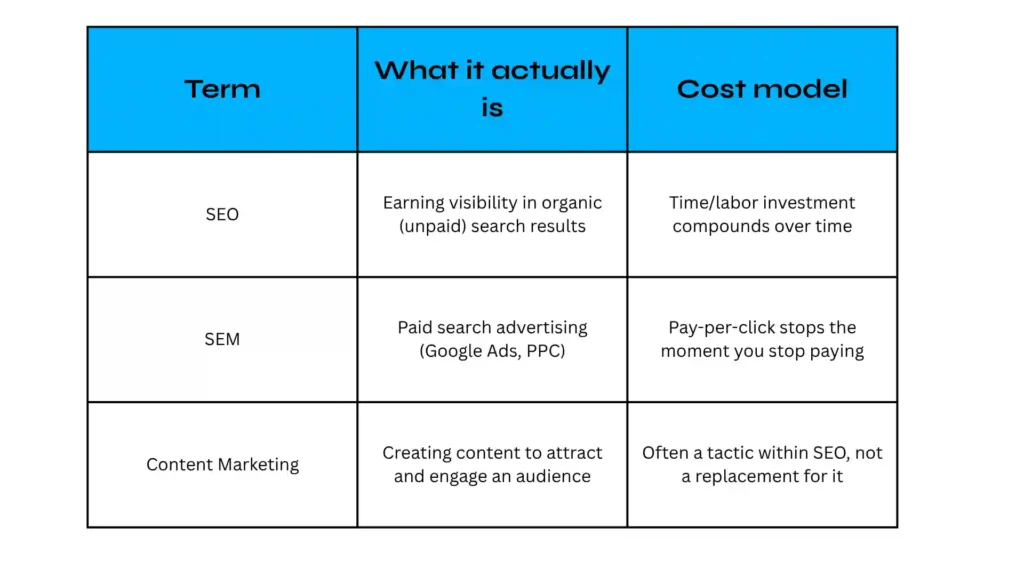
The practical difference: SEM gets you traffic today that disappears the day you stop paying. SEO is slower to build, but it compounds — a well-optimized page can keep generating traffic for years with minimal ongoing investment. The smartest businesses use both, not one instead of the other.
Why SEO Matters More in 2026, Not Less
There’s a narrative floating around that “SEO is dead” because of AI chatbots and AI Overviews. The data tells a more nuanced story.
The search landscape has indeed changed dramatically. Ahrefs data from March 2026 showed AI Overviews appearing on 48% of all Google queries, up from 34.5% in December 2025 — a 58% increase in just three months. When an AI Overview appears above the traditional results, the position-one organic result loses roughly 18% of its clicks, and informational queries have seen declines in the 30–40% range.
That sounds like bad news for SEO. It isn’t — it’s a redefinition of what winning looks like. Sites that get cited inside an AI Overview actually see about 35% more organic clicks than they would have gotten from a standard position-one ranking, because being the cited, trusted source carries more weight than being one of ten blue links.
Here’s what hasn’t changed, and won’t:
- People still search before they buy. Whether the answer comes from a traditional result, an AI Overview, or a chat interface, that answer still has to come from somewhere — and that somewhere is a website that did the SEO work to earn the citation.
- Local intent still drives local action. Google has stated there are no special optimizations required to appear in AI Overviews beyond strong SEO fundamentals and eligibility for snippets — meaning the businesses winning in AI search are the same ones who nailed the fundamentals.
- Trust and authority are now more valuable, not less. Google’s AI models select source pages based on content structure, claim clarity, and entity authority — not simply organic rank.
The businesses panicking about “SEO is dead” are the ones who never did SEO properly in the first place. The ones investing in genuine topical authority, technical cleanliness, and real expertise are the ones being cited by AI systems right now, today, while their competitors lose visibility.
What This Means for Your Business, Practically
- If you ignore SEO, you’re not just losing traditional rankings — you’re invisible in AI Overviews, AI Mode, and the growing share of searches that never produce a traditional results page at all.
- If you invest in genuine expertise and structure, you have a real shot at being the cited source, which converts better than a regular click.
- The cost of getting left behind compounds every quarter. Competitors who start now will have a multi-year head start by the time stragglers catch up.
How Search Engines Actually Work
You don’t need a computer science degree to do SEO well, but understanding the basic mechanics changes how you make decisions. Here’s the simplified version.
1. Crawling
Search engines use automated bots (Googlebot, for example) that travel across the web by following links, discovering new and updated pages. If your site has broken navigation, orphaned pages, or blocks crawlers by accident, this is where things go wrong before they even start.
2. Indexing
Once a page is crawled, Google analyzes its content and decides whether to store it in its index — essentially a massive database of web pages. A page can be crawled and still not indexed if Google decides it’s low-value, duplicate, or technically broken.
3. Ranking
When someone runs a search, Google’s algorithms sort through billions of indexed pages and decide which ones best match that specific query — using hundreds of signals including relevance, content quality, page experience, authority (links and mentions), and increasingly, how clearly a page demonstrates real expertise.
4. Serving (Including AI Features)
The result gets served — as a traditional list of links, a featured snippet, a local map pack, or now, increasingly, as part of an AI Overview that synthesizes information from multiple sources. AI Overviews increasingly synthesize from three to five sources per answer rather than relying on a single dominant source, which means even businesses outside the top 3 positions have a real shot at being included if their content is structurally clear and demonstrably authoritative.
The expert insight most guides miss: Google doesn’t rank websites. It ranks pages for specific queries in a specific context (location, device, search history). This is why “my website doesn’t rank” is the wrong way to think about it — the real question is always “which pages, for which keywords, and why not.”
The 5 Pillars of a Complete SEO Strategy
Every comprehensive SEO strategy rests on five pillars. Skip one, and the whole structure is unstable.
- Keyword & Search Intent Research — understanding exactly what your customers search for and why
- On-Page Optimization — structuring content so both users and search engines understand it
- Technical SEO — the infrastructure that allows everything else to function
- Off-Page Authority — links, mentions, and reputation signals from across the web
- Local SEO — geographic relevance for businesses serving specific areas
We’re going to walk through each one in depth, with the practical detail most guides leave out.
Keyword Research: The Foundation of Everything
Skipping keyword research is the single most common reason SEO efforts fail. Businesses guess what their customers search for, write content around that guess, and wonder why nothing happens. Real keyword research replaces guessing with evidence.
Understanding Search Intent (The Part Most Guides Gloss Over)
Before you even look at search volume, you need to understand intent — what the person actually wants when they type that phrase.
- Informational intent — “what is local SEO” (they want to learn)
- Navigational intent — “HQ Growth Lab” (they want a specific site)
- Commercial investigation intent — “best SEO agency for small business” (they’re comparing options)
- Transactional intent — “hire SEO agency” or “SEO services pricing” (they’re ready to act)
Targeting the wrong intent is why so many businesses rank for keywords that never convert. A page built for “what is SEO” will never out-convert a page built for “SEO services for [industry]” — even if the first keyword has ten times the search volume. Volume without matching intent is vanity, not strategy.
A Practical Keyword Research Process
- Start with seed terms — the broad phrases that describe what you do (e.g., “SEO services,” “web development company”)
- Expand using keyword tools — feed seed terms into tools like Ahrefs, Semrush, or Google Keyword Planner to surface related terms, questions, and long-tail variations
- Mine “People Also Ask” and related searches — these reveal the exact follow-up questions your audience has
- Analyze competitor keyword gaps — identify keywords competitors rank for that you don’t, especially ones with achievable difficulty
- Group keywords by topic, not just by phrase — modern SEO rewards topical clusters, not isolated keyword targeting
- Map each keyword to a funnel stage — informational keywords feed top-of-funnel content; transactional keywords feed service pages
Long-Tail Keywords: The Underused Advantage
Most businesses chase high-volume, high-competition keywords and ignore long-tail phrases (3+ word, highly specific searches). This is a mistake. Long-tail keywords convert at a much higher rate because they reflect specific, well-defined intent — and they’re dramatically easier to rank for.
Example: “SEO” gets enormous search volume and is nearly impossible to rank for as a new or mid-sized site. “Complete SEO guide for businesses” — the exact phrase this article targets — has lower volume but far more realistic competition and much clearer intent.
A smart content strategy builds a foundation of long-tail wins first, then uses the topical authority earned from those pages to eventually compete for harder, broader terms. We go deeper on this process in our [Keyword Research Guide].
Checklist: Keyword Research Done Right
- Identified search intent for every target keyword, not just volume
- Built keyword clusters around core topics, not isolated terms
- Included long-tail variations alongside head terms
- Mapped keywords to specific pages (no two pages targeting the same keyword)
- Checked competitor content for each priority keyword
- Identified the questions people ask around each topic
On-Page SEO: Optimizing What’s On Your Site
On-page SEO is everything you control directly on a given page — content, structure, and HTML elements that help both users and search engines understand what that page is about.
Title Tags and Meta Descriptions
The title tag is the single most important on-page element. It’s your headline in the search results, and it directly influences both rankings and click-through rate.
- Keep titles under 60 characters so they don’t get truncated
- Lead with the primary keyword where it reads naturally
- Make it specific — “SEO Guide” is weak; “The Complete SEO Guide for Businesses (2026)” is specific and current
Meta descriptions don’t directly impact rankings, but they heavily influence whether someone clicks. Treat every meta description like ad copy: state the benefit, include the keyword naturally, and give the reader a reason to choose your result over the nine others.
Header Structure (H1–H6)
Search engines and AI summarization systems both rely heavily on header structure to understand a page’s organization. Use one H1 per page (your main title), and break the body into logical H2 and H3 sections that mirror how someone would naturally ask questions about the topic — exactly the structure you’re reading right now.
Content Quality and Depth
This is where most businesses underinvest. Thin content — 400 words that vaguely cover a topic — almost never ranks for competitive terms anymore. The pages that rank, and increasingly the pages that get cited in AI Overviews, are the ones that comprehensively answer the question, address the related questions, and demonstrate real expertise rather than rehashing what’s already ranking.
Expert insight from experience: the highest-performing pages we’ve built for clients aren’t the longest — they’re the ones structured so each section can stand alone as a direct, citable answer to a specific question. Write for the person who only reads one section, not just the person who reads the whole page.
Internal Linking
Internal links do two jobs: they help users navigate to related, useful content, and they help search engines understand which pages on your site are most important and how topics relate to each other.
A page like this one should naturally link to supporting resources — for example, our [SEO Guide], [Technical SEO Guide], [Keyword Research Guide], and, where relevant, our [Web Development Guide] and [AI Automation Guide] — building a clear topical network rather than a pile of disconnected blog posts.
Image Optimization
- Use descriptive file names (local-seo-checklist.png, not IMG_4821.png)
- Add descriptive alt text for accessibility and image search visibility
- Compress images so they don’t slow down page load — page speed is a ranking factor and a user experience factor
URL Structure
Keep URLs short, descriptive, and keyword-relevant. /complete-seo-guide-for-businesses tells both users and search engines exactly what to expect. Avoid dates, unnecessary parameters, or auto-generated strings of numbers.
Technical SEO: The Engine Room
Technical SEO is invisible to most visitors, which is exactly why it’s so often neglected — and exactly why it causes so much wasted effort. You can write the best content in your industry, and it will never rank if Google can’t crawl, render, or trust your site.
Site Speed and Core Web Vitals
Page experience is a confirmed ranking factor. Google measures this through Core Web Vitals:
- Largest Contentful Paint (LCP) — how quickly the main content loads
- Interaction to Next Paint (INP) — how responsive the page feels to user interaction
- Cumulative Layout Shift (CLS) — how much elements move around as the page loads
Slow, janky pages don’t just rank worse — they convert worse. Every second of additional load time measurably increases bounce rate.
Mobile-First Indexing
Google primarily uses the mobile version of your site for indexing and ranking, regardless of whether most of your traffic is desktop. A site that looks great on desktop but breaks on mobile is, functionally, a broken site in Google’s eyes.
Crawlability and Indexability
- XML sitemap — submit a clean, updated sitemap through Google Search Console
- Robots.txt — make sure you’re not accidentally blocking important pages
- Canonical tags — prevent duplicate content issues when similar pages exist
- No orphan pages — every important page should be reachable through internal links
Structured Data (Schema Markup)
Schema markup is code that explicitly tells search engines what your content means — not just what it says. This has become dramatically more important in the AI Overview era. SEO best practices now include structured schema markup, original research, and brand authority signals as the path to earning AI Overview citations.
Practical schema types every business should implement where relevant:
- Organization schema — establishes your business identity
- LocalBusiness schema — critical for local SEO (covered below)
- FAQPage schema — increases chances of featured snippet and AI citation
- Article/BlogPosting schema — clarifies authorship and publication data
- Review/AggregateRating schema — surfaces star ratings in search results
HTTPS and Site Security
HTTPS has been a baseline ranking signal for years and is now simply table stakes. A site without a valid SSL certificate damages both trust and rankings.
Fixing Crawl Errors and Broken Links
Regularly audit for 404 errors, broken redirects, and redirect chains. These waste crawl budget and create dead ends for both users and search engine bots. For a full technical breakdown, see our [Technical SEO Guide].
Checklist: Technical SEO Health Check
- Core Web Vitals pass on both mobile and desktop
- The site is fully functional and responsive on mobile
- XML sitemap submitted and current
- Robots.txt isn’t accidentally blocking key pages
- No major crawl errors in Search Console
- HTTPS active sitewide
- Schema markup implemented on key pages
- No significant duplicate content issues
Off-Page SEO and Authority Building
Off-page SEO covers everything that happens outside your website that still influences your rankings — primarily backlinks, brand mentions, and reputation signals.
Why Backlinks Still Matter
A backlink is essentially a vote of confidence from one website to another. When authoritative, relevant sites link to your content, search engines interpret that as a trust signal. Not all links carry equal weight — a link from a respected industry publication matters far more than ten links from low-quality directories.
Realistic, Effective Link-Building Strategies
- Digital PR — getting featured in industry publications, local news, or relevant media through genuine newsworthy angles, original research, or expert commentary
- Guest contributions — writing for respected industry sites in exchange for a contextual link (quality over quantity, always)
- Resource link building — creating genuinely useful tools, templates, or data that other sites want to reference naturally
- Broken link reclamation — finding broken links on relevant sites and suggesting your content as a replacement
- Strategic partnerships — co-marketing with complementary (non-competing) businesses in your space
Brand Mentions and Unlinked Citations
Increasingly, search engines and AI systems factor in brand mentions even without a clickable link — this is part of what’s called “entity authority.” Winning strategies in the AI Overview era include structured data optimization, entity authority building, and citation-worthy content creation. Being talked about, reviewed, and referenced across the web — even without a hyperlink every time — builds the kind of broad digital footprint that search engines associate with real, trustworthy businesses.
What to Avoid
- Buying links in bulk from low-quality networks
- Participating in link exchange schemes
- Guest posting purely for link volume with no editorial standard
These tactics can trigger manual penalties or algorithmic devaluation, and the short-term gain is rarely worth the long-term risk.
Local SEO for Businesses With a Physical Presence
If you serve customers in a specific geographic area — a single location, a city, or several branches — local SEO deserves its own dedicated strategy, separate from your broader organic SEO efforts.
Google Business Profile Optimization
This is non-negotiable for local businesses. Your Google Business Profile is often the first thing a potential customer sees.
- Claim and fully verify your profile
- Keep your name, address, and phone number (NAP) identical across your website and every directory
- Choose accurate primary and secondary business categories
- Add photos regularly — profiles with photos get significantly more engagement
- Post updates and respond to every review, positive or negative
Reviews as a Ranking and Trust Signal
Reviews influence both rankings and conversion. Review themes that match real customer intent — things like “great with kids,” “wheelchair accessible,” “fast service,” or “quiet seating” — are increasingly extracted and used as signals by both traditional and AI-powered local search. A steady stream of detailed, authentic reviews matters more than a handful of generic five-star ratings.
NAP Consistency Across Directories
Inconsistent business information across the web — different phone numbers, slightly different addresses, outdated hours — actively damages local rankings and confuses AI systems trying to verify your business. AI systems don’t trust a single source; they triangulate information across multiple sources, and for multi-location brands, inconsistency is usually the root cause of poor visibility.
Local Content and Location Pages
For multi-location businesses, build a unique, genuinely useful page for each location rather than duplicating the same template with the city name swapped out. Include local landmarks, location-specific service details, and unique testimonials from that area.
Local Link Building
- Sponsor local events or organizations for natural local backlinks
- Get listed in local business directories and chamber of commerce sites
- Build relationships with local news and community sites for coverage
SEO in the Age of AI: Overviews and AI Search
This is the section most “complete” SEO guides are missing entirely — and it’s arguably the most important shift in search since mobile-first indexing.
What’s Actually Changing
AI Overviews now appear for approximately 47–64% of all search queries, and for certain verticals — health, finance, technology, education — that figure climbs to 70% or more for informational queries. These systems reward clarity and topical relevance more than pure keyword placement, favoring pages that clearly answer questions, define concepts, and explain processes in a structured way. Notably, pages ranking between positions 11 and 20 are sometimes still referenced in AI summaries — meaning ranking #1 is no longer the only path to visibility.
How to Optimize for AI Citation (Generative Engine Optimization)
- Answer questions directly and early — don’t bury the answer under three paragraphs of preamble
- Use clear, structured formatting — headers, lists, and tables are easier for AI systems to parse and extract
- Build genuine topical authority — citation patterns reward sources that demonstrate consistent topical authority over time, favoring sustained content investment over one-off optimization
- Implement schema markup thoroughly — structured data helps AI systems understand and trust your content’s meaning
- Produce original data, research, or insight — synthesized content rarely gets cited; original perspective does
- Maintain entity clarity — make sure your business’s expertise, authorship, and credentials are clearly and consistently presented across your site
What Not to Panic About
Google has been explicit that traditional SEO fundamentals remain relevant for AI search features — there’s no secret separate playbook. The businesses currently losing visibility are largely the ones that were already coasting on thin content and weak technical foundations. This is a moment of consolidation, not replacement.
This is also exactly the kind of complexity where most businesses benefit from outside expertise — our [AI Automation Guide] covers how we help clients build AI-ready content infrastructure and citation-tracking systems from the ground up.
Step-by-Step: Building Your SEO Strategy From Zero
If you’re starting today with no existing strategy, here’s the realistic order of operations.
Step 1: Run a Technical Audit
Before producing a single piece of content, confirm your site can actually be crawled and indexed properly. There’s no point in optimizing content on a foundation that’s structurally broken.
Step 2: Define Your Core Topics and Audience
Identify the 3–5 core business areas you want to be known for, and clearly define who you’re trying to reach at each stage of their buying journey.
Step 3: Conduct Keyword Research and Build Topic Clusters
Group keywords into clusters around your core topics. Each cluster typically includes one comprehensive “pillar” page (like this one) supported by several more specific subtopic pages.
Step 4: Optimize Your Core Pages First
Before chasing new content, make sure your most important existing pages — homepage, service pages, key category pages — are fully optimized. These usually carry the most existing authority and the fastest potential wins.
Step 5: Build Out Supporting Content
Develop the supporting content for each cluster, each one optimized for a specific keyword and intent, all internally linked back to the pillar page.
Step 6: Earn Authority Through Off-Page Work
Begin digital PR, guest contribution, and partnership outreach once you have strong content worth linking to. Links to thin or weak content rarely convert into rankings, even when earned.
Step 7: Optimize for Local Search (If Applicable)
Run the full Google Business Profile, NAP consistency, and review-generation process in parallel with your content work.
Step 8: Measure, Report, and Iterate
Track rankings, organic traffic, and — increasingly — AI citation visibility. SEO is never “done.” It’s a continuous cycle of refinement based on real performance data.
SEO Best Practices Checklist
A consolidated, practical checklist you can actually use:
- Every page targets a clear, specific keyword and intent
- Title tags are under 60 characters and include the target keyword naturally
- Meta descriptions are written to earn the click, not just describe the page
- Header structure (H1–H3) is logical and mirrors real user questions
- Ensure your website meets Core Web Vitals standards across both mobile and desktop devices.
- Schema markup is implemented on key pages
- Internal linking connects related content into clear topic clusters
- Content directly and clearly answers the question in the first few sentences
- Backlink profile is built from relevant, authoritative sources
- Google Business Profile is fully optimized (for local businesses)
- Reviews are actively monitored and responded to
- Rankings and organic traffic are tracked monthly, at a minimum
Common SEO Mistakes That Quietly Kill Rankings
These are the patterns we see repeatedly when auditing new clients’ sites — the ones that explain why effort hasn’t translated into results.
1. Targeting Keywords With No Realistic Chance of Ranking
Going straight for “SEO” or “digital marketing agency” with a brand-new domain is a guaranteed waste of time and budget. Build authority with achievable terms first.
2. Treating SEO as a One-Time Project
SEO isn’t a website launch checklist you complete once. Algorithms update, competitors publish new content, and search behavior shifts. Static SEO efforts decay.
3. Ignoring Technical Health
Beautiful content sitting on a slow, poorly structured site is like building a storefront with no door. We’ve seen businesses spend tens of thousands on content while a single misconfigured robots.txt file quietly blocked Google from indexing half their site.
4. Keyword Stuffing
Repeating a keyword unnaturally throughout a page doesn’t help rankings — modern algorithms penalize it, and it makes content unreadable for actual humans, which damages engagement signals anyway.
5. Duplicate or Thin Content
Publishing near-identical location pages, or content that doesn’t go deeper than what’s already ranking, rarely earns visibility — and increasingly, it won’t earn AI citation either.
6. Inconsistent NAP Data (Local Businesses)
A different phone number on Yelp than on your website seems minor. It isn’t. It actively undermines the trust signals local algorithms rely on.
7. Chasing Vanity Metrics
SEO delivers real value only when it attracts relevant visitors who convert, not when it simply earns high rankings for low-demand keywords. Align SEO goals with actual business outcomes — leads, calls, bookings, revenue.
8. Ignoring Mobile Experience
With mobile-first indexing as the standard, a desktop-only mindset is actively working against you.
Tools and Resources Worth Paying For
You don’t need to use every available SEO tool to achieve strong results. Here’s what earns its keep:
- Google Search Console (free) — non-negotiable; shows exactly how Google sees your site, including indexing issues and real search queries
- Google Analytics (free) — tracks user behavior and conversion data once visitors arrive
- Ahrefs or Semrush — comprehensive keyword research, backlink analysis, and competitor tracking
- Screaming Frog — technical site crawling and auditing
- PageSpeed Insights / Core Web Vitals report — diagnoses speed and experience issues
- Schema markup generators — simplify structured data implementation without manual coding
- Local SEO platforms (e.g., BrightLocal) — track local rankings and manage multi-location citations
The right approach for most businesses: use free tools (Search Console, Analytics) as the foundation, and invest in a single comprehensive paid platform rather than juggling five subscriptions that all do similar things.
How Long Does SEO Take to Work?
The honest answer: most businesses start seeing meaningful movement in 3–6 months, with significant compounding results by months 9–12. Highly competitive industries can take longer; less competitive, well-executed local strategies can move faster.
Anyone promising guaranteed first-page rankings in 30 days is either inexperienced or not being straight with you. SEO that works fast and SEO that lasts are rarely the same thing — quick wins from manipulative tactics tend to evaporate (or get penalized) just as fast as they arrived.
What actually determines your timeline:
- Domain age and existing authority — new domains take longer to earn trust
- Competitive density — how many established players you’re up against
- Content and technical starting point — how much needs fixing before growth can happen
- Consistency of execution — sporadic effort produces sporadic, unreliable results
The Future of SEO: What’s Coming Next
Based on the current trajectory and the data we’re tracking across client accounts, here’s what’s shaping the next phase of search:
- AI citation tracking becomes a standard KPI, alongside traditional rankings and traffic — businesses will need to monitor not just “where do I rank” but “am I being cited as a source”
- Entity-based authority continues to outweigh raw link volume — being a clearly defined, consistently represented expert entity matters more than ever
- Zero-click search grows, making brand visibility and trust-building content (not just transactional pages) increasingly important even when it doesn’t drive a direct click
- Voice and conversational search keep expanding, rewarding content written in natural, question-and-answer formats
- First-party data and original research become a competitive moat — synthesized, derivative content has a shrinking ceiling
- Video and visual search grow as discovery channels, especially for younger demographics
The constant through all of it: businesses that build genuine expertise, structure it clearly, and maintain technical excellence will keep winning — regardless of which interface delivers the answer.
Frequently Asked Questions
What is the difference between SEO and paid search advertising? SEO earns visibility through organic, unpaid rankings that build over time and continue working after the initial investment. Paid search (SEM/PPC) buys immediate visibility that stops the moment you stop paying. Each has a unique role, and they deliver the best results when used together.
How much does SEO cost for a small business? Costs vary widely based on competitiveness and scope, ranging from a few hundred dollars a month for basic local SEO to several thousand for competitive national or e-commerce strategies. The bigger question isn’t “how much” but “what return is realistic” — a good provider should be able to model that with you before you commit.
Can I do SEO myself, or do I need an agency? Basic SEO fundamentals — Google Business Profile setup, basic on-page optimization, foundational content — are absolutely doable in-house. Competitive technical SEO, large-scale content strategy, and authoritative link building typically require dedicated expertise and time most business owners don’t have to spare.
How often should I update my SEO strategy? Treat it as continuous, not seasonal. Monthly performance reviews and quarterly strategic reassessments are a healthy baseline; major algorithm updates or shifts in your competitive landscape may require faster adjustments.
Does social media activity affect SEO rankings? Not directly as a ranking factor, but social signals indirectly support SEO by increasing brand visibility, driving traffic, and occasionally generating backlinks when content gets shared and picked up by other sites.
What’s the difference between local SEO and regular SEO? Local SEO specifically targets geographically bound search intent (“near me,” city-specific searches) and relies heavily on Google Business Profile, reviews, and local citations. Regular (organic) SEO targets broader informational and commercial intent without geographic constraints.
Is keyword stuffing still a problem in 2026? Yes. Modern algorithms are sophisticated at detecting unnatural keyword repetition, and it actively damages both rankings and user trust. Write for clarity and comprehensiveness, not keyword density.
Will AI search replace traditional SEO entirely? No — it’s reshaping how visibility is earned and measured, not eliminating the underlying discipline. The fundamentals of technical health, content quality, and authority still determine who gets found and cited, whether the format is a traditional results page or an AI-generated summary
Summary and Next Steps
SEO isn’t a single tactic — it’s a system. Keyword research tells you what to build. On-page optimization makes each page clear and useful. Technical SEO ensures search engines can actually find and trust what you’ve built. Off-page authority and local SEO extend that trust beyond your own site. And in 2026, all of it now needs to hold up under the additional lens of AI search and citation.
The businesses that win aren’t the ones chasing every algorithm update — they’re the ones who build real expertise, structure it clearly, and stay consistent over time.
Your practical next steps:
- Run a technical audit of your current site to identify foundational issues
- Conduct real keyword research instead of guessing at search terms
- Audit your top 5–10 pages for on-page optimization gaps
- Claim and fully optimize your Google Business Profile if you serve local customers
- Build a content and link-building roadmap for the next 6–12 months
- Set up proper tracking so you can measure progress against real business outcomes, not vanity metrics
If that list feels like a lot — it is. That’s exactly why most businesses don’t tackle it alone.
At HQ Growth Lab, this is the work we do every day: building complete SEO strategies that connect technical foundations, content, and authority into one system — alongside web development, AI automation, and digital marketing that all work toward the same growth goals. If you want a clear, honest assessment of where your SEO stands today and what it would actually take to move the needle, let’s talk. [Get a free SEO audit from HQ Growth Lab] and see exactly where the opportunity is.
—