If you’re a law firm trying to generate more clients from Google, you’ve probably faced this question: Should you invest in Google Ads immediately or build SEO first? The answer isn’t as simple as choosing one marketing channel.
In my experience working with SEO strategies, the better question is, What does your law firm need right now—immediate lead generation, long-term organic visibility, or both?
Google Ads can put your firm in front of high-intent searchers almost immediately. Law firm SEO, on the other hand, can build organic visibility, topical authority, and a sustainable source of website traffic over time. Both can generate leads. Both can waste money when poorly managed.
The right choice depends on your practice area, geographic market, competition, website quality, budget, and how quickly you need new cases.
For most law firms, I don’t recommend treating SEO and Google Ads as mutually exclusive. A carefully managed PPC campaign can create short-term opportunities while SEO builds the organic foundation that reduces dependence on paid traffic.
In this guide, I’ll break down law firm Google Ads vs SEO, including costs, timelines, lead quality, ROI, advantages, disadvantages, and when each strategy makes the most sense.
Law Firm Google Ads vs SEO: What’s the Difference?
At the simplest level, Google Ads is paid search advertising, while SEO focuses on earning visibility in Google’s organic search results.
With Google Ads, your firm pays to participate in advertising auctions for relevant searches. Google considers factors such as your bid, ad quality, landing page experience, competition, search context, and other signals when determining whether and where an ad appears.
SEO works differently.
Instead of paying Google for each click, you optimize your website and content so search engines can understand, crawl, index, and potentially rank your pages for relevant searches. Google describes SEO as improving a website’s presence in Search and helping search engines understand content while helping users find and evaluate it.
The basic difference
| Factor | Google Ads | SEO |
| Traffic source | Paid | Organic |
| Speed | Fast | Gradual |
| Initial visibility | Can be immediate | Usually takes time |
| Cost model | Usually pay per click | Investment in optimization/content |
| Traffic after investment stops | Generally stops | Existing rankings can continue |
| Long-term value | Moderate | Potentially high |
| Competition | Auction-based | Organic ranking competition |
| Best for | Immediate demand | Sustainable visibility |
| Main risk | Wasted ad spend | Slow progress or poor execution |
| Measurement | Highly trackable | Highly trackable with analytics/Search Console |
The important point is that SEO vs PPC for law firms isn’t really about finding one universally superior channel. It’s about matching the channel to the firm’s business objective.
How Google Ads for Law Firms Works
Google Ads allows law firms to bid on searches that may indicate a potential need for legal services. Imagine someone searches:
“personal injury lawyer near me”
or:
“car accident attorney in Houston”
A relevant law firm may have an opportunity to show a paid search advertisement. This makes lawyer Google Ads particularly attractive because legal searches often have strong commercial intent.
Someone searching for “What is comparative negligence?” may simply want information. Someone searching for “hire a personal injury lawyer” is much closer to taking action. That’s an important distinction.
Google Ads targets existing demand.
One of the biggest strengths of paid search for law firms is that you don’t necessarily have to wait for someone to discover your content organically. you can target searches connected to specific services, locations, and problems.
Google’s keyword system supports broad, phrase, and exact match types, allowing advertisers to control how closely searches need to relate to their keywords. However, simply choosing expensive legal keywords isn’t enough.
A successful campaign requires:
Keyword strategy + ad relevance + landing page quality + geographic targeting + conversion tracking + budget management.
Why negative keywords matter
One of the most overlooked parts of PPC for law firms is excluding irrelevant searches. For example, a law firm that handles paid consultations might not want clicks from searches such as
“free legal advice”
“law school”
“lawyer jobs”
“legal definition”
“DIY legal forms”
“lawyer salary”
Negative keywords help prevent ads from appearing for unwanted searches. Google specifically recommends using negative keywords to prevent irrelevant traffic and improve targeting.
This is one reason professional Google Ads management for law firms can be valuable. The goal isn’t simply to generate clicks. The goal is to generate qualified legal leads.
How Law Firm SEO Works
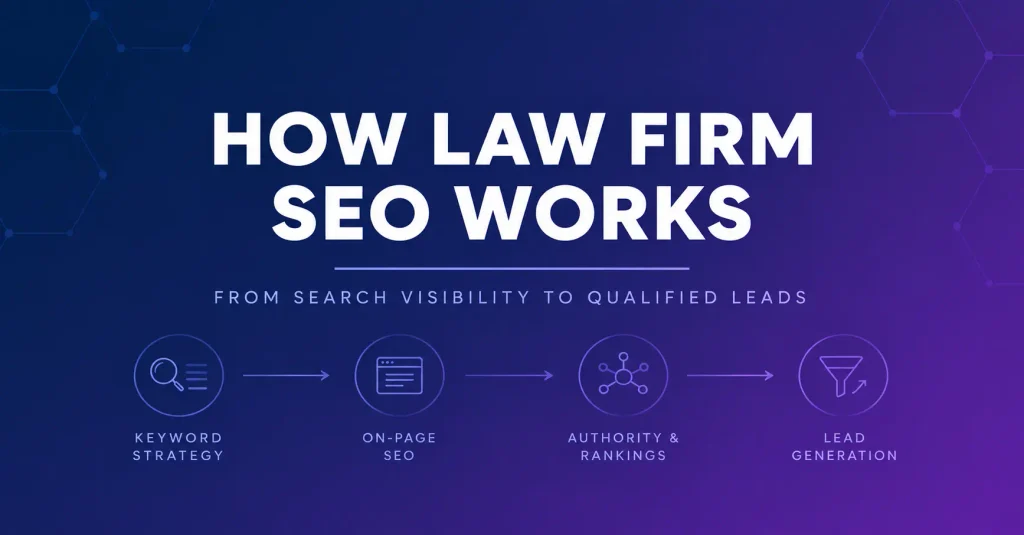
SEO takes a different approach. Instead of paying for every visit, your firm works to build organic visibility for searches related to your practice areas and geographic market.
A strong SEO for law firms strategy typically includes technical optimization, keyword research, service pages, location pages, useful educational content, internal linking, digital authority, local SEO, and ongoing measurement.
Google’s SEO documentation emphasizes making pages understandable to both search engines and users. It also recommends using Search Console to monitor how a website performs in Google Search.
Law firm SEO isn’t just blogging.
This is where many firms misunderstand SEO. Publishing 50 generic blog posts doesn’t automatically create a successful SEO strategy. For a law firm, I would first build around the services that actually generate revenue.
For example, a personal injury firm might develop strong pages around:
Personal Injury Lawyer
Car Accident Lawyer
Truck Accident Lawyer
Motorcycle Accident Lawyer
Wrongful Death Lawyer
Then build supporting educational content around relevant questions and search intent. This creates a relationship between commercial pages and informational content. That structure helps establish topical relevance while giving prospective clients useful information before they contact the firm.
Should Law Firms Invest in Google Ads or SEO?
If you need leads right now, Google Ads may deserve priority. If your goal is to build a durable acquisition channel over the next several years, SEO deserves serious investment. But there’s another factor that many agencies overlook:
Is the firm’s website ready to convert traffic?
Suppose you spend $10,000 on PPC and send every visitor to a slow homepage with unclear messaging, weak trust signals, and no obvious consultation process.
The problem isn’t necessarily Google Ads. The problem is the conversion infrastructure. The same applies to SEO.
If your organic traffic lands on poorly written service pages that don’t establish credibility or make the next step clear, rankings alone won’t produce enough cases. That’s why I prefer thinking about marketing as a system:
Search visibility → relevant traffic → trust → conversion → qualified consultation → retained client.
SEO and PPC influence the first part of that journey, but your website and intake process influence what happens next.
When Google Ads Should Come First.
There are several situations where I would consider Google Ads for lawyers before waiting for SEO results.
1. You need leads quickly
SEO is a compounding strategy. It can take months to build meaningful organic visibility, particularly in competitive legal markets.
Google Ads can provide visibility much faster once campaigns are approved, configured, and properly targeted. That makes PPC useful for a new practice, a newly launched service, or a firm entering a competitive market.
2. Your practice area has high commercial intent
Google Ads works especially well when people are actively looking for legal help. Consider the difference between:
“What happens after a car accident?”
and:
“Car accident lawyer near me.”
The second query usually signals stronger commercial intent. That doesn’t mean every click becomes a client. It means the searcher may be further down the decision-making funnel.
3. You’re launching a new location
Suppose your established law firm opens a new office in another city. Your website may have little organic authority in that market.
Rather than waiting for local SEO to develop, PPC can help you test demand while your local SEO for lawyers campaign develops.
4. You have a strong intake process
This point is critical. Paid traffic is only valuable if your firm can convert and follow up with it.
If calls go unanswered, forms aren’t monitored, or intake staff take hours to respond, increasing ad spend may simply increase wasted opportunities.
When SEO Should Come First.
SEO often deserves priority when a law firm is thinking beyond immediate lead volume.
1. You want sustainable organic traffic
One major advantage of law firm search engine optimization is that successful pages can continue attracting visitors without paying Google for each organic click. That doesn’t make SEO free.
Content creation, technical work, link acquisition, local optimization, strategy, and ongoing maintenance all require investment. But the economics can become attractive as your organic visibility grows.
2. Your website has weak organic visibility
If your firm barely appears for relevant searches, building the organic foundation can create substantial long-term value.
That means improving:
technical SEO
service pages
local relevance
content depth
internal linking
authority signals
user experience
conversion paths
3. You want to reduce dependency on paid traffic
Imagine your firm receives nearly all online leads through PPC. Your marketing pipeline is heavily dependent on advertising spend. If CPCs increase, competitors become more aggressive, or your budget changes, your lead flow can be affected.
A strong law firm organic traffic strategy gives you another acquisition channel.
4. You have a long-term growth strategy
SEO is particularly powerful when a firm intends to dominate a practice area and geographic market rather than simply generate short-term inquiries.
SEO vs PPC for Law Firms: Which Generates Better Leads?
This is one of the hardest questions to answer universally. Neither channel automatically produces better leads.
Search intent matters more than the channel itself.
A paid visitor searching for “hire a divorce attorney” could be extremely valuable. An organic visitor searching for “how much does divorce cost?” may still be researching.
Conversely, a visitor who finds an organic service page for “divorce lawyer in Miami” could be highly qualified. That’s why I recommend analyzing lead quality, not just traffic.
Measure these metrics
Don’t stop at impressions and clicks.
Track:
Cost per lead
Qualified lead rate
Consultation booking rate
Phone calls
Form submissions
Show-up rate
Retainer rate
Cost per retained client
Revenue per client
The final metric is especially important. A $300 lead isn’t necessarily expensive if it produces a $15,000 case.A $50 lead isn’t necessarily cheap if it never becomes a client.
Google Ads vs SEO: Cost Comparison
Legal advertising can be expensive because many practice areas have substantial commercial value. However, there isn’t one universal cost per click for lawyers.
CPC varies by practice area, location, competition, keyword, search context, ad quality, and other auction factors. Google explains that ad position and eligibility depend on multiple factors rather than simply whoever bids the most.
This means a firm’s PPC budget should never be determined by copying another firm’s spending. Instead, work backward from economics.
A simple law firm PPC calculation
Suppose:
Average case value = $8,000
Target acquisition cost = $1,500
Qualified lead-to-client rate = 10%
Then your firm needs to understand how many leads it can afford to acquire while maintaining acceptable profitability. The calculation becomes more useful when you have real historical conversion data.
That’s why I recommend starting with controlled campaigns and measuring actual results rather than making decisions from industry averages alone.
How Long Does Law Firm SEO Take to Work?
This is where expectations matter. SEO isn’t an instant lead-generation switch. A new website competing in a difficult legal market may need considerable time to establish visibility.
An established domain with strong authority, technical health, relevant content, and existing rankings may move considerably faster. There is no legitimate SEO strategy that can guarantee a specific first-page ranking within a fixed number of days. Google itself states that following SEO best practices doesn’t guarantee that a particular page will rank first.
A realistic SEO progression
During the initial phase, I would focus on technical problems, indexing, keyword mapping, service pages, local optimization, and foundational content.
As the campaign develops, the firm can begin building stronger topical coverage, authority, internal links, and content around commercial and informational queries.
Eventually, the goal is to create a growing portfolio of pages that attract relevant searches and support conversions. The exact timeline depends heavily on competition and execution.
Are Google Ads Worth It for Lawyers?
They can be—but only when the economics work. A common mistake is asking:
“How many clicks did we get?”
The better question is:
“How many qualified cases did those clicks produce?”
Google Ads provides conversion tracking that can help advertisers measure valuable actions such as leads and phone calls and determine which ads and keywords contribute to those actions.
For law firms, I would go one step further. Track what happens after the initial lead.
For example:
Click → Call → Qualified Lead → Consultation → Retainer → Revenue
That gives you a much clearer picture of SEO ROI vs PPC ROI.
Can Law Firms Use SEO and Google Ads Together?
Absolutely. in fact, this is often the strategy I prefer.
Instead of thinking:
SEO OR Google Ads
think:
SEO + Google Ads + conversion optimization.
Each channel can solve a different problem. Google Ads can capture demand while SEO develops. SEO can build organic visibility while PPC captures high-intent searches.
PPC data can also provide useful insight into which search terms and messages generate qualified inquiries. Meanwhile, SEO research can identify content opportunities and commercial topics worth testing through paid search. This creates a feedback loop.
A Better Law Firm Marketing Strategy: Use Both Strategically
Here’s how I would structure a combined approach.
Phase 1: Build the foundation
Before spending aggressively, make sure the website has:
A clear practice-area structure.
Dedicated service pages. Strong calls to action.
Fast and mobile-friendly performance.
Accurate contact information.
Trust-building attorney information.
Clear geographic targeting.
Conversion tracking.
A functional consultation process.
Without this foundation, both SEO and PPC performance can suffer.
Phase 2: Launch tightly controlled PPC
Don’t immediately target every legal keyword imaginable.
Start with the most commercially relevant searches.
Create tightly aligned ad groups and landing pages.
Use geographic targeting carefully.
Monitor actual search terms.
Add negative keywords regularly.
Google’s Search Terms reporting can reveal the searches that actually triggered ads and help advertisers identify irrelevant queries to exclude.
Phase 3: Build SEO simultaneously
While PPC produces immediate opportunities, invest in the organic foundation.
Map keywords to service pages.
Build location relevance.
Create useful supporting content.
Strengthen internal linking.
Improve technical SEO.
Develop authority.
Monitor Google Search Console.
Phase 4: Reallocate based on performance
After enough data accumulates, determine:
Which practice areas produce qualified leads?
Which locations perform best?
Which PPC keywords produce clients?
Which organic pages attract qualified visitors?
Which landing pages convert?
Where are prospects dropping out?
Then shift investment toward what produces profitable cases.
Pros and Cons of Google Ads for Law Firms
Pros
Fast visibility: Ads can begin generating exposure much faster than organic SEO.
High commercial intent: You can target searches associated with legal services.
Budget control: You can establish campaign budgets and bidding strategies.
Measurability: Conversion tracking can connect advertising interactions to valuable actions.
Testing: You can quickly test messages, locations, services, and landing pages.
Cons
Ongoing cost: You generally pay for advertising traffic, while organic traffic is earned through ongoing SEO investment.
High competition: Valuable legal keywords can attract aggressive competition.
Poor targeting wastes money: Irrelevant searches can consume budget.
Results can decline when spending stops: Paid visibility depends on continued campaign participation.
Management complexity: Effective campaigns require ongoing optimization.
Pros and Cons of Law Firm SEO
Pros
Long-term visibility: Strong organic pages can continue attracting relevant searches.
Compounding value: A growing content and authority base can expand your search footprint.
Broader discovery: SEO can capture informational, commercial, local, and navigational searches.
Reduced PPC dependency: Organic visibility creates another acquisition channel.
Authority building: Helpful legal content can demonstrate knowledge and credibility.
Cons
Slower results: SEO usually requires patience.
Competitive markets are difficult: Established firms may have strong authority.
Requires continuous work: Rankings aren’t permanently secured.
Content quality matters: Publishing generic content isn’t enough.
Technical problems can limit performance: Crawlability, indexing, site structure, and user experience matter.
What Should a New Law Firm Do?
If you’re launching a new law firm, I wouldn’t automatically recommend putting your entire marketing budget into SEO. You need to understand your economics first.
A practical strategy may involve a controlled PPC campaign for high-intent searches while simultaneously establishing the website’s SEO foundation.
This lets you learn.
You discover which practice areas attract demand. You learn which messages produce calls. You see which locations perform. You identify objections during intake.
Then you can use those insights to strengthen your website and SEO strategy. For a new firm, that feedback can be extremely valuable.
What Should an Established Law Firm Do?
An established law firm usually has more opportunities to leverage SEO. If the website already has authority, historical traffic, existing backlinks, and strong service pages, SEO improvements may unlock substantial organic growth.
At the same time, stopping profitable PPC simply because SEO is improving doesn’t necessarily make sense. Instead, compare the channels based on cost per qualified lead and cost per retained client. If both channels generate profitable cases, there may be no reason to eliminate either.
Local SEO vs Google Ads for Lawyers
Local visibility deserves special attention because many legal searches have geographic intent.
Someone may search:
“immigration lawyer near me”
“criminal defense attorney in Dallas”
“divorce lawyer Chicago”
or:
“personal injury attorney Houston.”
This is where local SEO for lawyers, Google Business Profile optimization, location relevance, reviews, local content, and geographically targeted advertising can work together.
Your website shouldn’t simply mention a city dozens of times. It should demonstrate genuine relevance to the market you’re serving.
That means creating useful local service content, maintaining accurate business information, developing a strong local presence, and ensuring your conversion experience makes sense for prospective clients.
How to Build an SEO Strategy for a Law Firm
A strong SEO strategy for lawyers should begin with business priorities rather than random keyword lists.
Start with practice-area profitability
Identify the cases the firm actually wants.
Then determine the searches prospective clients use before contacting an attorney.
Build commercial pages first
Your most valuable services deserve strong, dedicated landing pages.
These pages should clearly explain:
What the firm handles.
Who the service is for.
What potential clients should do next.
Why the firm is qualified to help.
What questions prospects commonly have.
Build supporting content
Once commercial pages are established, create informational content around relevant questions.
This creates a broader topical ecosystem.
For example:
Personal Injury Lawyer
can support content about accident claims, evidence, insurance disputes, settlement questions, negligence, and related legal issues.
Strengthen internal links
Internal linking helps users navigate related information and helps search engines understand relationships between pages. A blog about accident evidence could naturally link to the firm’s personal injury service page.
A strong internal linking structure can also connect educational content with relevant service pages, helping users discover the firm’s legal services when they’re ready to take the next step.
Content Quality Matters More Than Keyword Stuffing
A common misconception is that ranking requires repeating a keyword endlessly. It doesn’t. Google’s own SEO guidance emphasizes creating search-friendly content that helps users and enables search engines to understand the page.
For a legal website, content should answer the user’s actual question. It should be accurate, useful, current, clearly written, and appropriate for the jurisdiction being discussed.
This is especially important in legal marketing because prospective clients are making consequential decisions. Don’t write content merely to satisfy a keyword target. Write it to help someone make a better decision.
E-E-A-T and Legal Websites
Legal content requires a particularly strong trust layer. Your website should make it easy for visitors to understand who is providing the information and why they should trust the firm.
Depending on the page, consider including:
Attorney biographies.
Relevant qualifications.
Practice-area experience.
Jurisdiction information.
Author or reviewer information where appropriate.
Clear contact information.
Accurate legal information.
Sources where useful.
Updated content.
Transparent disclaimers where appropriate.
Avoid exaggerated claims.
Avoid guarantees of outcomes.
Avoid unsupported statements such as “the best lawyer in America” unless they can be objectively substantiated and comply with applicable professional rules.
The American Bar Association’s Model Rule 7.1 states that communications about lawyers and their services must not be false or misleading, while Rule 7.2 addresses lawyer advertising.
State-specific rules can also apply, so law firms should have advertising reviewed for compliance with the rules applicable to their jurisdiction.
How Much Should a Law Firm Spend on Digital Marketing?
There’s no responsible universal percentage or dollar amount that applies to every firm.
A better approach is to determine:
Target revenue → target number of new cases → acceptable acquisition cost → marketing budget.
Then divide investment across channels based on performance. For example, if PPC produces qualified cases at an acceptable acquisition cost while SEO is still developing, you might temporarily allocate more toward paid search.
As organic visibility grows, you may gradually shift some budget toward content, technical SEO, local optimization, and authority building. This is much more strategic than choosing a marketing budget based on what another law firm spends.
How to Measure SEO and Google Ads Success
A sophisticated law firm client acquisition strategy should connect marketing activity to business outcomes.
PPC dashboard
Monitor:
Impressions
Clicks
CTR
CPC
Conversions
Cost per lead
Qualified leads
Cost per qualified lead
Consultations
Retainers
Cost per retained client
SEO dashboard
Monitor:
Organic clicks
Organic impressions
Search visibility
Ranking trends
Non-branded traffic
Local visibility
Organic conversions
Qualified leads
Consultations
Retainers
Google Search Console can help website owners and SEO professionals understand how pages perform in Google Search. The goal is to move from vanity metrics to revenue metrics.
A Simple Decision Framework
If you’re still wondering SEO or Google Ads, use this framework.
| Your Situation | Recommended Priority |
| Need leads immediately | Google Ads |
| New law firm | PPC + SEO foundation |
| Strong website but weak rankings | SEO |
| Existing profitable PPC | Keep PPC + build SEO |
| Extremely competitive market | PPC + long-term SEO |
| Limited budget | Prioritize highest-intent opportunities |
| Strong organic visibility | Optimize SEO and use PPC selectively |
| New geographic market | PPC testing + local SEO |
| Poor website conversion rate | Fix website first |
| No conversion tracking | Fix measurement first |
This is why there isn’t one universal answer to law firm Google Ads vs SEO. Your firm’s situation determines the correct starting point.
The Best Strategy for Most Law Firms
If I had to simplify the entire article into one recommendation, it would be this:
Use Google Ads to capture immediate demand while building SEO to create long-term demand capture.
Don’t expect PPC to replace SEO. Don’t expect SEO to solve an immediate lead shortage. And don’t pour money into either channel before fixing your website’s conversion foundation.
The strongest strategy is usually an integrated legal marketing strategy where paid and organic search support each other. Google Ads can tell you which commercial searches generate action. SEO can build visibility around those topics.
Your website can turn that traffic into consultations. Your intake team can turn qualified consultations into clients. That’s the complete acquisition system.
A 90-Day Action Plan for Law Firms
Days 1–30: Build the foundation
Audit the website.
Identify technical SEO issues.
Install and verify analytics and Search Console.
Set up conversion tracking.
Define priority practice areas.
Research commercial keywords.
Review competitors.
Improve core service pages.
Clarify calls to action.
Create a PPC account structure if immediate leads are needed.
Days 31–60: Launch and optimize
Launch tightly targeted PPC campaigns.
Monitor search terms.
Add negative keywords.
Test landing pages.
Begin publishing supporting SEO content.
Strengthen internal links.
Improve local SEO signals.
Monitor organic impressions and clicks.
Review lead quality with the intake team.
Days 61–90: Scale what works
Identify profitable PPC keywords.
Pause wasteful campaigns.
Improve conversion rates.
Expand successful SEO content clusters.
Strengthen high-value service pages.
Review local search performance.
Compare PPC and organic qualified leads.
Calculate acquisition costs.
Create the next quarter’s SEO and PPC roadmap.
This approach creates a feedback loop instead of treating marketing as a collection of disconnected tactics.
Common Mistakes Law Firms Make With Google Ads and SEO
Mistake #1: Choosing the cheapest marketing option
Cheap traffic isn’t necessarily valuable traffic.
Your objective is profitable client acquisition.
Mistake #2: Sending every PPC visitor to the homepage
A person searching for a criminal defense attorney shouldn’t necessarily land on a generic homepage.
Create relevant landing experiences.
Mistake #3: Ignoring negative keywords
Irrelevant searches can consume advertising budgets.
Review search terms regularly and exclude unwanted queries.
Mistake #4: Measuring only rankings
A ranking is not a client.
Track organic leads and business outcomes.
Mistake #5: Publishing generic legal content
Content without a clear search intent or client value rarely becomes a meaningful competitive advantage.
Mistake #6: Ignoring intake
Marketing generates opportunities.
Your intake process determines how many opportunities become consultations and clients.
Mistake #7: Making aggressive advertising claims
Legal advertising must be truthful and compliant with applicable professional rules. The ABA’s advertising rules emphasize truthful communications and place restrictions around misleading statements and certain claims.
Frequently Asked Questions
Should law firms invest in Google Ads or SEO?
Law firms should choose based on their goals. Google Ads can provide faster visibility and lead opportunities, while SEO is better suited to building long-term organic visibility. Many firms benefit from using PPC for immediate demand while developing SEO as a sustainable acquisition channel.
Is SEO better than Google Ads for law firms?
SEO isn’t automatically better than Google Ads. SEO can create long-term organic visibility, while Google Ads can produce faster traffic for high-intent searches. The better channel depends on budget, competition, practice area, geographic market, website quality, and how quickly the firm needs new leads.
Are Google Ads worth it for lawyers?
Google Ads can be worthwhile when campaigns target relevant, high-intent searches and the firm tracks qualified leads and retained clients. Clicks alone don’t determine profitability. A law firm should evaluate cost per qualified lead, consultation rate, client acquisition cost, and revenue generated from advertising.
How much do Google Ads cost for law firms?
There is no universal Google Ads cost for law firms. Pricing varies according to practice area, location, competition, keyword demand, bidding strategy, ad quality, and other auction factors. Firms should set budgets according to acceptable client acquisition costs rather than relying on generic industry averages.
How long does law firm SEO take to work?
Law firm SEO commonly requires months rather than days, but the timeline varies significantly. Established websites with strong authority may progress faster than new sites in competitive markets. Results depend on technical health, content quality, competition, authority, local relevance, and the consistency of optimization.
Can SEO generate more leads than Google Ads?
Yes, SEO can generate more leads than Google Ads for some law firms, particularly when a website earns strong organic visibility across valuable practice areas and local searches. However, lead volume alone isn’t enough. The important comparison is the number and value of qualified clients generated relative to acquisition costs.
What is better for law firms: SEO or PPC?
Neither is universally better. PPC is generally useful when a firm needs immediate visibility, while SEO is valuable for long-term organic growth. A combined strategy can be stronger because paid search captures immediate demand while organic optimization builds an additional acquisition channel over time.
Should a new law firm use Google Ads?
A new law firm can use Google Ads if it needs immediate lead opportunities and has a properly optimized website and intake process. At the same time, the firm should build its SEO foundation. Starting both strategically can create short-term visibility while developing a sustainable organic marketing channel.
How can law firms get clients from Google?
Law firms can generate clients through Google Ads, organic SEO, local SEO, Google Business Profile visibility, useful legal content, and conversion-focused service pages. The strongest strategy connects search visibility with compelling landing pages, clear calls to action, conversion tracking, and a responsive client intake process.
Can law firms use SEO and Google Ads together?
Yes. Using SEO and Google Ads together can create a complementary acquisition strategy. PPC can capture high-intent searches while SEO builds organic visibility. Data from paid campaigns can also help identify valuable search themes that can inform SEO and content strategy.
How does SEO help law firms attract clients?
SEO helps law firms become more visible when potential clients search for legal services, attorneys, practice-area information, and local solutions. Strong SEO can attract users at different stages of the decision process and direct them toward relevant service pages, consultations, calls, and other conversion actions.
Final Verdict: Google Ads or SEO First?
So, should law firms run Google Ads or focus on SEO first?
My answer is:
If you need immediate leads, start with carefully controlled Google Ads. If you want sustainable growth, invest in SEO. If you want a stronger long-term acquisition system, use both strategically.
The smartest firms don’t obsess over whether law firm Google Ads vs SEO has a single winner.
They ask a better question:
Which channel can acquire the right clients at a profitable cost while strengthening the firm’s long-term visibility?
Google Ads can buy immediate attention. SEO can build lasting search visibility. Your website turns attention into inquiries.
Your intake process turns inquiries into clients. And your data tells you where to invest next.
If your law firm is currently deciding between PPC and SEO, start by auditing your existing search visibility, conversion funnel, practice-area demand, and acquisition economics. Then build a channel strategy around the numbers—not assumptions.
Need help deciding where your law firm’s marketing budget should go? A professional SEO and PPC audit can identify your highest-value opportunities before you increase spending.
About the Author
[jawaria toufiq] is an SEO strategist at HQ Growth Lab, helping small and mid-sized businesses improve organic visibility, generate qualified leads, and build scalable digital growth systems.
Their work focuses on SEO, technical optimization, content strategy, web development, AI automation, and conversion-focused digital marketing.