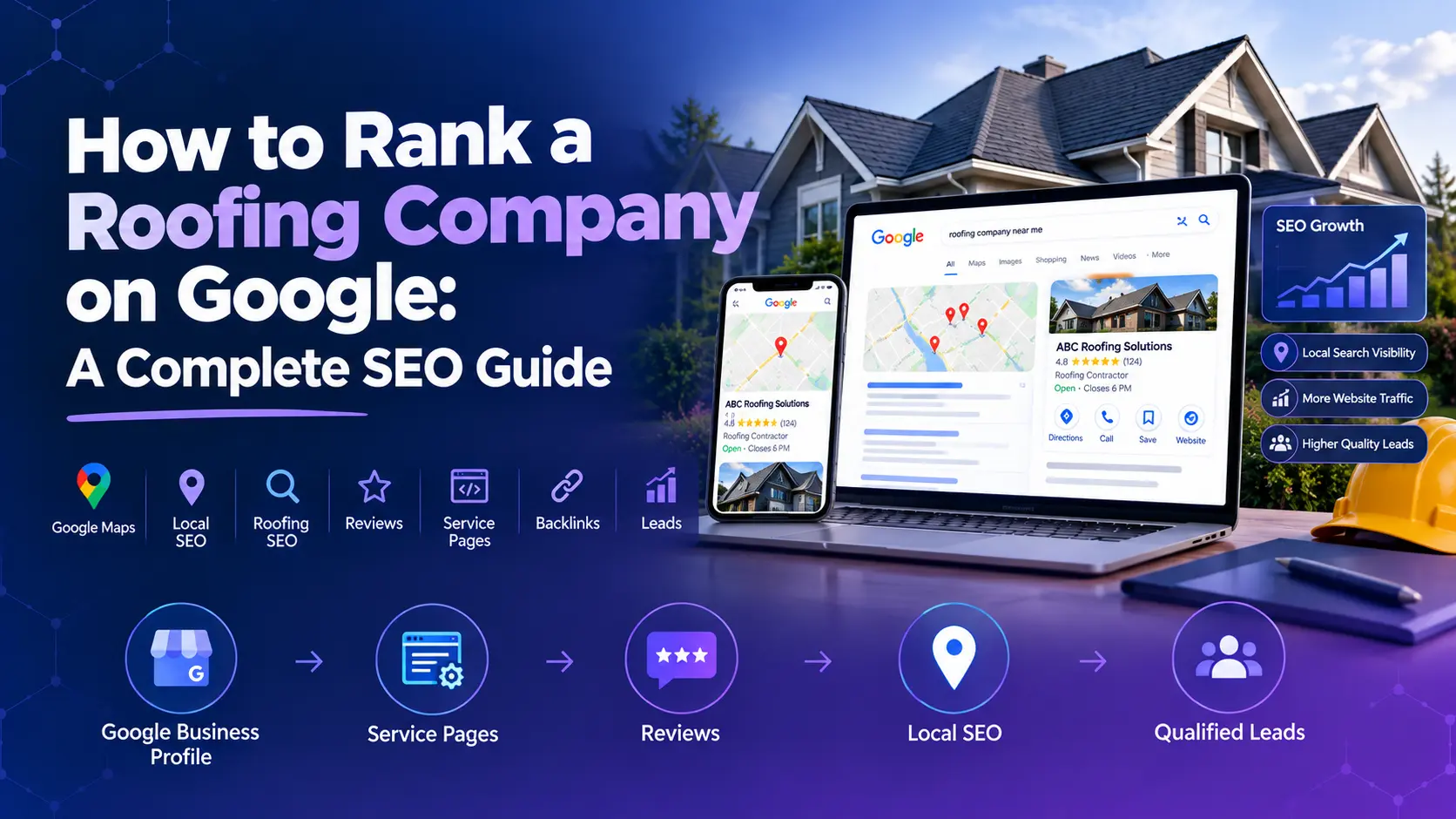
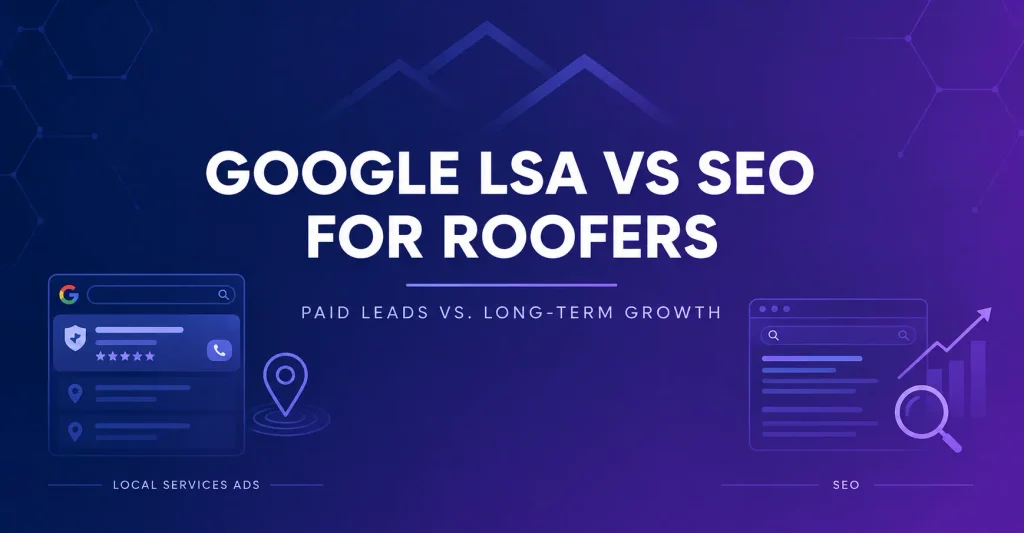
If you run a roofing company, getting found when homeowners search for a roofer can directly affect your sales pipeline. The challenge is deciding where to invest your marketing budget: Google Local Services Ads or long-term roofing SEO.
In my experience with local search strategies, the decision between local service ads vs. SEO roofing depends on several factors. Your budget, market competition, lead urgency, customer acquisition costs, and long-term growth goals all matter.
Local services ads can help eligible roofing businesses reach customers actively searching for services such as roof repair and replacement. SEO takes longer, but it can build organic visibility across service pages, local searches, educational content, and Google Maps.
For many roofing companies, the smartest strategy is not choosing between LSA and SEO. It is using both strategically, measuring qualified leads and revenue, and shifting investment toward the channels that produce profitable customers.
What Are Google Local Services Ads for Roofers?
Google Local Services Ads are paid local search placements that connect eligible service businesses with people searching for nearby services. The profile can highlight information such as services, service areas, business hours, reviews, photos, and business details. (Google Help)
For roofing companies, these ads can be relevant to searches such as:
- roofer near me
- roof repair near me
- roofing contractor in Dallas
- emergency roof repair
- roof replacement company
- local roofing contractor
When a potential customer finds your profile, they may be able to call, message, or book with the business depending on the available features and market. (Google Help)
This makes local services ads attractive for roofing contractors because the customer is often already looking for a service.
How Do Local Services Ads Work?
The process starts with creating your business profile and providing information such as your services, service areas, and business hours. Google uses this information to build the profile shown to potential customers. (Google Help)
Depending on the business category and location, Google may require different screening and verification steps. These can include business checks, licenses, insurance, and other verification requirements. (Google Help)
Roofing companies should also choose their job types and service areas carefully. Google says these settings help determine where Local Services Ads can appear and which types of searches can make an ad eligible to show. (Google Help)
How Much Do Local Services Ads Cost?
Local Services Ads use a pay-per-lead model rather than charging simply for every click. Google states that businesses are charged for valid leads, with lead prices varying by location, job type, lead type, and bidding mode. (Google Help)
Google currently provides different bidding options, including automated bidding and manual maximum-per-lead bidding. (Google Help) That means roofers should not judge LSA performance by lead volume alone.
Track:
- Total leads
- Valid leads
- Qualified leads
- Lead cost
- Booked appointments
- Estimates
- Closed jobs
- Revenue
- Customer acquisition cost
- Profit
A campaign that produces fewer but better leads may be more profitable than one producing a large number of low-quality inquiries.
What Does Google Verified Mean for Roofers?
Google uses verification and screening processes for local service businesses. Requirements vary by service category and location and can include license, insurance, background, and other checks. (Google Help)
Eligible profiles may display a Google Verified badge after completing the required screening process. Google says the badge is intended to help consumers identify businesses that have passed its applicable screening process. (Google Help)
Because roofing is a high-trust service, this can matter. Homeowners often choose a contractor to work on one of their most valuable assets.
However, the badge should not replace good reviews, professional communication, accurate business information, and a strong customer experience.
What Is Roofing SEO?
Roofing SEO is the process of improving a roofing company’s website and online presence so it can earn more visibility in unpaid search results. Instead of paying for every individual lead, you invest in creating an online asset that can attract organic traffic over time.
A strong SEO campaign for a roofing company can include:
- Keyword research
- Service-page optimization
- Location-page optimization
- Technical SEO
- Content creation
- Internal linking
- Google Business Profile optimization
- Review management
- Local citations
- Relevant backlinks
- Google Maps SEO
- Conversion optimization
The objective is not simply to rank for the word “roofer.” The objective is to become visible for the searches that can turn into real business.
For example, a roofing company may want visibility for:
- roof repair
- roof replacement
- emergency roof repair
- commercial roofing
- residential roofing
- storm damage roof repair
- roof inspection
- roofing contractor near me
- roof replacement cost
How Does SEO for Roofing Companies Generate Leads?
Imagine someone searches:
“roof replacement company in Austin”
A well-optimized roofing company could potentially appear through several search opportunities.
The company might have:
- A roof replacement service page
- A properly maintained Google Business Profile
- A location page
- Customer reviews
- Supporting educational content
- Relevant local links
- Strong website authority
Each asset supports a different part of the search journey. That is why SEO for roofing companies shouldn’t be reduced to adding keywords to a page. Good SEO connects search intent, useful content, local relevance, technical quality, authority, and conversion paths.
For broader SEO guidance, Google’s SEO documentation explains the fundamentals of helping search engines understand and discover website content. (Google Help)
Google Local Services Ads vs Roofing SEO: What’s the Difference?
The fundamental difference is simple:
Local Services Ads provide paid visibility, while SEO focuses on earning organic visibility.
But the practical differences go much deeper.
| Factor | Local Services Ads | Roofing SEO |
| Speed | Generally faster to start generating visibility | Usually slower |
| Payment model | Pay for eligible leads | Investment in SEO work and assets |
| Long-term value | Stops producing paid visibility when advertising stops | Organic assets can continue generating value. |
| Local intent | Very strong | Strong |
| Control | Budget, services, areas, bidding | Content, technical optimization, website assets |
| Trust signals | Reviews, profile information, verification | Reviews, content, links, website authority |
| Main risk | Lead costs and quality can vary. | Results can take time. |
| Best use | Capturing immediate demand | Building sustainable organic visibility |
| Measurement | Lead and job performance | Rankings, traffic, leads, revenue |
| Ideal strategy | Short-term demand capture | Long-term growth |
The key lesson is that local service ads vs. SEO for roofing is not really a question of which channel is universally better. It is a question of which channel best matches your business stage.
How Do Local Services Ads Compare With Traditional Google Ads for Roofers?
Roofers sometimes use “Google Ads” and “Local Services Ads” interchangeably, but they are not the same advertising product.
Traditional Google Search campaigns can use keyword targeting, ad copy, landing pages, bidding strategies, and conversion goals.
Local Services Ads are designed specifically around local service businesses and lead generation. The billing model is also different. Local Services Ads generally charge for valid leads rather than simply charging for every click. (Google Help)
| Factor | Local Services Ads | Traditional Search Ads |
| Main goal | Local lead generation | Traffic and conversions |
| Billing | Lead-based | Commonly click-based |
| Profile | Business profile | Search ad and landing page |
| Keyword control | More service/job-type based | More direct keyword control |
| Best for | High-intent local services | More flexible search campaigns |
| Landing page dependency | Lower | Often higher |
| Testing | Profile, services, budget, bidding | Keywords, ads, landing pages, audiences |
This is important when comparing roofing PPC vs. SEO. A roofing company may use Local Services Ads to capture immediate local demand, traditional Google Ads for more control over specific commercial searches, and SEO to build long-term organic visibility.
The right combination depends on the market and economics.
How Fast Can Roofers Get Leads From Local Services Ads?
Speed is one of the biggest reasons roofing contractors consider local services ads.
Once a business is eligible, verified as required, and properly configured, its profile can become eligible to appear when customers search for relevant services in selected areas. (Google Help)
That can be valuable for a newer roofing company that has little organic visibility. For example, imagine a roofer opens a new location and has almost no organic rankings. Waiting for a competitive SEO campaign to gain traction may not be practical if the company needs customers immediately.
LSAs can provide a faster route to capturing existing demand. But speed does not automatically mean profitability. You still need to measure:
Lead → Contact → Appointment → Estimate → Closed Job → Revenue
Google also notes that responsiveness matters. Regularly failing to answer calls or respond to messages can affect ad ranking. (Google Help) For roofers, this is especially important because homeowners dealing with leaks or storm damage may contact several companies. Fast response can become a competitive advantage.
How Long Does Roofing SEO Take to Work?
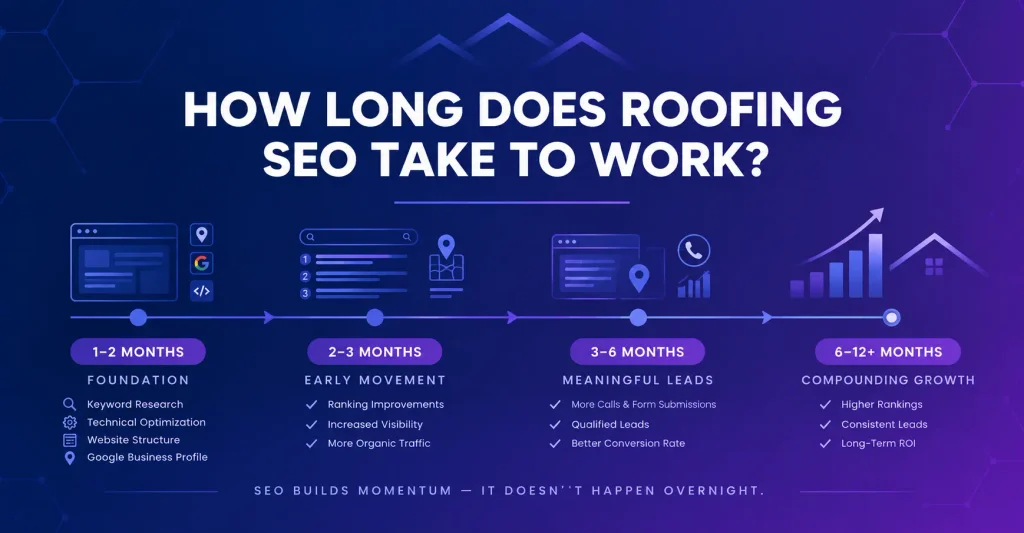
SEO usually requires more patience than paid lead generation. A new roofing website competing against established companies may need months to build meaningful organic visibility.
The timeline depends on factors such as
- Domain history
- Website quality
- Local competition
- Existing authority
- Backlink profile
- Content quality
- Search demand
- Technical health
- Google Business Profile strength
- Location
- Search intent
Instead of expecting SEO to produce immediate leads, monitor early indicators such as:
- Better indexing
- Increasing search impressions
- More keyword rankings
- Growing organic traffic
- Increased local visibility
- More calls and form submissions
- Increasing non-branded search traffic
SEO becomes more valuable when these improvements compound. That is the fundamental difference between buying immediate visibility and building an organic acquisition asset.
Roofing PPC vs SEO: Which Produces Better Leads?
There is no universal winner. Roofing PPC vs SEO should be evaluated according to your market, budget, lead quality, and conversion rate.
Paid campaigns can capture customers who are ready to contact a roofer today. SEO can capture both commercial and informational searches.
For example:
Transactional search:
“roof replacement contractor near me”
Commercial investigation:
“best roofing companies in Phoenix”
Informational search:
“How much does roof replacement cost?” SEO can create content and service pages for different stages of the customer journey.
Paid advertising can then be used to capture immediate commercial demand. The strongest strategy often combines both.
Cost Per Lead for Roofers: Which Channel Is Cheaper?
One of the most important questions roofing companies ask is
“How much does a roofing lead cost?”
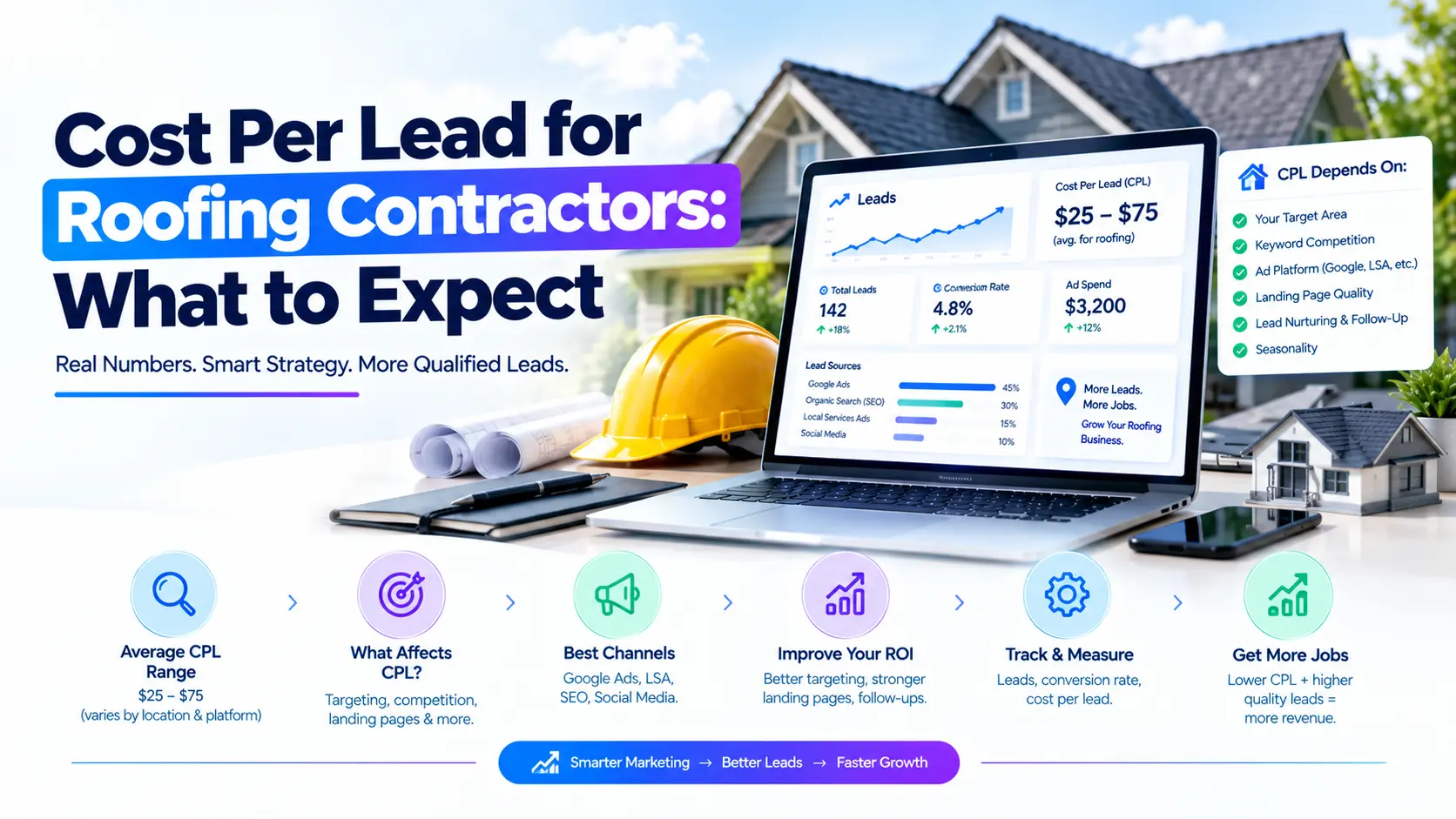
There is no single cost per lead that applies to every roofing company.
The cost per lead for roofers can vary based on:
- City
- Competition
- Roofing service
- Seasonality
- Lead quality
- Advertising demand
- Budget
- Reviews
- Response speed
- Landing-page conversion rate
- Sales process
For Local Services Ads, Google says lead prices can vary by location, job type, lead type, and bidding mode. (Google Help) That is why an industry-wide CPL benchmark should never replace your own data.
What Is the Break-Even Cost Per Lead for a Roofing Company?
A useful way to evaluate lead costs is to connect them to your average gross profit and close rate.
A simplified formula is
Break-even CPL = Gross profit per completed job × Lead-to-customer conversion rate
For example, suppose a roofing company generates $3,000 in gross profit from an average completed job.
If 10% of qualified leads become customers:
$3,000 × 10% = $300
The simplified break-even lead cost would be $300. This is only an illustration. Real calculations should account for sales costs, overhead, lead quality, refunds, cancellations, and other acquisition expenses. The important lesson is this:
The cheapest lead is not necessarily the most profitable lead.
How Should Roofers Measure Marketing ROI?
Consider this example:
| Metric | Channel A | Channel B |
| Leads | 40 | 20 |
| Qualified leads | 20 | 14 |
| Appointments | 12 | 10 |
| Closed jobs | 5 | 6 |
| Marketing cost | $2,000 | $2,500 |
| Revenue | $15,000 | $21,000 |
| Revenue per marketing dollar | $7.50 | $8.40 |
Channel B generated fewer leads but more revenue.
That is why roofing marketing ROI should be measured beyond lead volume.
Track the entire funnel.
Lead → Qualified lead → Appointment → Estimate → Customer → Revenue → Profit
Local SEO for Roofers: Where Does Google Maps Fit?
Local SEO for roofers helps businesses improve their visibility for searches connected to specific geographic areas.
Google says local ranking is mainly influenced by relevance, distance, and prominence. Google also notes that prominence can be influenced by information such as links and reviews. (Google Help) A roofing company should make sure its business information is accurate and complete.
Pay attention to:
- Business name
- Primary category
- Services
- Service areas
- Hours
- Phone number
- Website
- Photos
- Reviews
- Business information
Do not assume that simply adding more keywords to a business profile guarantees better rankings. Google explicitly says there is no way to request or pay for a better local ranking. (Google Help)
How Google Maps SEO and Organic SEO Work Together
Google Maps SEO and traditional organic SEO overlap, but they are not identical. Local visibility considers factors such as relevance, distance, and prominence.
Organic SEO involves broader factors such as content relevance, technical quality, website structure, links, and search intent. A strong roofing strategy should therefore consider both.
For example, your website’s roof replacement page can support organic visibility while your Google Business Profile helps reinforce your local presence.
When Should a Roofing Company Choose Local Services Ads?
Local services ads may make sense when immediate lead generation is a priority.
Consider testing them when:
- You need leads quickly.
- Your business is eligible.
- Your service area is clearly defined.
- Your reviews are competitive.
- You can answer calls quickly.
- You have enough budget to test performance.
- You can track qualified leads.
- Your sales team can handle new inquiries.
Roofing is often a high-intent local service. Someone searching for “emergency roof repair near me” is usually much closer to taking action than someone reading an article about roof maintenance.
That makes high-intent local advertising valuable. However, your business still needs a strong sales process after the lead arrives.
When Should Roofers Invest in SEO?
SEO becomes especially valuable when the goal is sustainable growth.
It may make sense if:
- You want consistent organic traffic.
- You want to reduce dependence on paid leads.
- Your market is competitive.
- You want stronger brand authority.
- You want traffic from informational searches.
- You want visibility for multiple roofing services.
- You want long-term marketing assets.
- You can invest consistently.
A strong SEO campaign can build assets that continue attracting organic search visibility after the initial work has been completed. That does not mean SEO becomes “free.”
Content needs updating. Technical issues need attention. Competitors continue publishing. Search behavior changes. SEO is better viewed as a long-term marketing investment rather than a one-time project.
Should Roofers Use Local Services Ads and SEO Together?
For many roofing companies, this is the strategy I would test first. Instead of treating LSA vs. SEO as an either-or decision, use each channel for what it does best.
Use Local Services Ads for Immediate Demand
LSAs can help capture customers who are actively looking for roofing services.
Use SEO for Long-Term Demand.
SEO can help your company capture commercial searches, informational searches, branded searches, and local organic opportunities.
Use Google Maps to Strengthen Local Visibility
A properly maintained Google Business Profile can support local discovery alongside your website and other marketing assets.
Use Your CRM to Connect the Channels
Do not allow leads to disappear inside separate marketing platforms.
Track:
Source → Lead → Qualified → Appointment → Estimate → Won → Revenue
This lets you compare actual business outcomes instead of comparing vanity metrics.
SEO vs. Paid Advertising for Roofers: Pros and Cons
Local Services Ads Pros
- Faster route to local visibility
- Strong service intent
- Direct lead generation
- Useful for urgent services
- Can complement organic search
- Lead performance can be measured.
Local Services Ads Cons
- Requires ongoing advertising spend
- Lead prices vary.
- Lead quality can vary.
- Competitors can compete for the same demand.
- Results depend heavily on response speed.
- Poor sales follow-up can waste the investment.
Roofing SEO Pros
- Builds long-term organic visibility
- Can target many relevant searches
- Supports brand authority
- Can reduce dependence on paid acquisition
- Creates reusable website assets
- Can capture informational and commercial intent
Roofing SEO Cons
- Takes time
- Requires ongoing work
- Competitive markets can be difficult.
- Rankings are not guaranteed.
- Requires technical and content expertise.
- Poor execution can waste months.
This is why SEO vs. paid advertising for roofers should be evaluated according to cash flow, competition, growth goals, and customer acquisition economics.
How Can Roofers Build a Strong Lead Generation Strategy?
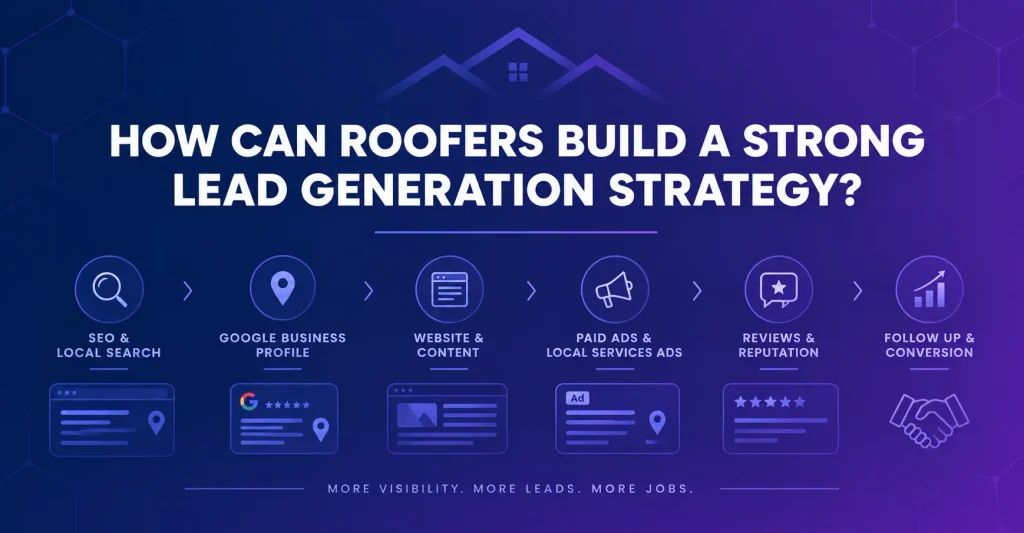
A successful roofing lead generation system should not depend on one traffic source. Think of your marketing as a funnel.
Step 1: Capture Existing Demand
Use local services ads, traditional paid search, Google Maps, and organic search to reach people who are already looking for roofing services.
Step 2: Build Trust
Use:
- Customer reviews
- Project photos
- Testimonials
- Certifications
- Clear service information
- Helpful content
- Accurate business details
- Transparent expectations
Step 3: Create Relevant Landing Pages
Do not send every visitor to your homepage. Someone searching for roof replacement should ideally reach a relevant roof replacement page. Someone searching for emergency roof repair should see information specifically about emergency services.
Step 4: Make Contact Easy
Use clear calls to action such as
Request a Roof Inspection
Get a Roofing Estimate
Call a Local Roofing Specialist.
Step 5: Follow Up Quickly
Generating a lead is only half the job. A lead that sits unanswered may become a competitor’s customer.
Step 6: Track Revenue
Do not stop at form submissions.
Connect:
Lead → Appointment → Estimate → Closed Job → Revenue
This is where marketing attribution becomes useful.
How Can Roofers Improve Qualified Roofing Leads?
More leads do not automatically mean more sales. The objective should be qualified roofing leads. To improve lead quality, make your targeting specific.
Clearly define:
- Service areas
- Roofing services
- Property types
- Emergency services
- Residential vs. commercial work
- Minimum project requirements
- Service availability
Your website should also clearly explain what your company does. If you specialize in residential roof replacement, do not create vague messaging that attracts every possible roofing-related inquiry. Specific messaging can help attract customers who are actually looking for the services you provide.
How Can Roofers Track LSA and SEO Performance?
This is one of the most important parts of the entire strategy. Many roofing companies track leads but fail to track which leads become customers. Start with a simple reporting system.
Track Paid Lead Performance
Monitor:
- LSA spend
- Leads received
- Valid leads
- Qualified leads
- Cost per lead
- Booked appointments
- Closed jobs
- Revenue
- Customer acquisition cost
Track SEO Performance
Monitor:
- Organic impressions
- Organic clicks
- Ranking trends
- Non-branded traffic
- Organic leads
- Local visibility
- Phone calls
- Form submissions
- Closed revenue
Google Search Console can help you understand how your website performs in Google Search, while analytics and CRM data can help connect traffic to business outcomes. The important point is that rankings are not the final KPI.
Revenue is closer to the business outcome that matters.
Common Mistakes Roofers Make With Google Advertising and SEO
Mistake 1: Measuring Only Lead Volume
A campaign generating 100 poor-quality inquiries may be worse than one generating 25 qualified opportunities.
Mistake 2: Ignoring Response Time
A lead that waits several hours may already have contacted another contractor.
Mistake 3: Sending Every Visitor to the Homepage
A roof repair search should usually lead to a relevant roof repair page.
Mistake 4: Targeting Every Roofing Keyword
Not every roofing-related search has commercial value.
Mistake 5: Ignoring Reviews
Reviews can influence customer trust and contribute to local visibility. Google specifically notes that reviews and positive ratings can contribute to local ranking. (Google Help)
Mistake 6: Stopping SEO Too Early
SEO often requires consistent investment before its full value becomes visible.
Mistake 7: Not Tracking Closed Revenue
If you only know how many leads you generated, you do not know which channel actually produced profitable customers.
Mistake 8: Treating All Paid Leads as Equal
Lead quality matters. A lead for a service you do not provide should not be evaluated the same way as a qualified roof replacement opportunity.
Google provides lead feedback and, in eligible markets, mechanisms for invalid or low-quality lead credits. Availability depends on the market and vertical. (Google Help)
A Practical Roofing Marketing Checklist
Before investing heavily in either channel, check these fundamentals.
Local Services Ads Checklist
- Business information is accurate.
- Required verification is complete.
- Services are relevant.
- Service areas are accurate.
- Reviews are legitimate.
- The budget is appropriate.
- Calls are answered quickly.
- Messages receive timely responses.
- Leads are tracked.
- Qualified leads are separated from poor-fit inquiries.
- Closed revenue is measured.
Roofing SEO Checklist
- The website is technically healthy.
- Roofing services have dedicated pages.
- Location targeting is relevant.
- Google Business Profile is complete.
- Business information is consistent.
- Reviews are actively managed.
- Internal links connect related pages.
- Service pages match search intent.
- Helpful content supports commercial pages.
- Website visitors have clear conversion paths.
A Simple Decision Framework for Roofers
If you are still unsure which channel to prioritize, use this framework.
| Your Situation | Recommended Priority |
| Need leads immediately | Test Local Services Ads |
| New business with little organic visibility | LSA + SEO |
| Strong organic rankings already | Continue SEO and test paid demand. |
| High local competition | LSA + SEO |
| Limited short-term budget | Start with one measurable channel |
| Want long-term growth | Invest in SEO. |
| Emergency roofing services | LSA + local SEO |
| Want to reduce paid lead dependence | Build SEO |
| Strong website and content foundation | Expand SEO |
| Need to validate a service quickly | Test paid acquisition |
The best answer to local service ads vs. SEO for roofing depends on your current business stage.
How I Would Allocate a Roofing Marketing Budget
I would not copy another roofing company’s marketing budget. Start with your business economics.
Calculate:
Average Job Revenue
minus
Direct Job Costs
equals
Gross Profit
Then determine how much you can realistically spend to acquire a customer. For example, if a roofing company generates $3,000 in gross profit from a completed job and closes 10% of qualified leads, a simplified break-even lead cost is $300.
But the real target should be lower than the break-even point because the company still has overhead and other expenses. Once SEO begins generating measurable leads, compare those results against paid acquisition.
The question becomes:
Which channel produces profitable customers at a sustainable acquisition cost?
That is much more useful than asking which channel has the cheapest raw lead.
Can SEO Eventually Reduce Dependence on Local Services Ads?
Potentially, yes. A successful SEO campaign can increase organic traffic, improve visibility for relevant searches, strengthen local presence, and create more opportunities for inbound leads.
But I would not automatically turn off Local Services Ads once SEO begins producing results. Instead, compare the channels.
Ask:
- Which channel produces better customers?
- Which produces higher average job value?
- Which produces better close rates?
- Which produces lower customer acquisition costs?
- Which generates more qualified opportunities?
- Which channel is growing?
- Which channel provides better geographic coverage?
Then adjust your budget. The objective is not to “win” the SEO vs. LSA debate. The objective is to build a profitable customer acquisition system.
FAQ: Google Local Services Ads vs SEO for Roofers
Are Local Services Ads better than SEO for roofers?
Local Services Ads can be better when a roofing company needs leads quickly and is eligible to use the program. SEO is generally better suited to building long-term organic visibility. For many roofing companies, combining both channels can provide broader search coverage.
Is SEO worth it for a roofing company?
Yes. Roofing SEO can help a company build organic visibility, attract relevant search traffic, support local visibility, and reduce dependence on paid acquisition over time. Results depend on competition, location, website quality, authority, content, and the consistency of the SEO strategy.
How much does a roofing lead cost?
There is no universal cost per lead for roofers. Lead prices vary by location, service, competition, advertising channel, bidding method, and lead type. Google also states that local services lead prices can vary based on factors such as location and job type. (Google Help)
How quickly can roofers get leads from Local Services Ads?
Local Services Ads can provide faster visibility than a new SEO campaign once a business is eligible and its profile is properly configured. However, lead volume and cost vary by market, competition, service area, budget, bidding settings, and customer demand.
Should a roofer use SEO and Google Local Services Ads?
For many roofing companies, yes. Local Services Ads can help capture immediate high-intent demand, while SEO builds longer-term organic visibility. Using both also gives the business more than one source of search-driven leads.
Does Google Verified help roofing companies?
Google Verified can signal that an eligible local services provider has completed Google’s applicable screening and verification process. Requirements vary by category and location, so roofing companies should check current requirements for their market. (Google Help)
What is better for long-term roofing lead generation?
SEO is generally better suited to long-term organic lead generation because rankings, content, website authority, and local visibility can continue creating value. However, SEO requires ongoing maintenance and does not guarantee rankings or a specific number of leads.
Is roofing PPC better than SEO?
Roofing PPC can provide faster visibility, while SEO focuses on building organic visibility over time. Neither is universally better. Your decision should depend on budget, competition, urgency, lead quality, conversion rate, and customer acquisition economics.
How can roofers improve Google Maps visibility?
Roofers should maintain accurate and complete business profile information, earn legitimate reviews, provide relevant business details, maintain a strong website, and build local authority. Google says local results are primarily influenced by relevance, distance, and prominence. (Google Help)
What should roofing companies track from Google leads?
Track the complete customer journey: lead source, lead quality, contact rate, appointment rate, estimate rate, close rate, revenue, customer acquisition cost, and profit. This reveals which marketing channel produces actual customers instead of simply generating inquiries.
Final Verdict: Google Local Services Ads vs. SEO for Roofers
So, which is better: local service ads vs. SEO for roofing?
If you need leads quickly, Local Services Ads can be an effective way to capture high-intent local demand when your business is eligible and properly configured. If you want sustainable organic visibility, roofing SEO deserves serious investment.
But you do not always have to choose one. For many established roofing companies, the strongest strategy is to use both.
Use Local Services Ads for roofers to capture immediate demand. Use local SEO for roofers, relevant service pages, Google Business Profile optimization, useful content, reviews, and authority building to create long-term visibility. Then measure what actually matters:
Qualified leads → booked appointments → estimates → closed jobs → revenue → profit.
That is the real answer to the local service ads vs. SEO roofing question. The goal is not simply to generate more leads or rank for more keywords.
The goal is to build a predictable acquisition system that turns search visibility into profitable roofing jobs. At HQ Growth Lab, the broader objective is simple:
Build. Rank. Scale.
If your roofing company is spending money on marketing but cannot clearly identify which channel produces profitable customers, start with tracking. Measure lead quality, customer acquisition cost, close rate, and revenue before increasing your budget.
The best marketing channel is not necessarily the one that generates the most leads. It is the one that consistently helps your roofing company acquire qualified customers profitably and sustainably.
About the Author
Jawaria is an SEO and digital marketing professional focused on helping small and mid-sized businesses improve organic visibility, lead generation, website performance, and digital growth. Through HQ Growth Lab, she focuses on practical SEO, web development, AI automation, and digital marketing strategies designed to help businesses build, rank, and scale.