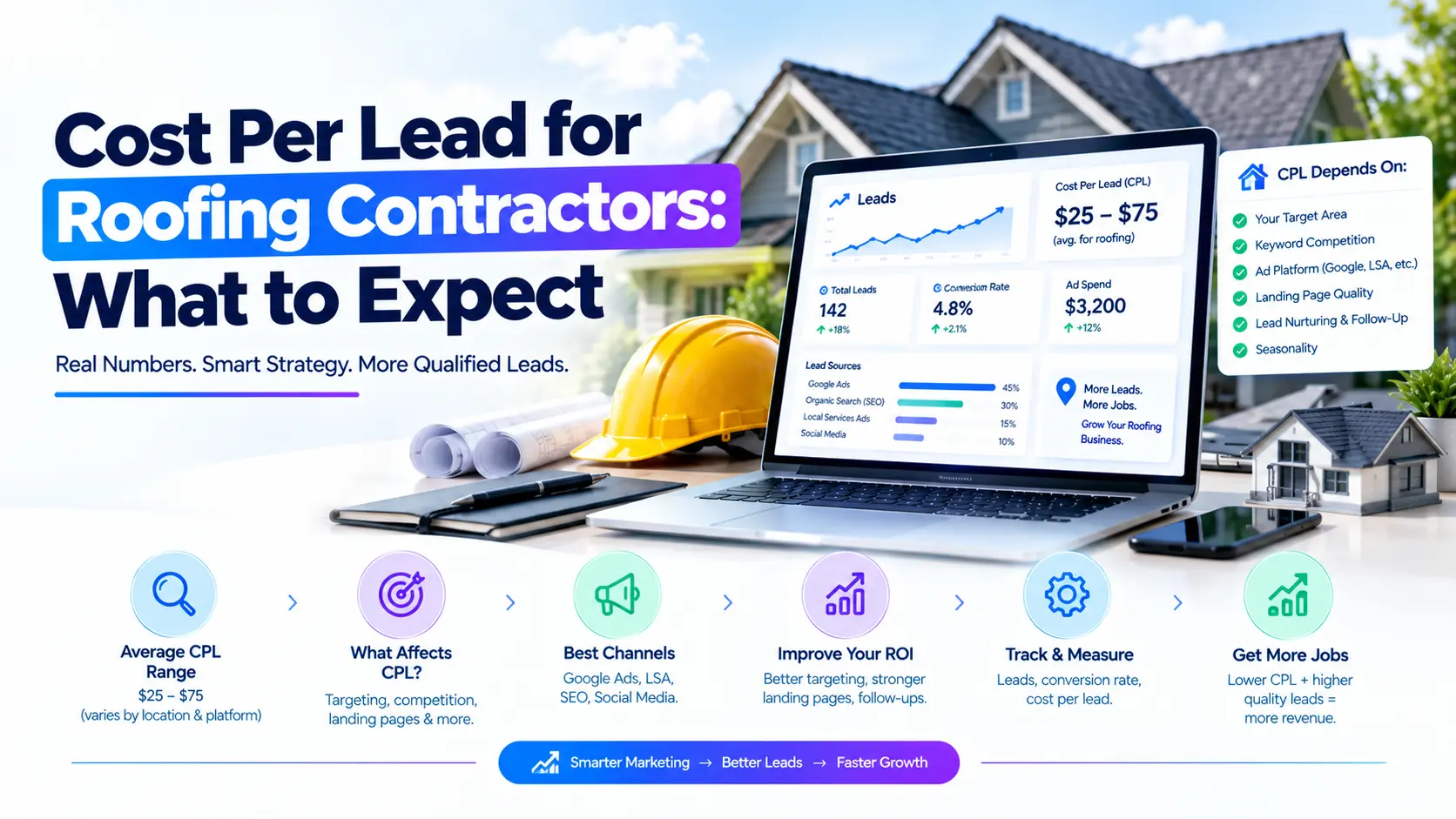
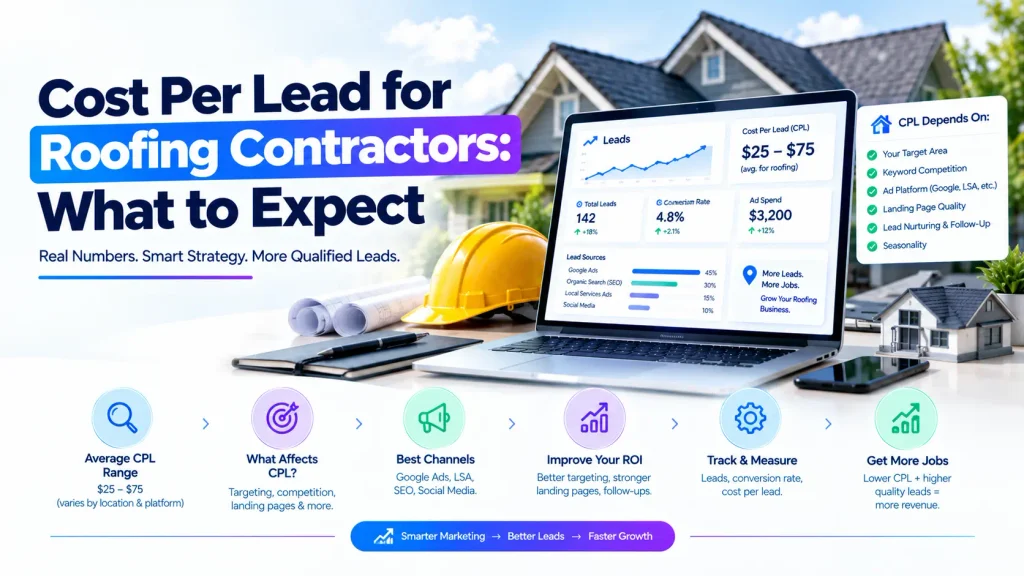
If you run a roofing company, one question quickly becomes important: how much should you pay for a new roofing lead? The answer is not as simple as choosing one industry-wide number. The cost per lead for roofing contractors can change significantly based on your location, service type, competition, marketing channel, lead quality, and conversion rate.
A roofing company targeting a competitive metropolitan area may pay considerably more for a lead than a contractor operating in a smaller market. Likewise, a roof replacement lead with strong buying intent can be worth far more than a low-quality inquiry that never answers the phone.
In my SEO and digital marketing work, I always recommend looking beyond the headline CPL. A cheaper lead is not automatically better. What matters is whether that lead becomes an estimate, a signed contract, and eventually profitable revenue.
Current search advertising benchmarks show why this matters. LocaliQ’s analysis of 3,211 U.S.-based home-services search advertising campaigns found a median cost per lead of $228.15 for roofing & gutters, compared with $90.92 across home services overall. The same dataset reported a $10.70 average CPC and 3.70% conversion rate for Roofing & Gutters. These figures are benchmarks, not guarantees for an individual roofing company.
So, what should roofing contractors expect?
Let’s break down the numbers, the factors that affect roofing lead costs, and how to determine whether your marketing is actually profitable.
What Is the Cost Per Lead for Roofing Contractors?
The cost per lead for roofing contractors is the amount your business spends to generate one potential customer. The basic formula is
Cost Per Lead = Total Marketing Spend ÷ Number of Leads Generated
For example, suppose your roofing company spends $3,000 on Google Ads and receives 20 leads.
$3,000 ÷ 20 = $150 per lead
That $150 figure is your roofing cost per lead for that campaign. However, there is an important distinction between a lead and a qualified roofing lead.
A form submission from someone outside your service area is technically a lead. So is a homeowner asking for a job you do not offer. But neither necessarily represents a valuable sales opportunity. A better measurement system tracks several stages
Lead → Qualified Lead → Appointment → Estimate → Sale
This gives you a much clearer picture of your actual roofing lead acquisition cost. Google Ads also distinguishes cost per conversion from other advertising metrics. Google defines cost per conversion as the average cost of each tracked conversion, calculated from advertising cost and recorded conversions.
What Is the Average Cost Per Lead for Roofing Contractors?
There is no single universal average roofing lead cost because different sources produce different types of leads. For paid search, however, current benchmark data provides a useful planning reference.
LocaliQ’s 2025 home-services search advertising benchmark analyzed 3,211 U.S.-based search advertising campaigns that ran from April 1, 2024, through March 21, 2025. Its Roofing & Gutters category reported:
| Metric | Roofing & Gutters Benchmark |
| Cost per lead | $228.15 |
| Cost per click | $10.70 |
| Conversion rate | 3.70% |
| Click-through rate | 5.66% |
The data uses median figures to reduce the influence of unusually large accounts. That does not mean every roofing contractor should target exactly $228.15. Your roofing contractor cost per lead should ultimately be judged against your own sales economics.
Benchmarks are reference points, not performance guarantees.
How Much Does a Roofing Lead Cost?
The answer depends heavily on the marketing channel. A roofing company can generate leads through:
- Google Search Ads
- Google Local Services Ads
- Google Maps
- Organic SEO
- Social media advertising
- Roofing directories
- Referrals
- Email marketing
- Content marketing
- Direct mail
- Partnerships
Each channel has a different cost structure.
Roofing Leads From Google Ads
Google Ads can produce highly relevant roofing sales leads because users are actively searching for services.
Someone searching for:
“roof replacement company near me”
has different intent from someone casually watching roofing content on social media. That high intent can make search advertising valuable, but competition can also make roofing PPC expensive.
The LocaliQ benchmark reported Roofing & Gutters as the highest-CPL home-services category in its 2025 dataset, at $228.15 per lead.
This makes proper campaign management extremely important. Your roofing PPC campaign should focus on:
- High-intent keywords
- Specific service areas
- Relevant landing pages
- Negative keywords
- Strong calls to action
- Call tracking
- Form tracking
- Accurate conversion measurement
Roofing Leads From Local Services Ads
Google Local Services Ads operate differently from traditional search campaigns. Instead of primarily paying for clicks, eligible advertisers can receive leads directly through the platform.
This can make local services ads an important channel for local roofing companies, particularly when the business wants phone calls and service inquiries. However, lead quality still matters. A lead is not valuable simply because Google recorded it as a lead.
You should track:
LSA lead → qualified lead → appointment → estimate → closed job
That tells you your real cost per customer.
Roofing Leads From SEO
SEO has a different economic model. With paid advertising, you generally pay whenever the advertising platform generates measurable interactions or conversions.
With SEO, you invest in creating and maintaining assets such as:
- Roofing service pages
- Location pages
- Helpful roofing guides
- Google Business Profile optimization
- Internal links
- Local citations
- Digital PR
- Relevant backlinks
- Technical SEO improvements
Once these assets generate organic visibility, they can continue attracting organic roofing leads without the direct media cost associated with every paid click. That does not make SEO free. You still pay for strategy, content, technical work, link acquisition, tools, and ongoing optimization.
But over time, SEO can change the economics of roofing lead generation because you are building an owned organic acquisition channel.
Roofing Cost Per Lead by Marketing Channel
Here is a practical framework for comparing your lead sources:
| Channel | How You Usually Pay | Intent | Main Advantage | Main Challenge |
| Google Search Ads | Per click | High | Immediate visibility | Competitive CPCs |
| Local Services Ads | Per lead | High | Direct inquiries | Lead quality varies. |
| SEO | Ongoing investment | Medium–high | Long-term organic traffic | Takes time |
| Google Maps | SEO/GBP investment | High local intent | Strong local visibility | Requires local authority |
| Facebook/Instagram Ads | Per impression/click | Low–medium | Large audience | Lower immediate intent |
| Referrals | Relationship-based | High | Strong trust | Harder to scale |
| Directories | Subscription/lead fees | Medium–high | Existing demand | Shared or variable lead quality |
The right strategy is often a combination rather than one channel.
What Factors Affect Roofing Lead Costs?
Several variables can change the cost of roofing leads.
1. Location and Competition
Location is one of the biggest factors. A roofing company competing in a large metropolitan market may face more advertisers bidding on the same commercial keywords.
The number of competitors, average household value, demand, population, and local search behavior can all influence advertising economics. Your roofing advertising cost therefore needs to be evaluated within your actual service area.
2. Type of Roofing Service
Not every roofing keyword represents the same customer value.
Compare:
- Roof repair
- Roof replacement
- Emergency roof repair
- Commercial roofing
- Storm damage to roofing
- Roof inspection
These searches can have different levels of urgency and commercial intent. A campaign focused on high-value roof replacement may tolerate a higher roofing contractor cost per lead than a campaign selling smaller repair jobs.
3. Keyword Competition
Commercial keywords can be expensive because multiple roofing companies want the same customers.
Examples include:
- Roofing contractor near me
- Roof replacement near me
- Roof repair company
- Roofing company
- Emergency roof repair
Broad keywords can also produce irrelevant searches. This is why I recommend combining keyword research with negative keyword management.
For example, searches involving jobs, training, DIY instructions, or unrelated products may need to be excluded from paid campaigns.
4. Landing Page Conversion Rate
You can have excellent ads and still have expensive roofing leads if the landing page does not convert. Imagine two contractors. Contractor A gets 100 clicks and generates 3 leads. Contractor B gets the same 100 clicks and generates 8 leads.
Even if both contractors pay the same CPC, Contractor B will usually produce a lower CPL. Your landing page should make the next step obvious.
Include:
- Clear service information
- Service-area details
- Strong trust signals
- Reviews
- Before-and-after examples
- Licensing or credential information where applicable
- Simple contact forms
- Click-to-call functionality
- Clear estimate requests
5. Lead Follow-Up Speed
Generating roofing leads is only half the job. If a homeowner submits a form and nobody responds promptly, the marketing investment can be wasted. This is where roofing lead follow-up becomes important.
A CRM can help your team track:
- New leads
- Contact attempts
- Appointments
- Estimates
- Follow-ups
- Closed deals
- Lost opportunities
Automated reminders and roofing lead follow-up automation can also reduce the number of inquiries that disappear because nobody followed up.
What Is a Good CPL for Roofing Contractors?
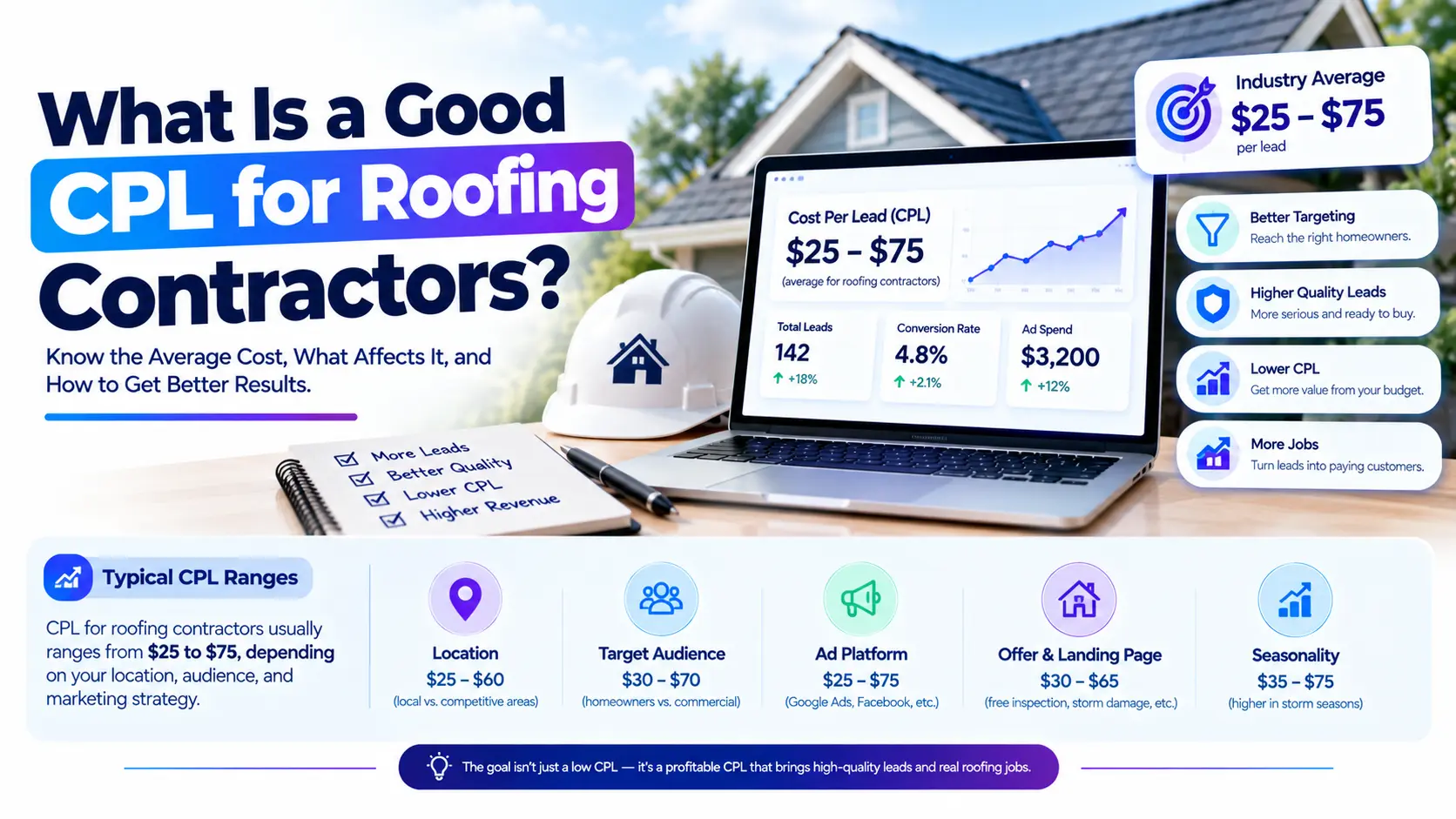
There is no universal “good” CPL. Instead, calculate your maximum acceptable lead cost from your actual sales numbers.
Suppose:
- Average roofing job = $12,000
- Gross profit after direct job costs = $4,000
- Lead-to-customer rate = 10%
If you need 10 leads to generate one customer, and each lead costs $150:
10 × $150 = $1,500 acquisition cost
That leaves approximately $2,500 of gross profit before other operating and marketing costs. Now consider a different scenario.
Your CPL falls to $75, but only 3% of leads become customers. You need roughly 34 leads for one customer.
34 × $75 = $2,550
The cheaper lead is not necessarily the better lead. This is why I prefer tracking cost per customer, not just cost per lead.
How to Calculate Your Maximum Affordable Roofing CPL
You can also work backward from your customer economics. A simple planning formula is
Maximum CPL = Gross Profit Per Customer × Lead-to-Customer Rate
For example:
$4,000 gross profit × 10% close rate = $400
This gives you a theoretical maximum before considering other operating costs, sales expenses, cancellations, overhead, and your desired profit margin.
The number you actually target should therefore be based on your complete business economics rather than an industry benchmark alone.
How to Calculate Roofing Customer Acquisition Cost
Your roofing customer acquisition cost, or CAC, measures what you spend to acquire an actual customer. A simple formula is
CAC = Total Marketing and Sales Acquisition Cost ÷ Number of New Customers
For example:
$6,000 marketing spend ÷ 4 new customers = $1,500 CAC
You can take this analysis further by calculating:
Cost Per Estimate
and
Cost Per Closed Job
These metrics often tell you much more than CPL alone. Google recommends using conversion tracking and conversion values to understand which ads and keywords generate valuable actions and to measure the business impact of advertising.
How to Reduce Roofing Cost Per Lead
If your roofing lead costs are too high, do not immediately slash your advertising budget. First, identify where the problem exists.
Improve Keyword Targeting
Separate campaigns by service and intent.
For example:
- Roof replacement
- Roof repair
- Storm damage
- Commercial roofing
- Emergency roofing
This makes it easier to align ads and landing pages with search intent.
Improve Your Landing Pages
Your landing page should answer three questions quickly:
What do you offer?
Where do you offer it?
Why should the homeowner contact you?
Remove unnecessary distractions and make the estimate request simple.
Strengthen Local SEO
A strong local SEO strategy for roofing contractors can help reduce dependence on paid acquisition over time.
Focus on:
- Complete Google Business Profile information
- Accurate service categories
- Relevant service descriptions
- Consistent business information
- Customer reviews
- High-quality photos
- Local service pages
- Helpful location-specific content
Google states that local results are mainly based on relevance, distance, and prominence. It also recommends keeping business profile information complete and accurate.
Build Roofing Service Pages
Instead of sending every visitor to your homepage, create dedicated pages for important services.
Examples include:
- Roof Replacement
- Roof Repair
- Storm Damage Roofing
- Commercial Roofing
- Emergency Roofing
- Roof Inspections
These pages can support both paid campaigns and roofing SEO.
Improve Lead Qualification
Not every inquiry deserves the same follow-up process.
Ask useful qualification questions such as
- What type of roofing service do you need?
- Where is the property located?
- Is this residential or commercial?
- Is the roof currently leaking?
- Are you requesting repair or replacement?
- When would you like the work completed?
This can help your team prioritize genuine opportunities.
How Can Roofing Contractors Improve Lead Quality?
Reducing CPL is not always the best way to improve your marketing. A better goal is to increase the percentage of leads that become genuine sales opportunities.
Start by reviewing:
Lead → Qualified Lead → Appointment → Estimate → Sale
Then identify where the largest drop-off occurs. If you receive many leads but few appointments, the issue may be follow-up or lead qualification.
If you receive appointments but few estimates, the issue may be service fit, sales process, or lead quality. If you receive estimates but few closed jobs, the issue may be pricing, sales execution, competition, or the quality of the opportunities entering the funnel.
This is why roofing lead quality should be evaluated alongside CPL.
Exclusive Roofing Leads vs. Shared Roofing Leads
Lead source matters as much as lead price. An exclusive lead is generally sent to one contractor. A shared lead may be distributed to multiple companies.
That creates an important comparison:
| Lead Type | Potential Benefit | Potential Risk |
| Exclusive roofing lead | Less direct competition | Higher price |
| Shared roofing lead | Lower upfront cost | Multiple contractors may contact the homeowner |
| Organic lead | No direct per-lead ad fee | Requires SEO investment |
| Referral lead | Strong trust | Limited scalability |
| Paid search lead | High commercial intent | Can be expensive |
When evaluating exclusive vs. shared roofing leads, do not compare only the purchase price.
Compare the percentage that becomes:
Qualified → Contacted → Appointment → Estimate → Sale
That is where the real economics appear.
How Much Should Roofing Contractors Spend on Lead Generation?
Your roofing marketing budget should be based on capacity and unit economics. Start with your target number of new customers. For example, suppose you want 10 new customers per month and historically close 10% of qualified leads.
You need approximately:
10 customers ÷ 10% close rate = 100 qualified leads
If your qualified roofing lead cost is $150:
100 × $150 = $15,000
That gives you a starting acquisition budget. But you should also account for your sales capacity. There is little value in generating 100 leads if your team can only inspect 30 roofs per month.
Your marketing budget should therefore consider:
- Sales capacity
- Crew capacity
- Average job value
- Gross margin
- Close rate
- Lead quality
- Service area
- Seasonality
- Available cash flow
Roofing PPC vs. Roofing SEO: Which Should You Use?
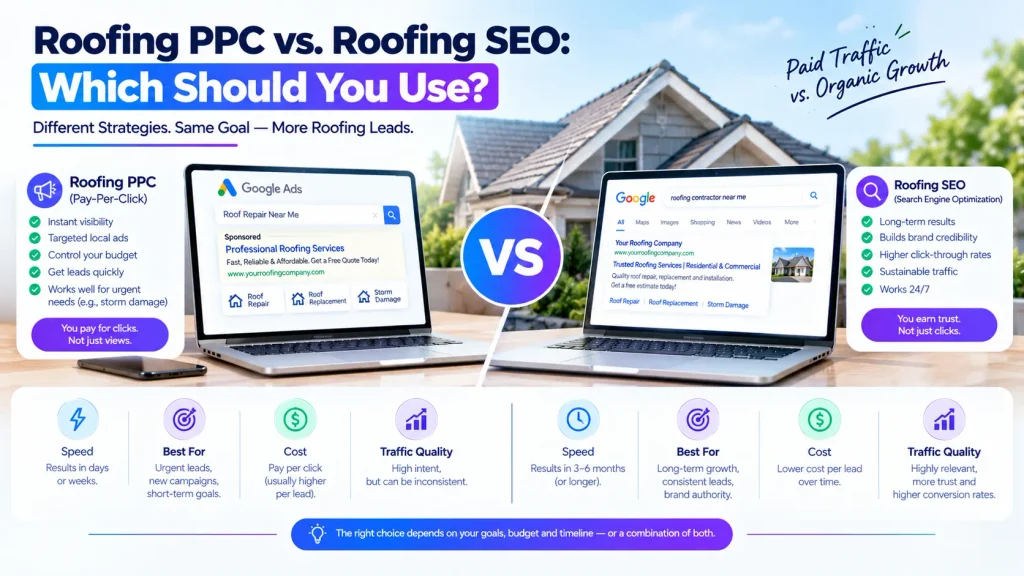
The two channels solve different problems.
Roofing PPC
Advantages:
- Faster visibility
- High commercial intent
- Greater control over targeting
- Immediate testing opportunities
- Easier to scale or reduce spending
Disadvantages:
- Clicks can be expensive.
- Results depend on campaign management
- Traffic generally stops when spending stops.
- Competitive markets can increase CPL.
Roofing SEO
Advantages:
- Builds long-term organic visibility
- Can generate organic roofing leads
- Supports Google Maps visibility
- Creates reusable website assets
- Can reduce dependence on paid traffic
Disadvantages:
- Takes time to build authority
- Requires ongoing optimization
- Results are not guaranteed.
- Competitive markets require stronger execution.
For many roofing companies, the practical solution is not choosing between them. It is building a system where PPC captures immediate demand while SEO and local search build longer-term visibility.
The Roofing Lead Metrics You Should Track
Do not stop at CPL. Your dashboard should include:
| Metric | Why It Matters |
| Impressions | Shows search visibility |
| CTR | Measures ad engagement |
| CPC | Shows click cost |
| Conversion rate | Shows traffic-to-lead efficiency |
| CPL | Shows acquisition cost per lead |
| Qualified lead rate | Measures lead quality. |
| Appointment rate | Shows sales team performance |
| Estimate rate | Measures serious opportunities |
| Close rate | Shows sales effectiveness |
| Cost per customer | Measures acquisition efficiency |
| Average job value | Measures revenue potential |
| ROI/ROAS | Connects marketing to financial results |
Google’s documentation specifically recommends conversion tracking to understand which ads, listings, and keywords generate meaningful actions. Conversion values can also help measure the business value generated by campaigns.
A Simple Roofing Lead Cost Checklist
Before deciding whether your roofing lead generation cost is too high, check these questions:
- Are you tracking phone calls?
- Are you tracking form submissions?
- Are duplicate leads being removed?
- Are spam submissions filtered?
- Are leads inside your service area?
- Are you separating qualified and unqualified leads?
- Are you tracking booked appointments?
- Are you tracking estimates?
- Are you tracking closed jobs?
- Do you know your average job value?
- Do you know your close rate?
- Do you know your cost per customer?
- Are your Google Ads conversion actions configured correctly?
- Are your landing pages relevant to the keywords?
- Are you using negative keywords?
- Is your Google Business Profile complete?
- Are you actively collecting legitimate customer reviews?
- Are you investing in roofing service pages?
- Are leads receiving fast follow-up?
If you cannot answer several of these questions, your CPL dashboard may not tell the complete story.
FAQ: Cost Per Lead for Roofing Contractors
How much does a roofing lead cost?
The cost of roofing leads varies by market and acquisition channel. LocaliQ’s 2025 U.S. search advertising benchmark reported a $228.15 median CPL for Roofing & Gutters. Individual campaigns can be substantially higher or lower depending on competition, targeting, conversion rate, and lead quality.
What is a good cost per lead for roofing?
A good roofing CPL depends on your close rate, average job value, gross margin, and lead quality. Instead of using one industry number, calculate the maximum amount you can spend to acquire a customer profitably.
Why are roofing leads so expensive?
Roofing leads can be expensive because roofing services often involve high-value projects and competitive search terms. Multiple contractors may compete for the same homeowner searches, increasing advertising costs.
How can roofing companies lower cost per lead?
Roofing companies can lower CPL by improving keyword targeting, landing-page conversion rates, negative keyword lists, local SEO, ad relevance, conversion tracking, and lead follow-up. Improving lead quality can be more valuable than simply reducing advertising spend.
Is Google Ads worth it for roofing contractors?
Google Ads can provide access to high-intent searches, but profitability depends on campaign economics. Track qualified leads, estimates, closed jobs, customer acquisition cost, and revenue rather than evaluating Google Ads only by clicks or CPL.
Is SEO cheaper than Google Ads for roofing?
SEO does not have a direct cost for every organic click, but it requires ongoing investment in content, technical SEO, local optimization, and authority building. Its economics should be evaluated over a longer period than paid search.
How do you calculate roofing customer acquisition cost?
Divide your total marketing and sales acquisition costs by the number of new customers acquired during the same period. For example, $6,000 in acquisition spending and four new customers produce a $1,500 customer acquisition cost.
What is the difference between CPL and CAC?
CPL measures the cost of generating a lead. CAC measures the cost of acquiring an actual customer. A roofing company can have a low CPL but a high CAC if many leads fail to become paying customers.
Conclusion: Focus on Profitable Roofing Leads, Not Just Cheap Leads
The cost per lead for roofing contractors can vary widely, so there is no single CPL that automatically defines success.
Current U.S. search advertising data shows why roofing deserves careful budgeting. LocaliQ reported a $228.15 median CPL for Roofing & Gutters in its 2025 home-services search advertising benchmark. The benchmark also reported a $10.70 CPC and 3.70% conversion rate for the category. These figures should be treated as planning references rather than promises for an individual roofing company.
The better approach is to connect every marketing dollar to the sales funnel:
Ad or SEO traffic → Lead → Qualified Lead → Appointment → Estimate → Customer → Revenue
If your roofing company generates leads for $100 but closes very few jobs, that $100 may be expensive. If you generate leads for $200 and consistently turn them into profitable roof replacements, the higher CPL may make economic sense.
That is why I recommend measuring roofing lead quality, cost per estimate, cost per customer, close rate, and ROI alongside CPL.
Start by auditing your current lead sources. Identify which channels produce qualified roofing leads, which keywords generate actual opportunities, and where prospects are dropping out of the funnel. Then improve the weakest stage.
For a roofing company, sustainable growth rarely comes from simply buying more leads. It comes from building a complete acquisition system that combines roofing SEO, local search, paid advertising, conversion optimization, accurate tracking, and fast lead follow-up. When you know what a lead is worth, you can make smarter decisions about what you are willing to pay for one.
About the Author
Jawaria is an SEO and digital marketing professional focused on helping small and mid-sized businesses improve organic visibility, lead generation, website performance, and digital growth. Through HQ Growth Lab, she focuses on practical SEO, web development, AI automation, and digital marketing strategies designed to help businesses build, rank, and scale.