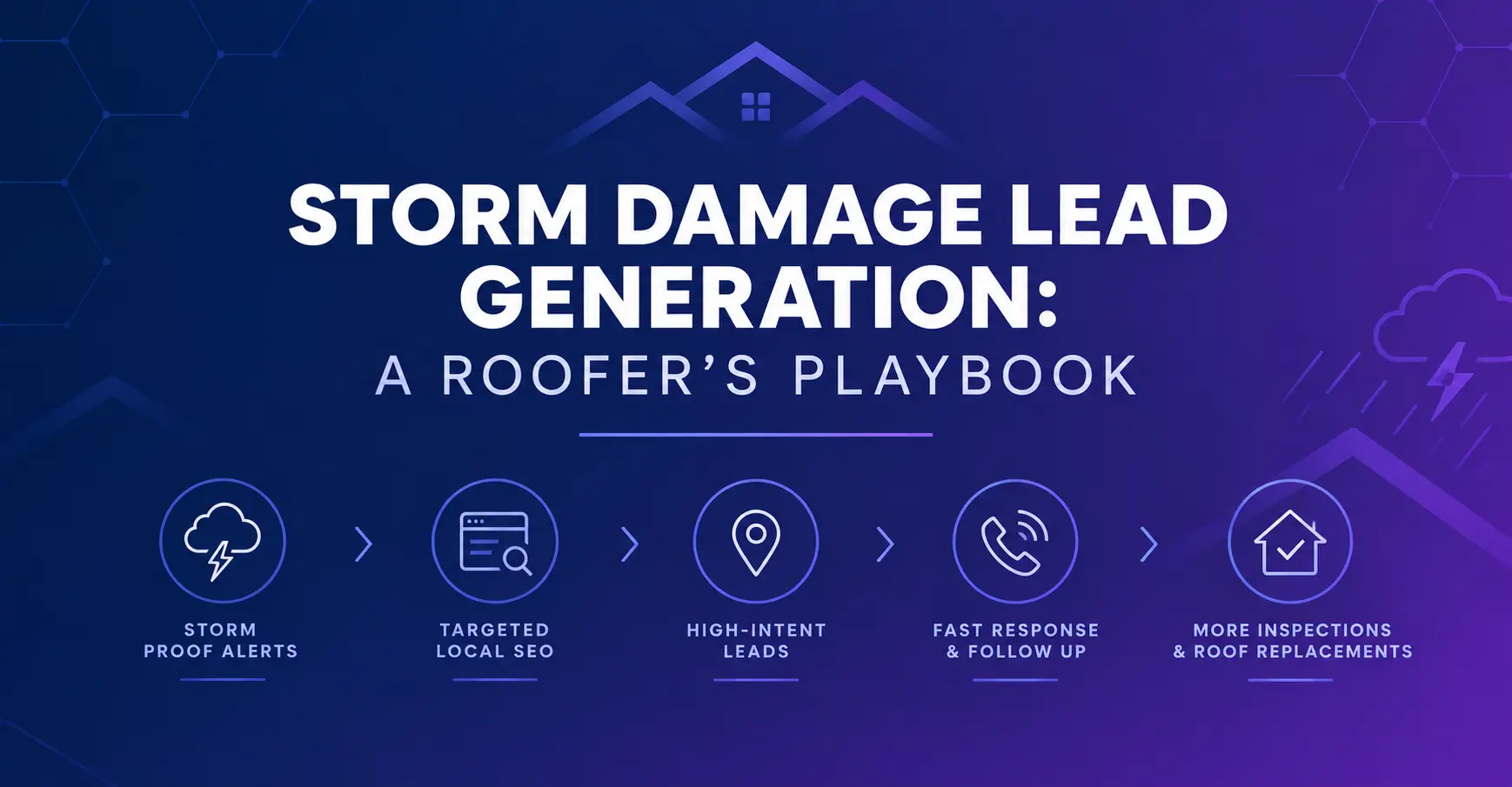
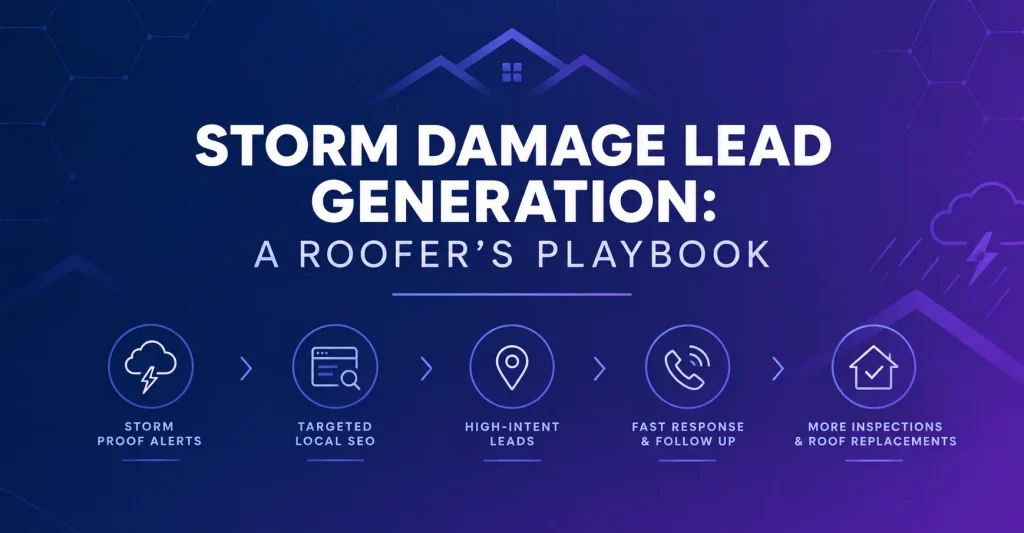
When a major hailstorm, windstorm, tornado, or severe weather event hits a local area, storm damage lead generation can become one of the fastest ways for a roofing company to capture urgent local demand.
Homeowners who were not thinking about their roofs yesterday may suddenly search for storm damage roof repair, inspections, emergency repairs, or a roofing contractor near them.
That creates a major opportunity for roofing companies. However, the companies that win these leads are not always the ones with the biggest advertising budgets.
In my experience with local SEO and lead generation, the strongest storm campaigns combine speed, local visibility, trust, conversion, and follow-up. A roofer needs to appear when demand rises, give homeowners a clear reason to choose the company, and respond before the lead goes cold. That is the real purpose of storm damage lead generation.
It is not simply about generating more phone calls. It is about attracting qualified roofing leads, turning those leads into inspections and estimates, and converting profitable opportunities into completed roofing jobs.
This playbook explains how to build that system using local SEO, Google Business Profile, Google Maps, Local Services Ads, Google Ads, storm-specific landing pages, content, reviews, CRM automation, and fast follow-up.
What Is Storm Damage Lead Generation for Roofers?
Storm damage lead generation is the process of attracting and converting homeowners who need roofing services after severe weather. Storm-related demand can come from several situations, including:
- Hail damage
- Wind damage
- Fallen trees or branches
- Heavy rain
- Tornado damage
- Hurricane damage
- Missing shingles
- Roof leaks
- Structural roof damage
- Emergency roof repairs
- Roof replacement after a storm
A homeowner might search for:
“storm damage roofer near me”
Or:
“Hail damage roof repair”
Or:
“roof inspection after storm”
These searches often have strong commercial intent because the homeowner may already have a problem that needs attention. However, the search is only the beginning. A successful lead generation system should move the homeowner through a clear process:
Search → Click → Call/Form → Qualification → Inspection → Estimate → Follow-Up → Job → Revenue
If your marketing only tracks the first step, you may think you are generating great results when your sales team is actually receiving low-quality opportunities.
Why Storm Damage Leads Are Different
Storm damage leads can arrive in concentrated bursts.
A normal roofing campaign might generate demand steadily throughout the month. A major storm can create a large increase in searches within a short period in an affected market. That creates both opportunity and competition.
Roofers may increase their advertising. Homeowners may compare several contractors. Search results can become more competitive, while calls and inquiries increase. This makes preparation important.
Your storm damage roofing marketing should be ready before the storm happens rather than being built from scratch afterward.
How Do Roofers Get Leads After a Storm?
The best roofing companies do not rely on one acquisition channel. Instead, they build several paths that capture homeowners at different stages of the buying journey.
| Lead Source | Best For | Speed | Long-Term Value |
| Google Maps | Local discovery | Fast | High |
| Local SEO | Organic local demand | Medium | High |
| Roofing SEO | Long-term visibility | Slow | Very high |
| Local Services Ads | High-intent leads | Fast | Medium |
| Google Ads | Specific searches | Fast | Medium |
| Storm landing pages | High-intent traffic | Medium | High |
| Reviews | Trust and conversion | Medium | High |
| Referrals | Trust-based leads | Variable | High |
| CRM follow-up | Lead conversion | Fast | Very high |
| Email/SMS nurturing | Unconverted opportunities | Medium | High |
The goal is not to use every channel blindly. Each channel should have a specific job. For example, local services Ads can help capture immediate demand, while roofing SEO builds organic visibility over time.
Your Google Business Profile can support local discovery, while reviews can reduce homeowner hesitation. Your CRM then helps ensure that expensive leads do not disappear because nobody followed up.
How to Prepare Your Roofing Business Before the Storm
One of the biggest mistakes I see is waiting until after a storm to start marketing. By then, competitors may already have:
- Strong Google rankings
- Established Google Business Profiles
- Hundreds of legitimate reviews
- Storm-related service pages
- Advertising campaigns
- CRM workflows
- Trained sales teams
- Inspection processes
You can still compete, but preparation gives you an advantage.
Create Dedicated Storm Damage Services
Your website should clearly communicate the storm-related services your company actually provides. Depending on your qualifications and service area, these may include:
- Storm damage roof inspection
- Hail damage inspection
- Wind damage repair
- Emergency roof repair
- Roof leak repair
- Roof replacement
- Storm restoration
- Storm-related documentation support
Do not create services simply because they contain valuable keywords. Every service you advertise should represent work your company is qualified, licensed, insured, and equipped to perform.
How to Optimize Google Business Profile for Storm Damage Leads
For local roofing companies, Google Business Profile is one of the most important assets in the lead-generation system. A complete and accurate profile can help customers discover and contact your business through Google Search and Maps.
Google explains that local results are primarily influenced by relevance, distance, and prominence. Your profile should accurately represent:
- Business name
- Primary category
- Services
- Service areas
- Phone number
- Website
- Business hours
- Reviews
- Photos
- Business description
Add Relevant Roofing Services
Include legitimate services that your company actually provides. Examples include
- Roof repair
- Roof replacement
- Hail damage repair
- Storm damage repair
- Emergency roofing
- Roof inspection
Avoid keyword stuffing. Your business profile should help customers understand what you do rather than simply repeat keywords.
Build Reviews Before Storm Season
Reviews are more than a branding asset. They can influence whether a homeowner feels comfortable contacting your company. Build a consistent review-generation process throughout the year.
After completing legitimate jobs, ask satisfied customers to leave honest feedback. Do not manufacture reviews or use misleading incentives. The goal is to build genuine evidence that your company delivers quality work.
How to Create High-Converting Storm Damage Roofing Landing Pages
Your homepage should not be responsible for every storm-related search. Create dedicated pages around the services and problems you actually solve.
For example:
- /storm-damage-roofing/
- /hail-damage-roof-repair/
- /wind-damage-roof-repair/
- /emergency-roof-repair/
- /storm-damage-roof-inspection/
The exact URL structure should depend on your website architecture and target locations.
What Should a Storm Damage Landing Page Include?
A strong page should answer the homeowner’s immediate questions.
Include:
- The storm damage you repair
- Signs of roof damage
- What your inspection includes
- Your service area
- What happens after someone contacts you
- Real project photos
- Reviews or testimonials
- Relevant credentials
- Clear contact options
- A strong call to action
The next step should be obvious.
For example:
Schedule a Storm Damage Roof Inspection
is more specific than:
Learn More
How Does Local SEO Generate Storm Damage Roofing Leads?
Local SEO helps roofing businesses compete for searches connected to geographic intent.
Examples include
- storm damage to the roofer near me
- emergency roofer near me
- hail damage to the roofer in Dallas
- storm damage roof repair Houston
- roof inspection after a storm
- wind damage roof repair Austin
The exact searches will vary by market. Your job is to understand what homeowners actually search for and create useful pages that match those needs.
A strong local SEO strategy can include:
- Google Business Profile optimization
- Dedicated service pages
- Useful location pages
- Local citations
- Relevant local links
- Review generation
- Internal linking
- Helpful storm-damage content
- Strong conversion paths
- Accurate business information
Local SEO is not simply about adding a city name to every page. It is about proving relevance, building local prominence, and giving searchers a useful experience.
What Keywords Should Roofers Target After a Storm?
Not every roofing keyword has the same intent.
Someone searching:
“How to identify hail damage on shingles”
may still be researching.
Someone searching:
“Hail damage roof repair near me”
is much closer to contacting a roofing company. Your keyword strategy should cover different stages of the customer journey.
Informational Keywords
Examples include
- How to tell if your roof has storm damage
- Signs of hail damage on roof
- What wind damage looks like on shingles
- Should I inspect my roof after a storm?
- How to check roof after hail
Commercial Keywords
Examples include
- storm damage roofing company
- hail damage roofing contractor
- storm damage roof inspection
- wind damage roof repair
- emergency roof repair
Transactional Keywords
Examples include
- storm damage to the roofer near me
- hail damage roof repair near me
- emergency roofer near me
- storm damage roof replacement
- roof repair after storm
This structure allows your website to attract homeowners before and during the buying decision.
How to Build a Storm Damage Content Cluster
A single storm damage service page is rarely enough to cover every related search. Create supporting content around the questions homeowners ask before hiring a roofer.
Pillar Page
Supporting Content
Storm Damage Lead Generation: A Roofer’s Playbook
- How to Generate Storm Damage Roofing Leads
- How to Get Hail Damage Roofing Leads
- How to Generate Emergency Roofing Leads
- How Much Do Storm Damage Roofing Leads Cost?
- What Does Hail Damage Look Like on a Roof?
- How Long Does Storm Damage Roof Repair Take?
- Does Homeowners Insurance Cover Storm Damage?
- What Should Homeowners Do After a Hailstorm?
- How to Choose a Storm Damage Roofing Contractor
- Wind Damage vs. Hail Damage: What’s the Difference?
These articles can internally link back to your core service pages. This creates a stronger relationship between informational content and commercial pages.
How Can Google Ads and Local Services Ads Generate Storm Leads?
Organic SEO takes time. Storm-related demand may not wait. Paid search can help capture high-intent demand when homeowners are actively searching for roofing services. Depending on your market and eligibility, roofing companies may use Google Ads and Local Services Ads.
Match Ads to Search Intent
Instead of sending every paid visitor to your homepage, create relevant landing experiences.
For example:
Hail Damage Search → Hail Damage Landing Page
Emergency Roof Repair Search → Emergency Roof Repair Page
Storm Damage Search → Storm Damage Roofing Page
This improves message consistency. The homeowner searches for a specific problem and immediately sees a page that addresses it.
Use Local Services Ads Carefully
Local Services Ads can be useful for eligible roofing businesses because they are designed around local service demand. However, do not evaluate them based only on lead volume.
Track:
- Total leads
- Valid leads
- Qualified leads
- Appointments
- Inspections
- Estimates
- Closed jobs
- Revenue
- Customer acquisition cost
- Gross profit
Respond Quickly
Speed matters. If you are paying for leads, your business needs the capacity to receive and respond to them. A lead that arrives in the afternoon and receives no response until the next morning may already be speaking with another contractor.
How to Qualify Storm Damage Roofing Leads
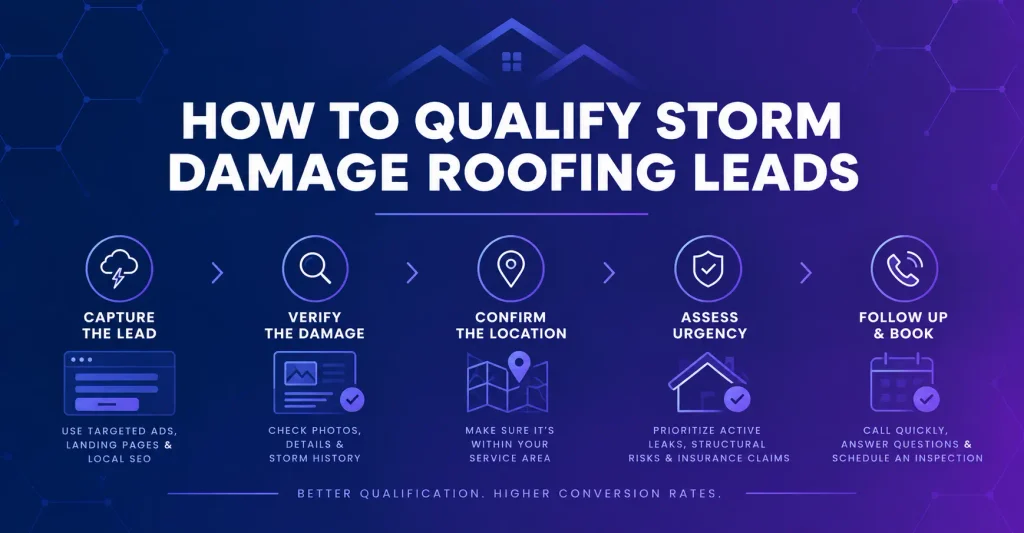
Not every storm damage lead is a good lead. A qualification process helps your team prioritize opportunities.
Ask questions such as:
- What type of damage occurred?
- When did the storm happen?
- What city is the property in?
- Is the roof currently leaking?
- Is the property residential or commercial?
- Has the homeowner contacted their insurer?
- Is an inspection already scheduled?
- What type of roofing system is involved?
- Is the homeowner looking for repair or replacement?
- Can your company legally and operationally serve the property?
Your team should avoid guaranteeing insurance coverage. Insurance policies differ by customer, location, and circumstances. Your role is to accurately document the roofing issue within your professional scope and explain the services your company provides.
How to Follow Up With Storm Damage Leads
Generating a lead is not the same as converting one. Your sales process should define exactly what happens after a new inquiry arrives. A simple workflow looks like this:
New Lead
↓
Immediate Call Attempt
↓
SMS or Email Confirmation
↓
Qualification
↓
Inspection Scheduled
↓
Inspection Completed
↓
Estimate Delivered
↓
Follow-Up
↓
Job Won or Lost
↓
Revenue Recorded
This is where a roofing CRM becomes valuable. Instead of storing leads in random spreadsheets, your team can track where every opportunity sits in the sales pipeline.
Automate Routine Follow-Up
Automation should support your sales team, not replace human communication. After a homeowner submits a form, your system could send:
Message 1: Confirmation
Message 2: Inspection scheduling instructions
Message 3: Appointment reminder
Message 4: Post-inspection follow-up
Message 5: Estimate follow-up
Message 6: Re-engagement message
This becomes especially valuable when storm-related lead volume suddenly increases. Automation ensures that every opportunity has a defined next step.
How to Create a Strong Storm Damage Inspection Offer
Your conversion offer should match the homeowner’s immediate problem.
Instead of a generic:
Contact Us
consider
Request a Storm Damage Roof Inspection.
or:
Schedule a Hail Damage Roof Inspection
The offer should be truthful and match what your company actually provides.
Explain:
- What the inspection covers
- Who performs it
- What the homeowner should expect
- What documentation is provided
- What happens next
- Whether there is a fee
Clarity reduces friction.
How Before-and-After Roofing Content Builds Trust
Storm damage is visual. That makes images extremely useful for both homeowners and roofing companies.
Show genuine examples of:
- Hail impacts
- Missing shingles
- Wind damage
- Damaged flashing
- Roof leaks
- Temporary repairs
- Completed replacements
Use genuine company work whenever possible. Do not use another company’s project photos and present them as your own. You can also create educational content explaining what homeowners should look for after severe weather. This can support both trust and organic search visibility.
How to Build a Storm-Ready Roofing Advertising Campaign
A storm-specific campaign should not be improvised after the weather event. Prepare your core assets beforehand.
Landing Pages
Prepare pages for:
- Storm damage roofing
- Hail damage repair
- Wind damage repair
- Emergency roofing
Ad Copy
Possible themes include:
- Storm Damage Roof Inspection
- Hail Damage Roof Repair
- Local Roofing Contractor
- Emergency Roof Repair
Conversion Assets
Make sure your website includes:
- Click-to-call buttons
- Lead forms
- Inspection requests
- Appointment scheduling
Trust Assets
Use legitimate:
- Reviews
- Certifications
- Licensing information
- Insurance information
- Project photos
- Local experience
Then scale the appropriate campaigns when demand increases.
How to Measure Storm Damage Lead Generation ROI
This is one of the most important parts of the entire strategy. Imagine two campaigns:
| Metric | Campaign A | Campaign B |
| Leads | 100 | 50 |
| Qualified leads | 25 | 35 |
| Inspections | 15 | 25 |
| Closed jobs | 5 | 12 |
| Marketing cost | $5,000 | $4,000 |
| Revenue | $20,000 | $48,000 |
Campaign A generated twice as many leads. However, Campaign B generated more qualified opportunities, more jobs, and more revenue. This is why I recommend measuring lead quality before celebrating lead volume. Your objective is profitable customer acquisition.
Calculate Your Storm Damage Lead Cost
Storm damage roofing lead costs vary by market, competition, service, channel, and lead quality. Instead of asking:
“How much does a roofing lead cost?”
ask:
“What can we profitably afford to pay for a qualified lead?”
A simplified calculation is:
Break-even CPL = Gross profit per completed job × Lead-to-customer conversion rate
For example:
If your average gross profit per job is $3,000 and 10% of qualified leads become customers:
$3,000 × 10% = $300
That gives you a simplified $300 break-even qualified CPL.
Your actual target should normally be lower after considering overhead, sales costs, cancellations, operational expenses, and other acquisition costs.
Track Revenue, Not Just Rankings
SEO reports often focus on:
- Rankings
- Impressions
- Clicks
- Traffic
- Keywords
These metrics matter.
But roofing companies ultimately need:
- Calls
- Inspections
- Estimates
- Jobs
- Revenue
- Profit
Your reporting should connect marketing with sales whenever possible:
Keyword → Landing Page → Lead → Qualified Lead → Inspection → Estimate → Closed Job → Revenue
This gives you a much clearer picture of which channels actually drive growth.
How to Convert Storm Damage Leads Into Roofing Customers
Getting the lead is only half the battle. Your sales process should make the next step simple.
Step 1: Respond Quickly
Try to contact the homeowner as soon as practical.
Step 2: Confirm the Problem
Understand whether they have visible damage, a leak, missing shingles, or another issue.
Step 3: Schedule the Inspection
Move the conversation toward a concrete appointment.
Step 4: Document the Damage
Use appropriate photos, measurements, notes, and inspection documentation.
Step 5: Explain the Recommended Work
Keep your explanation clear and easy to understand.
Step 6: Provide the Estimate
Make the scope, materials, timeline, and pricing clear.
Step 7: Follow Up
Many homeowners need time before making a decision. A structured follow-up system prevents valuable opportunities from disappearing.
How Should Roofers Handle Insurance-Related Storm Damage Leads?
Insurance can be part of the storm-damage conversation, but roofers need to be careful. Coverage depends on the homeowner’s policy, applicable exclusions, deductibles, the cause of loss, and other factors. Do not promise insurance approval.
Avoid statements such as
- “Your insurance will definitely pay.”
- “We’ll guarantee your claim.”
- “Everyone gets a free roof through insurance.”
Instead, explain what your company actually does.
For example:
“We inspect storm-related roof damage and provide documentation and repair estimates based on our findings. Insurance coverage depends on your policy and insurer.” This is clearer and more responsible.
Be Careful With Assignment of Benefits
Homeowners should understand any legal document they sign. Your marketing should never pressure homeowners into signing documents they do not understand. Trust is a competitive advantage, especially after a disaster.
How to Avoid Unethical Storm-Chasing Marketing Tactics
Storm damage creates vulnerable customers. That makes ethical marketing especially important.
Avoid:
- Misrepresenting your location
- Fake local addresses
- Fake reviews
- False urgency
- Misleading insurance promises
- Unlicensed work
- Fake credentials
- Pressure tactics
- Misleading “free roof” claims
- Pretending to represent an insurer
- Misleading lead-selling practices
Your storm damage marketing should accurately represent your company, services, qualifications, and service area. The best storm damage lead generation strategy is one you can sustain after the storm.
Build a Roofing Lead Generation Strategy That Works Beyond Storms
Storm damage can create a demand spike. However, your company should not depend entirely on storms. Build a broader roofing lead generation engine around:
- Roof replacement
- Roof repair
- Emergency roofing
- Commercial roofing
- Residential roofing
- Maintenance
- Inspections
- Hail damage
- Wind damage
- Local SEO
- Referrals
- Reviews
- Organic content
This creates a more stable acquisition system. Storm campaigns then become an accelerator rather than your entire business model.
What Are the Best Storm Damage Lead Generation Strategies?
For most roofing companies, I would prioritize the following:
| Strategy | Priority | Why |
| Google Business Profile | Very High | Local visibility |
| Storm service pages | Very High | Captures commercial intent |
| Local SEO | Very High | Builds organic demand |
| Reviews | Very High | Builds trust |
| Lead response system | Very High | Improves conversion |
| CRM tracking | Very High | Connects leads to revenue |
| Local Services Ads | High | Captures immediate demand |
| Google Ads | High | Targets specific searches |
| Storm content | High | Builds topical authority |
| Email/SMS follow-up | High | Recovers opportunities |
| Referral marketing | Medium | Builds trust-based leads |
| Social media | Medium | Supports awareness |
The right mix depends on your market, budget, capacity, service area, competition, and sales process.
Common Storm Damage Lead Generation Mistakes
1. Waiting Until After the Storm
Your competitors may already have the infrastructure in place. Build the foundation before demand spikes.
2. Buying Leads Without Tracking Quality
A cheap lead is not necessarily a profitable lead. Track the complete funnel.
3. Ignoring Google Maps
Local homeowners often look for nearby businesses. Your Google Business Profile deserves ongoing attention.
4. Sending Every Ad to the Homepage
A storm-damage search should usually lead to a storm-damage experience.
5. Responding Too Slowly
Speed can make the difference between a booked inspection and a lost opportunity.
6. Promising Insurance Results
Coverage is not something a marketing campaign can guarantee.
7. Using Fake Reviews
Fake reviews can destroy trust and create policy problems.
8. Ignoring Existing Leads
Many roofing companies spend money generating leads but fail to follow up consistently.
9. Measuring Traffic Instead of Revenue
Traffic is useful. Revenue is the business outcome.
10. Treating Every Storm the Same
A hailstorm, hurricane, tornado, and wind event can create different customer needs. Your messaging should reflect the actual event and services you provide.
Storm Damage Lead Generation Checklist
Use this checklist before storm season.
Google Business Profile
- Profile verified
- Business information accurate
- Correct service areas
- Roofing services listed
- Current photos
- Recent legitimate reviews
- Website connected
- Phone number working
Website
- Storm damage page
- Hail damage page
- Wind damage page
- Emergency roofing page
- Local service pages
- Strong calls to action
- Mobile-friendly design
- Fast loading
- Clear service areas
- Real project photos
SEO
- Local keyword research
- Internal linking
- Search intent mapping
- Location optimization
- Helpful storm content
- Local citations
- Relevant backlinks
- Search Console tracking
Paid Advertising
- Google Ads account ready
- Local Services eligibility checked
- Storm-related campaigns prepared
- Landing pages ready
- Conversion tracking active
- Call tracking configured
- Budget defined
- Lead quality monitored
Sales
- CRM configured
- Lead qualification questions
- Fast response process
- Inspection scheduling
- Estimate follow-up
- Automated reminders
- Lost-lead reactivation
- Revenue attribution
How I Would Build a Storm Damage Lead Generation Funnel
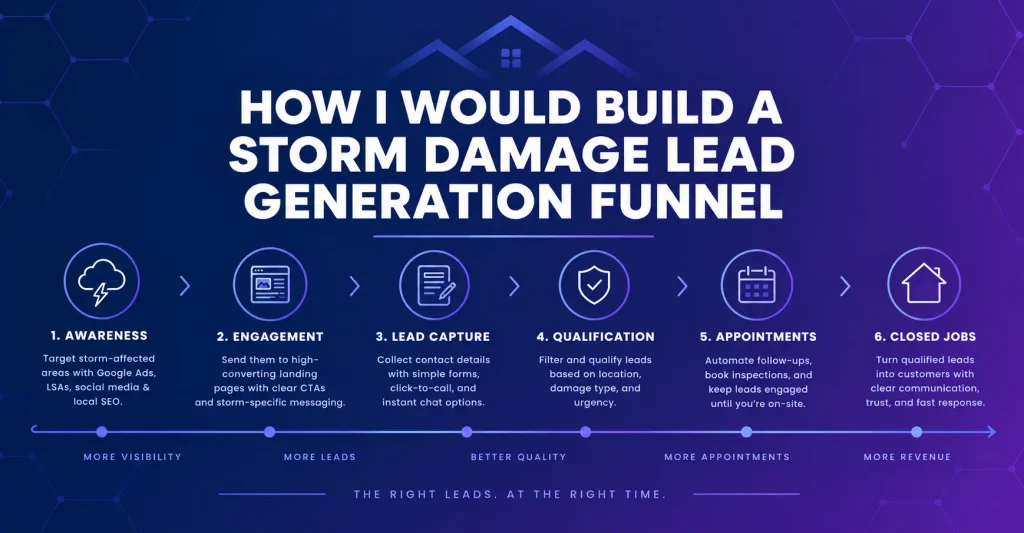
If I were building this system for a roofing company from scratch, I would structure it around four stages.
Top of Funnel
Target homeowners researching storm damage. Content could include:
- Storm damage guides
- Hail damage guides
- Roof inspection information
- Storm preparation content
Middle of Funnel
Target homeowners looking for solutions. Create content and landing pages around:
- Storm damage roofing
- Hail damage repair
- Wind damage repair
- Emergency roof repair
Bottom of Funnel
Target homeowners ready to contact a roofer.
Examples include
- storm damage to the roofer near me
- hail damage roof repair near me
- emergency roofer near me
- storm damage roof inspection
- roof repair near me
Conversion and Sales
Use:
- Phone calls
- Lead forms
- Inspection requests
- Appointment scheduling
Then move the lead through:
Lead → Qualification → Inspection → Estimate → Follow-Up → Closed Job
This is where marketing and sales become one system.
Should Roofers Use SEO or Paid Advertising for Storm Damage Leads?
I would not treat this as an either-or decision. Paid advertising is useful when you need to capture demand quickly. SEO is valuable when you want to build long-term visibility. A roofing company entering a competitive market may benefit from both.
| Goal | Better Starting Point |
| Need leads quickly | Paid search / eligible lead-based ads |
| Build long-term visibility. | SEO |
| Improve Maps presence. | Local SEO |
| Capture emergency searches. | Paid + local SEO |
| Reduce dependence on ads. | SEO |
| Build authority | SEO + content |
| Test a new service. | Paid search |
| Improve conversion | Landing pages + CRM |
| Increase repeat/referral value. | Reviews + customer experience |
The strongest strategy is usually a coordinated system rather than choosing one channel exclusively.
How Much Should Roofers Spend on Storm Damage Marketing?
There is no universal marketing percentage that works for every roofing company. Start with your economics.
Calculate:
Average Job Revenue
minus
Direct Job Costs
equals
Gross Profit
Then determine how much you can afford to spend acquiring a customer. For example, if a roofing company earns $3,000 in gross profit from an average job and converts 10% of qualified leads into customers, the simplified break-even qualified CPL is $300.
However, that does not mean the company should automatically spend $300 per lead. You still need to account for:
- Office costs
- Sales labor
- Fuel
- Insurance
- Software
- Call handling
- Failed appointments
- Financing costs
- Management
- Cancellations
- Unclosed estimates
Your goal should be a profitable customer acquisition cost, not simply a low CPL.
Frequently Asked Questions About Storm Damage Lead Generation
How do roofers generate storm damage leads?
Roofers can generate storm damage leads through local SEO, Google Business Profile, Google Maps visibility, Local Services Ads, Google Ads, storm-specific landing pages, referrals, reviews, and fast follow-up. The strongest strategy combines multiple channels and tracks qualified leads, inspections, closed jobs, and revenue.
How can I get roofing leads after a storm?
Start by targeting high-intent searches such as “storm damage roofer near me, hail” damage roof repair, “emergency roof repair, and roof inspection” after a storm. Optimize your local presence, activate appropriate advertising, publish relevant service pages, and respond quickly to inquiries.
What are the best storm damage roofing leads?
The best storm damage roofing leads match your service area, services, property type, and project requirements. A qualified lead should have a legitimate roofing need and enough information for your team to determine whether an inspection or estimate makes sense.
How do I generate hail damage roofing leads?
Build dedicated hail damage service pages, optimize your Google Business Profile, target high-intent local searches, use appropriate paid advertising, and publish helpful hail-damage content. Reviews and genuine project photos can also strengthen trust.
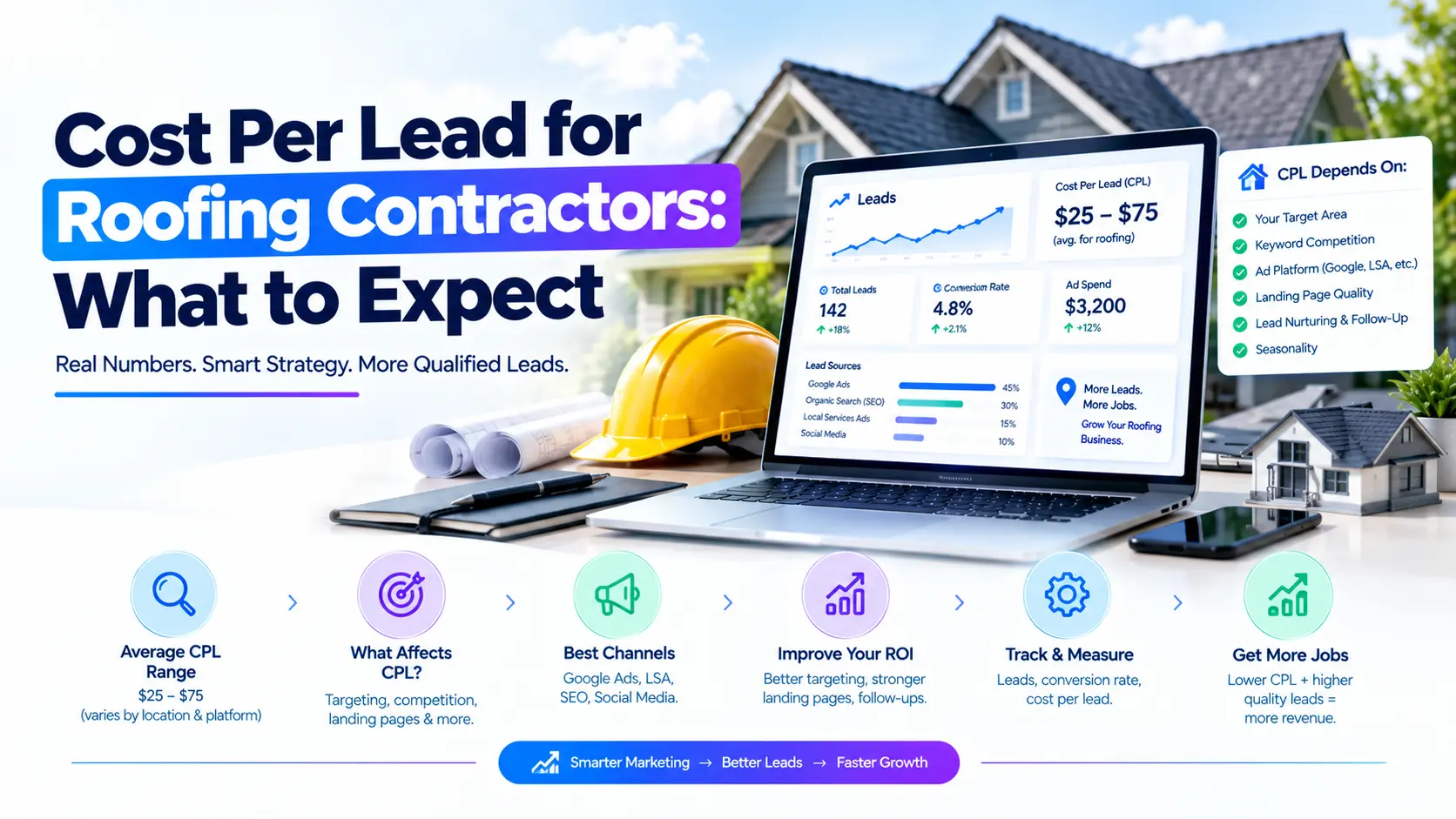
How much do storm damage roofing leads cost?
Storm damage roofing lead costs vary by market, competition, service type, channel, and lead quality. Instead of relying on an industry-wide average, calculate your break-even qualified CPL using gross profit, conversion rate, operating costs, and customer acquisition economics.
How quickly can roofers get storm damage leads?
Paid channels can potentially generate visibility quickly when campaigns are properly configured and demand exists. SEO usually takes longer because organic visibility must be developed. The speed of lead generation also depends on your market, competition, budget, and response system.
Is local SEO important for storm damage roofing?
Yes. Local SEO helps roofing companies become more visible when homeowners search for roofing services in specific geographic areas. A complete Business Profile, relevant service pages, reviews, accurate information, and local authority can all support local visibility.
Should roofers use Google Ads after a storm?
Google Ads can help capture high-intent searches when homeowners actively need roofing services. Use relevant keywords, dedicated landing pages, accurate service areas, conversion tracking, and a budget based on profitable customer acquisition.
How should roofers follow up with storm damage leads?
Respond quickly, confirm the homeowner’s needs, qualify the opportunity, schedule an inspection, document the findings, provide an estimate, and follow up consistently. A roofing CRM and automated reminders can help your team manage opportunities efficiently.
Should roofers promise insurance coverage?
No. Roofing companies should not promise that an insurer will approve a claim or guarantee a particular settlement. Coverage depends on the homeowner’s policy and circumstances. Homeowners should review their policy and communicate with their insurer about coverage and claims.
Final Verdict: Build a Storm-Ready Lead Generation System
The biggest mistake a roofer can make is thinking storm damage lead generation means buying as many leads as possible after a storm. It doesn’t. The strongest system starts before the storm.
Build your Google Business Profile. Develop your local SEO foundation. Create storm-specific service pages. Build legitimate reviews. Prepare paid campaigns. Set up your CRM. Create fast follow-up workflows. Train your team to qualify leads. Then measure what happens after the phone call.
The complete process should look like this:
Storm → Search Demand → Visibility → Lead → Qualification → Inspection → Estimate → Follow-Up → Closed Job → Revenue
That’s the difference between simply generating roofing leads and building a predictable roofing acquisition system. For most roofing companies, I would use SEO and local search as the long-term foundation, paid channels to capture urgent demand, and CRM automation to improve conversion.
The objective is not to generate the most storm damage leads. It is to generate the right leads, convert more of them, and turn every marketing dollar into measurable roofing revenue.
Build visibility. Capture demand. Follow up fast. Measure profit. Scale what works.
About the Author
Jawaria is an SEO and digital marketing professional focused on helping small and mid-sized businesses improve organic visibility, lead generation, website performance, and digital growth. Through HQ Growth Lab, she focuses on practical SEO, web development, AI automation, and digital marketing strategies designed to help businesses build, rank, and scale.