If your gym is generating leads but membership sales still feel inconsistent, the problem may not be your marketing. It may be what happens after someone becomes a lead.
A prospect submits a free-trial form. Someone at the front desk plans to call them. Then the gym gets busy. A class starts. A member needs help. Another lead comes through Instagram. By the time someone finally follows up, the prospect has already contacted another gym.
I’ve seen this pattern repeatedly in lead-driven businesses: companies invest heavily in gym lead generation but treat follow-up as a manual task.
That creates an expensive gap between generating a lead and converting that lead into a member. This is where gym lead follow-up automation changes the economics.
Instead of relying entirely on staff to remember every call, text, email, appointment, and trial-member follow-up, automation creates a system that responds immediately, nurtures prospects consistently, and alerts staff when human intervention matters most.
The goal isn’t to replace your sales team. The goal is to make sure your sales team never has to wonder, “Did anyone follow up with that lead?”
What Is Gym Lead Follow-Up Automation?
Gym lead follow-up automation is the use of software, CRM workflows, SMS, email, appointment systems, and increasingly AI to automatically communicate with prospects after they express interest in a gym.
A typical automated workflow might look like this:
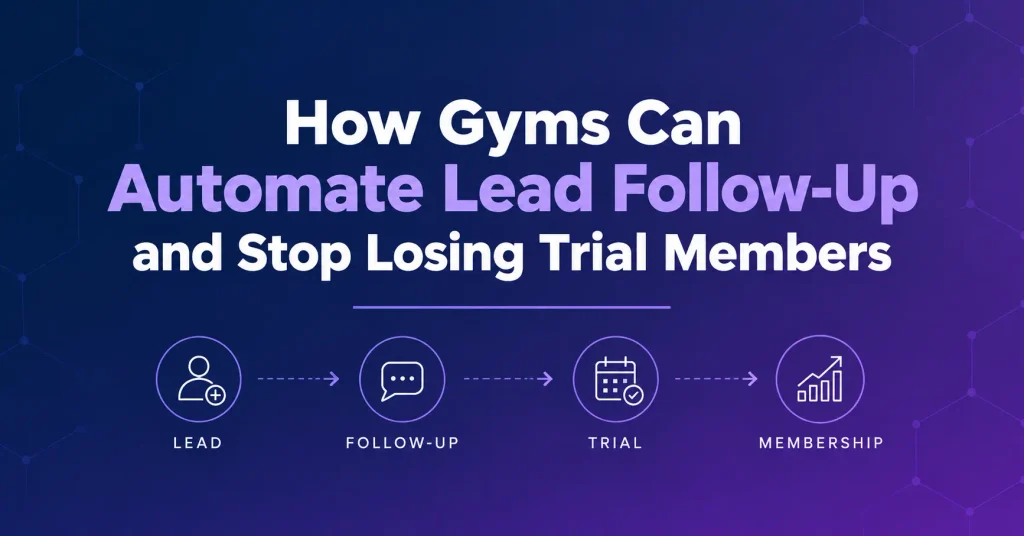
Lead submits form → instant response → lead qualification → trial booking → appointment reminder → staff notification → post-trial follow-up → membership offer → re-engagement
Instead of treating every prospect as a separate task, the gym creates a repeatable gym sales funnel. For example, imagine someone searches for a local fitness centre and submits: “I’d like to try the gym. How much is membership?”
Within seconds, the system could send: “Hey Sarah! Thanks for reaching out to [Gym Name]. We’d love to help you get started. Would you prefer to visit today at 6 PM or tomorrow at 10 AM?”
Sarah chooses a time. The CRM records the appointment a reminder is sent. The salesperson receives an alert. After the visit, another workflow begins. That’s gym automation working behind the scenes.
How Does Gym Lead Follow-Up Automation Work?
The best approach isn’t to automate everything at once.Instead, build your gym lead follow-up automation around the prospect’s actual customer journey.
A simple system connects each stage:
Lead capture → immediate response → qualification → booking → reminders → trial → follow-up → membership offer → nurture
Each stage has a specific purpose. The system should also recognise customer behaviour.
For example, a new lead needs a fast response. A booked appointment needs reminders. A missed appointment needs a rescheduling message. A completed trial needs post-trial follow-up.
This creates a consistent gym lead management process without requiring employees to remember every individual task.
Why Do Gyms Lose Leads After Generating Them?
Most gym owners understand gym lead generation.
They run Google Ads.
They post on Instagram.
They offer free trials.
They create landing pages.
They promote introductory memberships.
They partner with local businesses.
But generating the lead is only the beginning.
The real commercial opportunity exists between:
Lead → Conversation → Appointment → Trial → Membership
If prospects disappear somewhere in that sequence, increasing your advertising budget may simply produce more wasted leads.
The Hidden Problem Is Usually Lead Leakage
Lead leakage happens when interested prospects aren’t properly moved through the sales process.
Common examples include:
| Lead Problem | What Happens |
| Slow response | Prospect contacts another gym. |
| No second attempt | Interested lead becomes forgotten. |
| Generic messaging | The prospect doesn’t feel understood |
| No appointment reminder | The prospect misses consultation |
| Poor trial follow-up | The trial member never joins |
| No CRM tracking | Staff doesn’t know lead status. |
| Manual processes | Follow-up depends on employee memory. |
| No re-engagement | Old leads remain dormant. |
This is why gym lead management deserves as much attention as lead generation.
Speed Matters More Than Many Gyms Realize
Harvard Business Review’s research into online sales leads found that companies contacting prospects within an hour were nearly seven times more likely to qualify a lead than companies waiting another hour and more than 60 times as likely compared with companies waiting 24 hours or longer. The study analysed 1.25 million leads and separately audited 2,241 U.S. companies.
That research isn’t specific to gyms, and qualification isn’t the same thing as a closed membership. But the principle is highly relevant:
Interest decays when businesses respond slowly. That’s precisely why instant lead response should be one of the first workflows a gym automates.
How Can Gyms Automate Lead Follow-Up?
Step 1: Capture Every Gym Lead Automatically
Your first problem is often not follow-up.
It’s fragmented lead capture.
A gym may receive prospects from:
- Website forms
- Google Ads
- Facebook Ads
- Phone calls
- Website chat
- Google Business Profile
- Referral campaigns
- Free-trial landing pages
- Walk-ins
- Promotional campaigns
If these leads enter different spreadsheets, inboxes, or employees’ phones, your gym lead management becomes unreliable. The first automation should centralise them.
Your CRM should ideally capture:
Name → Contact information → Source → Goal → Offer → Lead status → Appointment → Trial status → Membership status
That creates a single gym sales pipeline.
Step 2: Respond to New Leads Immediately
This is where lead response automation creates enormous value. A prospect shouldn’t have to wait until the next morning because your sales representative is busy. A new lead can automatically receive an SMS or email acknowledging their enquiry.
For example:
“Hi Mike, thanks for requesting a free trial at Peak Fitness. We’d love to help you get started. Are you looking to lose weight, build strength, or improve your overall fitness?”
This message accomplishes three things:
It confirms the lead was received.
It starts a conversation.
It gathers useful information.
The important distinction is that an automated acknowledgement shouldn’t feel like a receipt.
It should create the next step.
Step 3: Use Automated Lead Qualification
Not every lead has the same intent. Someone asking about membership prices isn’t necessarily ready to buy.
Someone asking:
“Can I start my free trial tonight?”
has considerably stronger buying intent.
Your gym CRM can use simple questions to classify prospects.
For example:
| Qualification Question | Why It Matters |
| What’s your primary fitness goal? | Personalisation |
| When would you like to start? | Buying intent |
| Have you trained before? | Sales context |
| Would you like a free trial? | Offer intent |
| What’s your preferred visit time? | Scheduling |
| Are you interested in personal training? | Upsell opportunity |
This creates automated lead qualification without forcing your staff to manually ask the same questions repeatedly.
Step 4: Automate Trial and Consultation Booking
One of the biggest opportunities in gym sales automation is eliminating unnecessary scheduling friction.
Instead of:
“What day works for you?”
following five messages trying to find a mutually convenient time, your system can show available appointment slots.
A prospect selects a time.
The appointment enters the calendar.
The CRM updates the lead.
The employee gets notified.
The prospect receives confirmation.
This creates automated appointment scheduling and reduces administrative work. For gyms offering consultations, assessments, personal training sessions, or free trials, this can become a critical part of the fitness sales funnel.
Step 5: Send Gym Appointment Reminders
Getting the appointment isn’t enough. The prospect needs to actually show up. That’s why gym appointment reminders should be automated. A simple sequence could include:
Immediately: Appointment confirmation
24 hours before: Reminder
2–3 hours before: Short confirmation
After missed appointment: Rescheduling message
For example:
“Hi Sarah, just a reminder that your fitness consultation is tomorrow at 6 PM. If you need to reschedule, simply reply here and we’ll find another time.” This isn’t complicated. But it removes another point of failure from your gym lead funnel.
Step 6: Create a Dedicated Trial-Member Follow-Up Sequence
This is where many gyms leave substantial revenue on the table. Getting someone through the door isn’t the same as converting them. A gym trial membership creates an opportunity, not a guaranteed sale. Your follow-up should therefore continue after the trial.
Example Trial Follow-Up Sequence
Immediately after trial
“Great meeting you today, Alex. How did your first workout feel?”
Next day
“Based on what you told us about your goal, I think our [membership/programme] could be a strong fit. Want me to send you the options?”
Day 3
Share a relevant success story or explain the membership.
Day 5
Ask whether the prospect has any questions.
Day 7
Present a clear next step.
Day 14
Move the prospect into a longer-term nurture campaign if they haven’t joined. The objective isn’t to bombard people. It’s to maintain a helpful conversation while their original motivation is still relevant.
How Can Gyms Stop Losing Trial Members?
If you want to stop losing gym trial members, don’t measure only how many trials you generate. Measure what happens afterwards. Your funnel should look something like this:
Trial booked → Trial attended → Follow-up completed → Membership conversation → Membership offer → Joined
A useful KPI is:
Trial-to-Member Conversion Rate
Trial-to-member conversion rate = New members from trials ÷ Completed trials × 100
For example:
If 100 people complete a trial and 25 become members:
25 ÷ 100 × 100 = 25%
Now you have a measurable baseline.
Instead of saying:
“Our trials aren’t converting.”
You can diagnose the actual problem.
Maybe:
- Too many trials don’t show.
- Staff isn’t following up.
- Prospects don’t understand membership value.
- Pricing objections aren’t handled.
- Follow-up stops after one message.
- The trial experience doesn’t match expectations.
That’s the difference between gym lead management and simply collecting names.
Why Don’t Gym Trial Members Join?
There isn’t one universal reason. A prospect may not join because:
They Lost Motivation.
The urgency that caused them to request a trial has faded.
Nobody Followed Up
The gym assumes the prospect will return on their own.
The Membership Wasn’t Positioned Correctly
The salesperson explained features instead of connecting the membership to the prospect’s goals.
The Prospect Had Unanswered Objections
Price, schedule, location, classes, equipment, or uncertainty may still be blocking the decision.
The Prospect Is Comparing Gyms
This is especially important for local fitness businesses. Your prospect may have requested trials from several competitors.
The Trial Experience Wasn’t Personalized
If someone wants weight loss but receives a generic tour, the perceived value can remain low. Automation can’t fix a poor customer experience. But it can make sure the gym doesn’t lose someone simply because nobody followed up.
What Should an Automated Gym Lead Follow-Up Sequence Include?
A strong automated gym follow-up sequence should combine speed, persistence, personalization, and human intervention.
Here’s a practical framework:
| Stage | Channel | Goal |
| New lead | SMS | Immediate response |
| New lead | Provide details. | |
| No reply | SMS | Start conversation. |
| No booking | Build value. | |
| Appointment booked | SMS | Confirm |
| Before visit. | SMS | Reduce no-show. |
| Trial completed | SMS | Ask for feedback. |
| Trial follow-up | Email/SMS | Handle objections. |
| No conversion | Nurture | Re-engage |
| Long-term inactive | Campaign | Recover lead |
The system should also stop automated messages when a staff member takes over. That prevents embarrassing situations such as an employee having a live conversation with someone while the automation continues sending generic sales messages.
How Can Gyms Automate SMS Follow-Up?
Automated SMS follow-up is particularly useful when prospects expect quick communication.
A good SMS should be:
Short.
Relevant.
Conversational.
Action-oriented.
Instead of:
“Thank you for your inquiry. One of our representatives will contact you shortly.”
Try:
“Hey James! This is Mike from ABC Fitness. I saw you requested a free trial. Would you like to come in today or tomorrow?” The second message creates an easy response. But gyms must also treat SMS automation as a compliance issue, not simply a marketing tactic.
For U.S. businesses, automated marketing texts can implicate federal consent requirements under the TCPA. FCC materials explain that consent requirements can apply to certain autodialed text messages, and consumers have recognized mechanisms for revoking consent, including replies such as “STOP” or “CANCEL.”
So your automation platform, consent process, messaging language, opt-out handling, and applicable state requirements should be reviewed before launching campaigns.
How Can Gyms Automate Email Follow-Up?
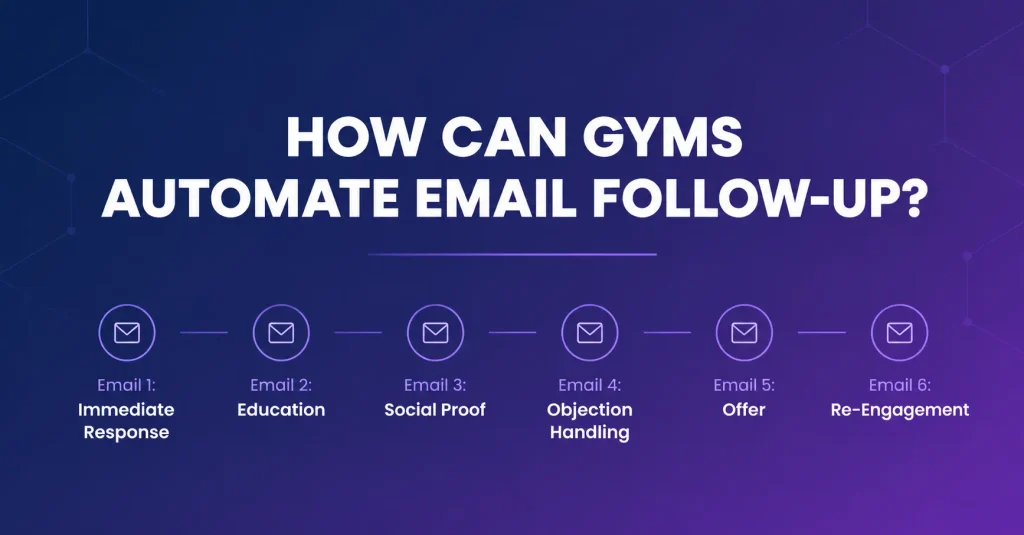
Email works particularly well for longer-form education and gym lead nurturing.
For example, your email sequence might include:
Email 1: Immediate Response
Confirm the inquiry and explain the next step.
Email 2: Education
Explain how the gym helps people achieve their specific goal.
Email 3: Social Proof
Show testimonials, results, or member stories where appropriate.
Email 4: Objection Handling
Address common concerns such as price, schedule, beginner anxiety, or commitment.
Email 5: Offer
Present the appropriate membership or trial option.
Email 6: Re-Engagement
Invite the prospect to restart the conversation. For U.S. commercial email, gyms also need to follow applicable requirements under CAN-SPAM, including accurate sender information, non-deceptive subject lines, a valid physical postal address, an opt-out mechanism, and prompt handling of opt-out requests.
Automation makes compliance easier to operationalize, but it doesn’t remove the business’s responsibility.
Where Does AI Fit Into Gym Lead Follow-Up?
Traditional automation follows predefined rules. AI lead follow-up can make those workflows more adaptive.
For example, a conventional automation might say:
If the lead submits the form → send an SMS.
An AI-powered workflow could potentially interpret:
“I’m interested, but I’m traveling for two weeks. Can I start when I get back?” and respond appropriately according to your approved business rules.
AI can support:
Conversational lead qualification
Personalized messaging
FAQ responses
Appointment booking
Lead prioritization
Follow-up recommendations
CRM updates
Conversation summaries
Re-engagement campaigns
This is where an AI sales assistant for gyms becomes interesting. Instead of forcing every prospect through identical messaging, an AI system can help adapt the conversation to the person’s intent. However, I wouldn’t let AI operate without boundaries. AI marketing claims should be accurate and supported by appropriate evidence.
A gym should define:
- What AI can answer
- What requires a human
- What pricing information it can provide
- What promises it cannot make
- What personal information it can process
- When conversations must be escalated
- How consent and opt-outs are handled
AI should increase responsiveness without sacrificing trust.
AI Chatbots vs. Traditional Gym Automation
| Capability | Traditional Automation | AI Automation |
| Instant response | ✓ | ✓ |
| Fixed SMS sequences | ✓ | ✓ |
| Appointment reminders | ✓ | ✓ |
| Rule-based qualification | ✓ | ✓ |
| Conversational responses | Limited | ✓ |
| Intent detection | Limited | ✓ |
| Personalized conversations | Moderate | Stronger |
| FAQ handling | Fixed | Dynamic |
| Human escalation | ✓ | ✓ |
| Lead scoring | Rule-based | AI-assisted |
The best system isn’t necessarily AI-only. In many gyms, the strongest model is Automation + AI + Human Sales
Automation handles predictable tasks. AI handles conversational complexity. Humans handle high-value sales conversations.
What Should You Look for in a Gym CRM?
There isn’t one universally best gym CRM. The right system depends on your size, lead volume, sales process, existing software, and budget. But I recommend evaluating a fitness CRM based on workflow capabilities rather than brand popularity.
Look for:
Lead Capture
Can it collect leads from your website, ads, social channels, and other sources?
CRM Lead Tracking
Can staff see exactly where every prospect sits?
Automated Messaging
Can it send SMS and email sequences?
Appointment Scheduling
Can prospects book without staff intervention?
Trial Tracking
Can you see who booked, attended, converted, or disappeared?
Lead Scoring
Can high-intent prospects be prioritized?
Reporting
Can you measure lead-to-member conversion?
Integrations
Can it connect with your existing gym management and marketing systems?
Automation Controls
Can workflows stop when someone replies, books, joins, or opts out? That final feature is more important than many gym owners realize.
Automation should respond to customer behavior. It shouldn’t blindly continue.
Gym Lead Follow-Up Automation vs. Manual Follow-Up
| Factor | Manual Follow-Up | Automated Follow-Up |
| Response speed | Variable | Immediate |
| Consistency | Employee-dependent | System-driven |
| Lead tracking | Often fragmented | Centralized |
| Appointment reminders | Manual | Automated |
| Trial follow-up | Frequently missed | Scheduled |
| Reporting | Difficult | Easier |
| Scalability | Limited | Higher |
| Personalization | High | High when configured properly |
| Human interaction | Strong | Still necessary |
| Setup effort | Low | Higher |
| Ongoing optimization | Manual | Data-driven |
Automation isn’t automatically better. Bad automation can produce spam, awkward conversations, and poor customer experiences. The advantage comes from well-designed automation.
What Should Gyms Automate—and What Should Stay Human?
This is one of the most important strategic decisions.
Automate Repetitive Tasks
I recommend automating the following:
Lead acknowledgments
- Appointment confirmations
- Appointment reminders
- Trial reminders
- Basic qualification
- FAQ responses
- Follow-up scheduling
- Re-engagement reminders
- CRM updates
- Lead assignment
- No-show recovery
Keep High-Value Interactions Human
Your staff should handle:
- Complex objections
- Membership negotiations
- Personal training consultations
- Sensitive customer issues
- High-value sales conversations
- Complaints
- Unusual requests
- Closing conversations
Think of automation as the infrastructure around your sales team. It shouldn’t eliminate the relationship.
What Does Gym Lead Follow-Up Automation Cost?
The cost of gym lead follow-up automation depends on the systems your gym already uses, lead volume, required workflows, messaging channels, CRM capabilities, AI features, and implementation requirements.
A basic system may focus on:
Lead capture → instant response → appointment booking → reminders → trial follow-up
A more advanced system may include:
CRM segmentation → SMS and email nurturing → AI conversations → lead scoring → re-engagement → reporting → integrations
Rather than choosing a system based only on its monthly software cost, consider the commercial value of recovering leads that would otherwise be lost. The right question isn’t simply
“How much does automation cost?”
It’s:
“How much revenue are we currently losing because follow-up isn’t consistent?”
What Are the Best Gym Lead Automation Tools?
The best tools depend on your existing technology stack and workflow. At minimum, your gym lead automation system should connect the core functions that move a prospect toward membership:
Lead capture
CRM lead management
SMS
Appointment scheduling
Trial tracking
Lead notifications
Reporting
AI assistance, where appropriate
The goal isn’t to collect as many tools as possible. The goal is to create one connected system where lead information moves automatically from one stage to the next.
How Long Does It Take to Set Up Gym Lead Follow-Up Automation?
Implementation depends on the complexity of the gym’s sales process, existing software, integrations, messaging workflows, and automation requirements. The safest approach is to build the system in stages.
Start with the highest-impact workflow:
New lead → instant response → qualification → appointment → reminder
Then add:
Trial follow-up → membership conversation → nurture → re-engagement
This approach makes it easier to test each workflow, identify problems, and improve the system before adding more automation. The objective isn’t to launch the most complicated system. It’s to launch a reliable system that consistently moves leads forward.
How Can Gyms Automate Missed-Call Follow-Up?
Missed calls can represent another form of lead leakage. If a prospect calls while the front desk is busy, the opportunity shouldn’t simply disappear. A missed-call workflow can notify staff and trigger an appropriate follow-up process.
For example:
Missed call → CRM record → staff notification → follow-up message → conversation → appointment
The exact messaging and consent requirements should be reviewed before implementing automated SMS communication. The important principle is simple:
A missed call shouldn’t automatically become a lost lead.
How Can Gyms Measure Gym Lead Follow-Up Automation ROI?
Automation shouldn’t be purchased because it’s trendy. You need measurable gym marketing ROI.
Track:
Lead Response Time
How quickly does a new lead receive a meaningful response?
Contact Rate
How many leads actually engage with the gym?
Appointment Booking Rate
How many leads schedule a visit?
Show Rate
How many booked prospects attend?
Trial Conversion Rate
How many trial members become paying members?
Lead-to-Member Conversion
How many total leads eventually become members?
Cost Per Acquisition
How much marketing and sales spend produces each new member?
Follow-Up Conversion Rate
How many conversions occur after automated follow-up?
A simple ROI formula is:
Automation ROI = (Additional Financial Benefit − Automation Cost) ÷ Automation Cost × 100
For example, suppose better follow-up produces 10 additional memberships per month. If the average initial membership value is $100, that’s $1,000 in additional initial revenue.
But don’t stop there. If members stay for several months, the economic value may be substantially higher. That’s why gyms should connect lead tracking with actual membership revenue wherever possible.
A Practical Gym Lead Follow-Up Automation Workflow
Here’s the system I would build for a typical local gym.
Trigger: New Lead
0–1 minute
Send personalized SMS.
Create a CRM record.
Assign lead source.
Notify the sales team.
First 15 Minutes
AI or automation asks one or two qualification questions. Offer appointment slots.
Same Day
If no response, send a short follow-up. Then send useful information about the trial.
Day 1
Send a value-focused message.
Day 2–3
Address common questions or objections.
Day 4–5
Invite the prospect to book.
Day 7
Send a clear CTA.
Day 14
Move the lead into nurture.
Day 30+
Launch an appropriate re-engagement campaign. The exact timing should be tested against your audience and offer. The important principle is persistent but helpful communication.
How Can Gyms Recover Lost Leads?
Not every lost lead is dead.
Your CRM may contain hundreds or thousands of people who:
- Requested information
- Asked about pricing
- Started a free trial
- Missed an appointment
- Attended but didn’t join
- Previously showed interest
- Stopped responding
These are potential gym membership leads hiding inside your database.
Instead of sending:
“Are you still interested?”
Create a reason to restart the conversation.
For example:
“Hey Sarah, we haven’t spoken in a while. We’re opening a few new beginner training slots this month. Would you like me to send you the details?”
The offer gives the person a reason to respond. This is gym prospect nurturing, not simply repeated sales messaging.
How to Build a Gym Lead Nurturing System
A mature gym lead-nurturing system segments prospects based on behavior.
For example:
Segment 1: High Intent
Requested a trial and wants to start immediately.
Action: Fast human sales follow-up.
Segment 2: Interested but Undecided
Asked questions but hasn’t booked.
Action: Education + objection handling.
Segment 3: Trial Booked
Has an upcoming appointment.
Action: Confirmation + reminders.
Segment 4: Trial Completed
Visited but hasn’t joined.
Action: Personal sales follow-up.
Segment 5: No-Show
Booked but didn’t attend.
Action: Rescheduling workflow.
Segment 6: Cold Lead
No recent interaction.
Action: Long-term nurture and re-engagement.
This segmentation turns your fitness lead funnel into a behavioral system instead of a generic mailing list.
Common Gym Automation Mistakes
Automation can fail when gyms automate the wrong things.
Mistake 1: Sending Too Many Messages
More messages don’t necessarily mean more conversions. Every message needs a reason.
Mistake 2: Making Every Message Sound Robotic
“Dear valued customer” doesn’t sound like a local gym. Write conversationally.
Mistake 3: Automating Without Segmentation
A new lead shouldn’t receive the same message as someone who completed a trial.
Mistake 4: Ignoring Response Time
An automation that sends a message 12 hours later isn’t solving the core problem.
Mistake 5: Never Involving Humans
A prospect ready to buy shouldn’t be trapped inside a chatbot.
Mistake 6: Measuring Leads Instead of Revenue
More leads aren’t necessarily better. More qualified gym leads that become members are what matter.
Mistake 7: Forgetting Compliance
SMS and email automation must account for applicable consent, disclosure, and opt-out requirements.
Gym Lead Follow-Up Automation Checklist
Before launching your system, verify that you can answer “yes” to these questions:
| Question | Ready? |
| Are all leads captured in one CRM? | ☐ |
| Do new leads receive an immediate response? | ☐ |
| Are leads automatically assigned? | ☐ |
| Can prospects book appointments online? | ☐ |
| Are appointments automatically confirmed? | ☐ |
| Are reminders automated? | ☐ |
| Does every trial trigger follow-up? | ☐ |
| Are no-shows automatically re-engaged? | ☐ |
| Are unconverted leads nurtured? | ☐ |
| Does staff receive high-intent alerts? | ☐ |
| Does automation stop when a lead replies? | ☐ |
| Are SMS permissions and opt-outs managed properly? | ☐ |
| Are commercial emails compliant? | ☐ |
| Can you track lead-to-member conversion? | ☐ |
| Can you calculate acquisition cost? | ☐ |
If several boxes remain unchecked, there’s probably significant room to improve your gym sales pipeline.
Internal Linking Opportunities
For a broader gym marketing content cluster, internally link this article to relevant pages targeting:
| Suggested Anchor Text | Recommended Destination |
| gym lead generation | Gym Lead Generation Guide |
| gym marketing automation | Gym Marketing Automation Guide |
| fitness CRM | Best Fitness CRM Guide |
| gym membership conversion | Gym Membership Conversion Guide |
| gym sales funnel | Gym Sales Funnel Guide |
| AI automation for gyms | AI Automation for Gyms |
| SMS marketing for gyms | SMS Marketing for Gyms |
| gym customer retention | Gym Customer Retention Guide |
| gym marketing ROI | Gym Marketing ROI Guide |
| how to get more gym memberships | Gym Membership Growth Guide |
This creates a topical cluster around fitness marketing automation, rather than relying on one article to rank for every related query.
Important: These should be actual internal links to relevant pages on your website. Don’t leave them as plain anchor-text suggestions when publishing the article.
Frequently Asked Questions About Gym Lead Follow-Up Automation
What Is Gym Lead Follow-Up Automation?
Gym lead follow-up automation uses CRM software, SMS, email, scheduling tools, and AI to automatically respond to prospects, nurture gym leads, schedule appointments, remind trial members, and trigger sales follow-up based on customer behavior.
How Quickly Should Gyms Respond to New Leads?
Ideally, gyms should respond as quickly as practically possible. Research published by Harvard Business Review found that contacting online leads within an hour significantly improved qualification compared with slower responses.
How Can Gyms Automate Lead Follow-Up?
Gyms can connect lead forms to a CRM and create automated workflows for immediate responses, qualification, appointment booking, reminders, trial follow-up, membership offers, and long-term lead nurturing.
How Do You Convert Gym Trial Members Into Paying Members?
Follow up quickly after the trial, ask about the prospect’s experience, identify objections, connect the membership to their goals, and provide a clear next step. Automation helps ensure that follow-up happens consistently.
How Can Gyms Stop Losing Trial Members?
Create a structured trial-to-membership workflow that includes appointment reminders, post-trial communication, objection handling, sales alerts, and re-engagement sequences for prospects who don’t join immediately.
How Can AI Automate Gym Lead Follow-Up?
AI can help qualify leads, answer common questions, personalize conversations, schedule appointments, summarize conversations, identify buying intent, and alert staff when human intervention is needed.
What Is the Best CRM for Gym Lead Follow-Up?
The best CRM depends on your gym’s lead volume, existing software, budget, sales process, and automation requirements. Prioritize lead tracking, SMS and email automation, appointment scheduling, segmentation, reporting, and integrations.
Can Gym Lead Follow-Up Automation Increase Membership Sales?
It can improve the consistency and speed of follow-up, which may increase opportunities for conversion. However, results depend on lead quality, offer quality, sales execution, pricing, customer experience, and the automation strategy.
Should Gyms Automate SMS Follow-Up?
SMS can be useful for fast communication, reminders, and appointment workflows. However, gyms should obtain and document appropriate consent and provide required opt-out mechanisms before using automated marketing texts in applicable jurisdictions.
Should Gym Follow-Up Be Automated or Manual?
The strongest approach is usually a combination. Automate repetitive communication and reminders while allowing staff to take over important sales conversations, objections, complaints, and high-intent leads.
How Do Gyms Recover Old Leads?
Segment old leads according to their previous behavior and send relevant re-engagement campaigns. Instead of simply asking whether they’re still interested, give them a useful reason to restart the conversation.
What Should Gyms Measure After Implementing Automation?
Track lead response time, contact rate, appointment booking rate, show rate, trial conversion, lead-to-member conversion, customer acquisition cost, membership revenue, and follow-up conversion rate.
Final Thoughts: Gym Lead Follow-Up Automation Is About Speed, Consistency, and Timing
Most gyms don’t have a lead-generation problem alone. They have a lead-management problem. They generate interest, but the system between that initial inquiry and the final membership isn’t always reliable. That’s why gym lead follow-up automation matters.
The objective isn’t to replace your front-desk team or turn your gym into a collection of robotic messages. It’s to eliminate the preventable gaps:
No slow responses.
No forgotten leads.
No missed appointment reminders.
No trial members disappearing without follow-up.
No valuable prospects sitting untouched inside a CRM.
The most effective system combines automated lead follow-up, gym CRM software, SMS, email, appointment scheduling, AI lead qualification, and human sales conversations.
Start with the simplest workflow:
New lead → instant response → qualification → appointment → reminder → trial → post-trial follow-up → membership conversation → nurture.
Then measure every stage. Because when you know exactly where prospects are dropping out, you can improve the system instead of simply buying more leads.
And that’s the real opportunity with gym lead follow-up automation: not just generating more fitness leads, but turning more of the leads you’re already paying for into trial members, paying members, and long-term gym revenue.
About the Author
[jawaria toufiq] is an SEO strategist at HQ Growth Lab, helping small and mid-sized businesses improve organic visibility, generate qualified leads, and build scalable digital growth systems.
Their work focuses on SEO, technical optimization, content strategy, web development, AI automation, and conversion-focused digital marketing.