If you’re planning to build a real estate website in 2026, the first question is usually simple: How Much Does a Real Estate Website Cost in 2026? The honest answer is that there isn’t one universal price.
A five-page real estate agent website with a contact form is completely different from an IDX website with MLS listings, advanced property search, CRM integration, map functionality, lead routing, and custom dashboards.
Based on current 2026 market pricing, a straightforward real estate website can start around $1,000–$4,000, while a professionally customized IDX site can reach $3,000–$15,000+. Team and brokerage platforms commonly move into the $10,000–$50,000+ range, while highly customized real estate marketplaces can exceed that substantially. These are planning ranges, not fixed industry rates. Current public pricing benchmarks show similarly wide differences depending on scope, platform, IDX requirements, and customization.
And there’s another important point the initial development invoice isn’t the entire real estate website cost. You may also need to budget for hosting, domain registration, MLS/IDX services, integrations, maintenance, security, SEO, content, analytics, and ongoing improvements.
In this guide, I’ll break down 2026 real estate website pricing, what you actually get at different price levels, which features increase the budget, and how to avoid paying for functionality your business doesn’t need.
How Much Does a Real Estate Website Cost in 2026? Quick Answer
If you’re still wondering How Much Does a Real Estate Website Cost in 2026, the answer depends mainly on your website type, features, IDX requirements, and level of customization.
For most businesses, I’d think about the budget in four broad tiers:
| Website Type | Typical 2026 Budget | Best For |
| Basic real estate website | $1,000–$3,000 | Solo agents and new businesses |
| Professional website with listings | $3,000–$8,000 | Established agents and small teams |
| Custom IDX/MLS website | $5,000–$18,000+ | Growth-focused teams and brokerages |
| Advanced real estate portal | $15,000–$50,000+ | Large brokerages and marketplaces |
| Enterprise/custom platform | $50,000–$100,000+ | Complex multi-user ecosystems |
These ranges should be treated as budgeting estimates rather than universal market prices. A website using an existing real estate platform can cost dramatically less than a custom platform developed around unique business workflows.
For example, IDX Broker currently lists plans beginning at $60/month for its Core service and $149/month for its Elite offering, while Showcase IDX lists plans beginning at $94.95/month. These figures illustrate why comparing only the developer’s upfront quote can give you an incomplete picture of your total ownership cost.
So, if you’re asking How Much Does a Real Estate Website Cost in 2026, my practical answer is:
Budget approximately $3,000–$8,000 for a serious agent or small-team website, $8,000–$20,000+ for a customized IDX experience, and $15,000–$50,000+ for a sophisticated brokerage or property portal.
Why Real Estate Websites Cost More Than Normal Business Websites
A normal service-business website might need:
- Home
- About
- Services
- Contact
- Blog
A real estate website often needs much more.
Your visitors may want to search hundreds or thousands of properties by:
- Location
- Price
- Bedrooms
- Bathrooms
- Property type
- Square footage
- Listing status
- Amenities
- Neighborhood
- Map boundaries
That means property search functionality becomes a core part of the website rather than an optional feature. You may also need MLS integration, IDX compliance, saved searches, listing alerts, agent profiles, property galleries, mortgage calculators, maps, lead forms, CRM integration, and automated follow-up.
The National Association of REALTORS® reports that social media, CRM systems, local MLS systems, brokerage websites, and business websites all play roles in lead generation. Its 2025 technology survey also found that 82% of respondents said clients responded positively or very positively to technology integrated into buying and selling.
That’s why a real estate website should be viewed as a lead-generation system, not merely an online brochure.
How Much Does a Real Estate Website Cost in 2026 by Website Type?
The easiest way to understand How Much Does a Real Estate Website Cost in 2026 is to classify the website according to its purpose.
Basic Real Estate Agent Website: $1,000–$3,000
This is usually the starting point for an individual agent.
A basic real estate agent website might include:
- Custom or semi-custom homepage
- About page
- Services
- Agent profile
- Contact page
- Property showcase
- Blog
- Contact forms
- Google Maps
- Mobile responsiveness
- Basic SEO
This approach works well when you primarily want to establish credibility and generate inquiries. However, it may not include a sophisticated property database or live MLS feed.
Professional Real Estate Website: $3,000–$8,000
This is where the website becomes a serious marketing asset.
You may get:
- Professional real estate web design
- Custom branding
- Property listing management
- Advanced search
- Listing detail pages
- Lead capture
- Blog and content management
- Local SEO foundations
- Analytics
- CRM integration
- Map integration
- Conversion-focused landing pages
- Mobile optimization
For many agents and small teams, this is the sweet spot.
You get enough functionality to compete professionally without paying for enterprise-level infrastructure.
Custom IDX Website: $5,000–$18,000+
An IDX website adds another layer of complexity. IDX allows property data from participating MLS systems to appear through an approved technology solution.
The actual cost varies because IDX is not simply a design feature. It involves data access, vendor fees, MLS rules, integration, configuration, search functionality, and ongoing service.
For example, IDX Broker currently advertises Core at $60/month, Engage at $99/month, and Elite at $149/month. Other providers publish different pricing structures. Therefore, IDX integration cost should be evaluated separately from your website design and development quote.
Advanced Real Estate Portal: $15,000–$50,000+
A real estate portal development project is considerably more complex.
It might include:
- Multiple agents
- Agent dashboards
- Seller accounts
- Buyer accounts
- Property submissions
- Favorites
- Saved searches
- Listing alerts
- Advanced filters
- Map search
- Payment processing
- Subscription plans
- CRM integration
- Admin dashboards
- Reporting
- Notifications
- API integrations
At this point, you’re no longer purchasing a simple website.
You’re building a real estate marketplace website or business platform.
Enterprise Real Estate Platform: $50,000+
Large brokerages may need custom infrastructure supporting:
- Hundreds of agents
- Multiple offices
- Multiple markets
- Complex permissions
- Custom MLS feeds
- Proprietary CRM systems
- Advanced analytics
- Marketing automation
- Custom APIs
- High traffic
- Enterprise security
At this level, the cost of building a real estate website depends heavily on architecture and business requirements.
Real Estate Website Development Cost Breakdown
A website quote becomes easier to evaluate when you separate the major components. Understanding How Much Does a Real Estate Website Cost in 2026 also requires looking beyond the initial development quote.
| Cost Component | Typical Impact |
| Strategy and planning | Low–medium |
| UX/UI design | Medium–high |
| Front-end development | Medium–high |
| CMS implementation | Low–medium |
| Property database | Medium–high |
| IDX/MLS integration | Medium–very high |
| CRM integration | Medium–high |
| Custom functionality | High |
| SEO implementation | Medium |
| Content creation | Medium |
| Testing | Medium |
| Hosting | Ongoing |
| Maintenance | Ongoing |
| Third-party software | Ongoing |
This is why two developers can quote completely different amounts for what appears to be the same project. One may be offering a template with plugins.The other may be proposing custom UX, development, integrations, testing, SEO architecture, and ongoing support.
The real estate website development pricing only makes sense when you compare deliverables.
What Factors Affect Real Estate Website Development Cost?
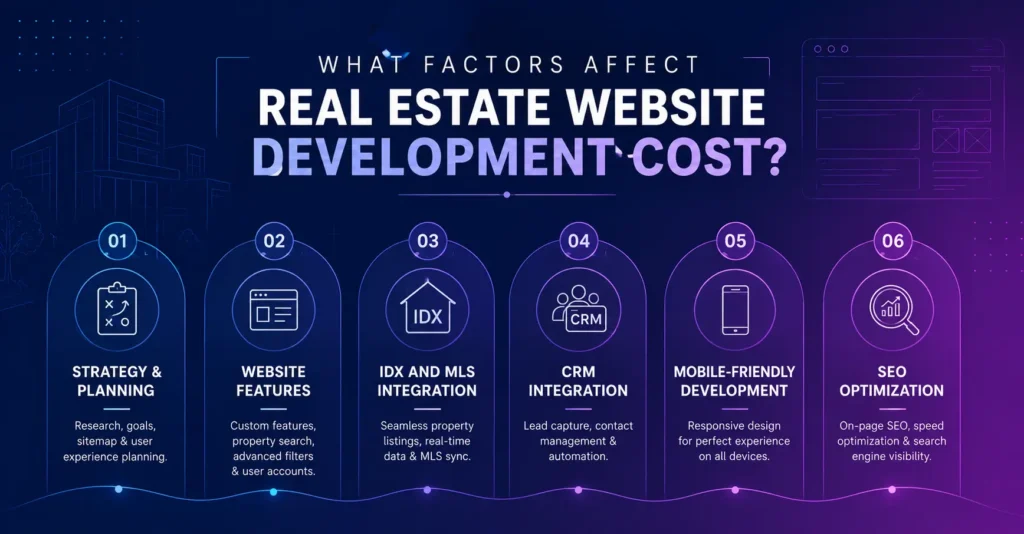
These factors can significantly change How Much Does a Real Estate Website Cost in 2026, especially when custom functionality and integrations are involved.
1. Custom Design
The real estate website design cost rises when you move from a template to an original interface.
A template gives you a proven visual framework.
Custom design gives you control over:
- Branding
- Layout
- User journeys
- Property presentation
- Search experience
- Conversion elements
- Mobile UX
For a luxury brokerage, custom design may be worthwhile because the website itself contributes to perceived brand value. For a new solo agent, it may be unnecessary.
2. Website Features
Every additional feature adds design, development, testing, and maintenance requirements.
Common examples include:
- Property search filters
- User registration
- Saved listings
- Property listing management
- Agent dashboards
- Mortgage calculators
- Map search
- Google Maps integration
- Virtual property tours
- Property image galleries
- Reviews
- Appointment booking
- Live chat
- Lead forms
- Email alerts
The question shouldn’t be “Can we add this?”
It should be:
“Will this feature improve revenue, efficiency, user experience, or lead quality?”
3. IDX and MLS Integration
If you’re asking How Much Does a Real Estate Website Cost in 2026 with IDX, you should separate development costs from recurring IDX and MLS expenses.
This is one of the biggest variables in real estate website development cost. A website can display manually entered listings relatively cheaply.
An IDX-enabled platform is different.
You need to consider:
- IDX provider
- MLS participation
- Data licensing
- Feed configuration
- Search functionality
- Listing synchronization
- Compliance requirements
- Additional MLS markets
Some providers charge monthly fees while others have setup charges or additional fees for multiple MLS feeds. For example, MLSListings IDX currently lists additional MLS pricing separately from its base plans.
4. CRM Integration
A website that generates leads but doesn’t organize them efficiently leaves money on the table. Real estate CRM integration can connect website forms with your sales system.
For example:
A visitor searches for three-bedroom homes → submits a request → enters your CRM → receives an automated response → gets assigned to an agent → enters a follow-up sequence. That workflow is much more valuable than a simple “Contact Us” form.
5. Mobile-Friendly Website Development
Real estate browsing happens across smartphones, tablets, and desktops.
Your property website should therefore use responsive web design.
Search filters need to remain usable.
Images need to load efficiently.
Buttons need to be easy to tap.
Forms shouldn’t become frustrating on smaller screens.
Accessibility matters, too. WCAG 2.2 is the current W3C recommendation and covers accessibility across devices and a wide range of user needs.
6. SEO Optimization
A website can look incredible and still generate almost no organic traffic. That’s why SEO should be considered during development rather than added afterward.
Your technical foundation should support:
- Clean URLs
- Crawlable pages
- Internal linking
- Indexable content
- Fast performance
- Schema where appropriate
- XML sitemap
- Canonicalization
- Metadata
- Location pages
- Property content
- Helpful neighborhood guides
Google Search Central provides guidance also emphasizes that foundational SEO remains relevant for AI Overviews and AI Mode. Google specifically recommends crawlable, indexable pages, strong internal linking, useful textual content, good page experience, and structured data that matches visible content.
Real Estate Website Cost Comparison for 2026
Here’s a practical comparison for buyers trying to choose the right approach.
| Option | Approx. Initial Budget | Ongoing Cost | Flexibility | Best For |
| DIY/template | $300–$1,500 | Low–medium | Low | Beginners |
| Real estate platform | $500–$3,000 | Medium | Medium | Solo agents |
| WordPress + IDX | $2,000–$8,000 | Medium | High | Agents and teams |
| Custom website | $5,000–$20,000+ | Medium–high | Very high | Growth businesses |
| Custom portal | $15,000–$50,000+ | High | Very high | Brokerages |
| Enterprise platform | $50,000+ | High | Maximum | Large organizations |
These are planning ranges synthesized from current public pricing benchmarks and vendor pricing, not standardized industry rates. Public 2026 estimates range from low-cost platform implementations to $15,000–$60,000+ custom IDX/MLS builds.
This comparison makes it easier to understand How Much Does a Real Estate Website Cost in 2026 at different levels of complexity.
What’s Included in a Professional Real Estate Website Package?
Before accepting a quote, ask exactly what the real estate website package includes.
Design and Branding
A professional package might include:
- Homepage design
- Property page templates
- Agent profile templates
- Brand styling
- Typography
- Color system
- Responsive layouts
- Conversion-focused sections
Development
You might receive:
- CMS integration
- Property database
- Search functionality
- Contact forms
- Blog
- User accounts
- Listing management
- Map integration
- Third-party integrations
Marketing Infrastructure
A stronger package may include:
- SEO setup
- Analytics
- Search Console
- Conversion tracking
- Lead forms
- CRM integration
- Email automation
Support
Clarify whether the quote includes:
- Bug fixes
- Security updates
- Software updates
- Backups
- Technical support
- Content changes
- Performance monitoring
Never assume support is included.
What Hidden Costs Increase Real Estate Website Cost?
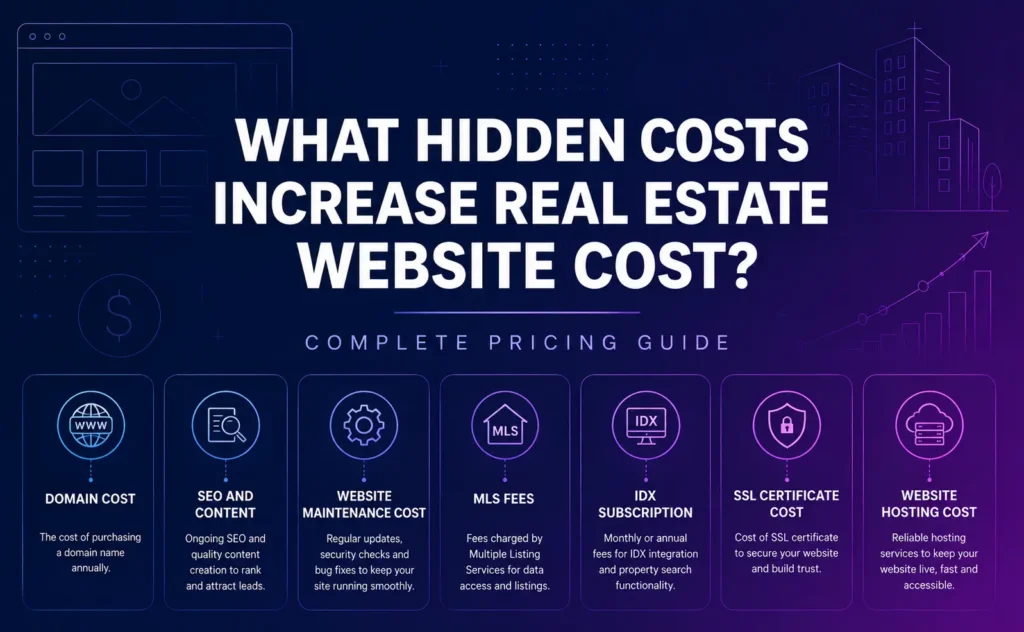
These recurring expenses are an important part of understanding How Much Does a Real Estate Website Cost in 2026.
Domain Cost
Your domain is relatively inexpensive compared with development, but it still needs annual renewal. A premium domain can cost significantly more.
Website Hosting Cost
Hosting varies according to traffic, performance requirements, resources, backups, and infrastructure. A basic site may use inexpensive shared hosting. A large property portal may require more sophisticated hosting.
SSL Certificate Cost
HTTPS is essential for modern websites.
Many hosting providers include SSL, so you don’t necessarily need a separate expensive certificate.
IDX Subscription
This is often a recurring expense. Current provider pricing demonstrates that IDX services can range from roughly $60 to $150+ per month for common standalone or hosted solutions, with other platforms costing substantially more.
MLS Fees
MLS-related costs vary by market and provider.
Never assume an advertised IDX price represents your complete MLS expense.
Website Maintenance Cost
Your ongoing website maintenance budget may cover:
- Updates
- Backups
- Security
- Monitoring
- Fixes
- Content changes
- Performance improvements
A neglected website can become a liability.
SEO and Content
If organic traffic is a priority, you’ll need ongoing content and SEO work.
That may include:
- Local landing pages
- Neighborhood guides
- Market reports
- Property content
- Blog articles
- Internal linking
- Digital PR
- Link acquisition
- Technical SEO
This should be considered a separate marketing investment rather than hidden inside development.
How Much Does a Real Estate Website Cost in 2026 With IDX?
If you’re specifically asking How Much Does a Real Estate Website Cost in 2026 with IDX, I’d separate the budget into three layers.
Layer one: website development.
This covers design, development, CMS, pages, forms, templates, and technical setup.
Layer two: IDX technology.
This covers the provider, listing feed, search functionality, map tools, and related features.
Layer three: ongoing operations.
This includes hosting, maintenance, MLS-related expenses, SEO, content, and software subscriptions.
For a small agent, an IDX platform may be more economical than commissioning custom MLS infrastructure.
For a brokerage with unique workflows, custom development may make more financial sense over time.
The cheapest option isn’t automatically the best option.
The right question is
Which solution produces the required business outcome at the lowest sustainable total cost?
Affordable Real Estate Website vs. Cheap Real Estate Website
There’s an important distinction between affordable real estate website development and cheap development. An affordable website delivers the right functionality at a reasonable cost. A cheap website simply minimizes the initial invoice.
For example, a $500 website might look attractive.
But if it:
- Loads slowly
- Has poor mobile UX
- Can’t scale
- Has weak SEO
- Doesn’t integrate with your CRM
- Requires expensive rebuilding later
Then you haven’t actually saved money.
You’ve deferred the cost.
When a Cheap Website Makes Sense
A low-cost solution can work when:
- You’re testing a market.
- You’re a new agent.
- You only need basic information pages.
- You already have listing technology elsewhere.
- You don’t need custom functionality.
When You Should Spend More
Invest more when:
- Your website is a primary lead source.
- You’re operating a team.
- You need IDX.
- You’re targeting competitive markets.
- You need CRM automation.
- You have multiple agents.
- You need a custom search.
- SEO is central to your acquisition strategy.
Custom Real Estate Website: Pros and Cons
Pros
Greater control: You can design the experience around your business.
Better differentiation: Your website doesn’t have to resemble dozens of competitors.
Scalability: Custom architecture can support future functionality.
Integration flexibility: APIs and CRM systems can be connected according to your workflow.
SEO flexibility: Developers can build information architecture around your organic strategy.
Cons
Higher upfront cost: Custom development requires more design and engineering.
Longer development time: Discovery, UX, development, testing, and launch take time.
Maintenance responsibility: Custom systems require ongoing technical support.
More decisions: You need to define exactly how the system should work.
Template Real Estate Website: Pros and Cons
Pros
Lower initial investment
Faster launch
Proven layouts
Less technical management
Cons
Limited customization
Potentially weaker differentiation
Platform dependency
Possible limitations with advanced SEO or workflows
For a solo agent who needs to get online quickly, a template can be perfectly sensible.
For a brokerage trying to dominate organic search, the limitations may become expensive later.
How to Choose the Right Real Estate Website Development Package
I recommend starting with your business model rather than your desired design.
Ask yourself:
Are You a Solo Agent?
A platform or WordPress-based site may be enough.
Prioritize:
- Professional branding
- Local SEO
- Lead capture
- Property search
- Reviews
- Neighborhood content
- CRM integration
Are You a Growing Team?
Invest more heavily in:
- Agent profiles
- Lead routing
- CRM integration
- Listing automation
- Team dashboards
- Analytics
- SEO landing pages
Are You a Brokerage?
You’ll likely need:
- Multiple agents
- Permission systems
- Advanced IDX
- CRM integration
- Office pages
- Lead assignment
- Reporting
- Custom workflows
Are You Building a Property Marketplace?
Now you’re entering application-development territory.
You’ll need to think about:
- User accounts
- Listing submissions
- Verification
- Search infrastructure
- Payments
- Messaging
- Moderation
- Notifications
- Security
- Scalability
That’s a fundamentally different project from a real estate business website.
How to Reduce Real Estate Website Development Cost Without Sacrificing Quality
You don’t need to spend $30,000 to build a useful website.
Instead, control scope.
Start With the Highest-Value Features
Build the essentials first:
Phase 1: Website + branding + lead capture + SEO foundation.
Phase 2: IDX + advanced search + CRM automation.
Phase 3: Advanced dashboards + personalization + automation.
This approach reduces unnecessary upfront spending.
Use Existing Technology Where It Makes Sense
Don’t custom-build something that reliable software already handles well.
For example, an established IDX service may be more economical than developing an MLS integration entirely from scratch.
Don’t Overbuild Your First Version
I’ve seen businesses make the same mistake repeatedly in website planning: they design for a company they hope to become rather than the company they are today. Build a strong foundation then expand according to measurable demand.
A Practical Real Estate Website Development Cost Breakdown
Suppose you’re a small real estate team with a $7,500 budget.
A sensible allocation might look like this:
| Area | Example Budget |
| Strategy and planning | $500 |
| UX/UI design | $1,250 |
| Development | $2,500 |
| CMS and listing functionality | $750 |
| IDX implementation | $750 |
| CRM/forms/integrations | $500 |
| Technical SEO | $500 |
| Testing and launch | $500 |
| Training/documentation | $250 |
| Total | $7,500 |
This isn’t a universal quote. It’s an example showing how the real estate website development cost breakdown can be structured. The actual allocation should change according to your business priorities.
Real Estate Website Cost for Small Businesses
If you’re a small agency or solo realtor, don’t start by asking for every possible feature. Start with your revenue model. If your primary goal is generating seller leads, your website should prioritize seller-focused landing pages and conversion paths.
If your primary goal is buyer leads, prioritize property search, saved searches, neighborhood pages, and lead capture. If you’re focused on luxury real estate, visual presentation and brand positioning may deserve more investment.
In other words:
Your website budget should follow your business strategy.
That’s the most important principle behind sustainable real estate website development pricing.
SEO, GEO, and AEO: The 2026 Real Estate Website Advantage
A modern real estate website shouldn’t be built exclusively for traditional blue-link rankings.
Search behavior is becoming more conversational.
People ask questions such as
“What are the best neighborhoods for families in Austin?”
“How much should I budget for a home in Miami?”
“Which areas have the best schools?”
“What are the property taxes in this neighborhood?”
Your website should provide genuinely useful answers.
Build Topical Authority
Create content around:
- Neighborhoods
- Property taxes
- Buying processes
- Selling processes
- Market trends
- Mortgage questions
- Schools and amenities
- Local regulations
- Property types
- Investment opportunities
This creates a topical ecosystem rather than a collection of disconnected blog posts.
Optimize for AI Search
Google states that existing SEO fundamentals remain important for AI Overviews and AI Mode. It also says there are no special technical requirements or special AI markup required for eligibility.
That means you don’t need to chase gimmicks.
Instead:
Create useful content.
Make it crawlable.
Structure it clearly.
Support claims with credible information.
Use internal links intelligently.
Keep important information in text.
Make structured data consistent with visible content.
That is a much more durable GEO and AEO strategy.
Real Estate Website Features Worth Paying For
Not every feature has equal ROI.
| Feature | Priority | Why It Matters |
| Mobile responsiveness | Essential | User experience |
| Lead forms | Essential | Conversion |
| Property search | High | Buyer experience |
| IDX/MLS | High | Live listings |
| CRM integration | High | Lead management |
| Local SEO | High | Organic visibility |
| Google Maps | Medium–high | Local discovery |
| Analytics | Essential | Measurement |
| Property galleries | High | Visual selling |
| Saved searches | Medium–high | Engagement |
| Mortgage calculator | Medium | Buyer utility |
| Virtual tours | Medium | Property presentation |
| AI chatbot | Optional | Qualification/support |
| Custom dashboard | Business-dependent | Workflow efficiency |
I’d prioritize features based on revenue impact rather than novelty. Knowing How Much Does a Real Estate Website Cost in 2026 can help you prioritize the features that actually contribute to business growth.
Real Estate Website Cost Checklist Before Hiring a Developer
Use this checklist before signing a contract.
- Is the design custom or template-based?
- Is mobile responsiveness included?
- Is CMS integration included?
- Is IDX included?
- Who pays the IDX subscription?
- Who pays MLS-related fees?
- How many MLS feeds are supported?
- Is CRM integration included?
- Are property search filters included?
- Is Google Maps integration included?
- Are property galleries included?
- Is technical SEO included?
- Are analytics configured?
- Is Google Search Console configured?
- Is schema implemented where appropriate?
- Is hosting included?
- Is SSL included?
- Are backups included?
- What is the website maintenance cost?
- Who owns the website?
- Who owns the domain?
- Who owns the content?
- What happens if you leave the agency?
- How many revisions are included?
- What happens after launch?
These questions can save you thousands of dollars.
How Long Does Real Estate Website Development Take?
The timeline depends on the scope.
A simple agent website might take 2–4 weeks.
A professional website with integrations may take 4–8 weeks.
A custom IDX site may take 6–12 weeks.
A complex property portal can take 3–6 months or longer.
The biggest variables are
- Content readiness
- Design revisions
- Integration complexity
- MLS requirements
- Custom functionality
- Testing
- Client feedback
- Third-party approvals
A rushed project isn’t necessarily a cheaper project.
Poor planning often creates expensive revisions.
How to Calculate Your Real Estate Website ROI
Instead of looking only at How Much Does a Real Estate Website Cost in 2026, consider how the website can contribute to leads and revenue.
Suppose your website costs $8,000. If it generates 40 qualified leads per year and five become clients, your economics look very different from a website that produces 500 irrelevant inquiries.
Track:
Organic traffic → leads → qualified leads → appointments → clients → revenue.
A simple ROI framework is
Website ROI = (Revenue Attributed to Website − Total Website Investment) ÷ Total Website Investment × 100
Include development, subscriptions, SEO, content, maintenance, and other meaningful costs.
This gives you a more realistic view of your real estate website price.
Common Mistakes That Increase the Cost of Building a Real Estate Website
Choosing the Lowest Quote
A low quote may exclude essential services.
Ignoring Recurring Costs
A $2,000 website can become a $5,000 annual technology stack if subscriptions aren’t considered.
Building Without SEO
Retrofitting SEO can require restructuring URLs, templates, content, and internal links.
Overbuilding
Adding unnecessary features increases both development and maintenance costs.
Forgetting Content
Beautiful design can’t compensate for weak property descriptions and thin local content.
Ignoring Conversion Tracking
Without measurement, you can’t determine which pages produce revenue.
Locking Yourself Into a Platform
Always understand ownership, export options, contracts, and migration limitations before committing.
What Should You Budget for a Real Estate Website in 2026?
Here’s my practical recommendation.
Solo Agent
Recommended budget: $1,500–$5,000
Focus on professional design, local SEO, lead capture, property presentation, and essential integrations.
Established Agent
Recommended budget: $3,000–$8,000
Add IDX, advanced search, stronger content architecture, analytics, and CRM workflows.
Real Estate Team
Recommended budget: $5,000–$15,000+
Prioritize agent profiles, lead routing, CRM integration, IDX, local landing pages, and automation.
Brokerage
Recommended budget: $10,000–$50,000+
Expect more sophisticated permissions, integrations, multiple agents, MLS feeds, dashboards, and enterprise requirements.
Property Marketplace
Recommended budget: $20,000–$100,000+
The scope now resembles custom software development rather than conventional website development.
Frequently Asked Questions About Real Estate Website Cost
How much does a real estate website cost in 2026?
How Much Does a Real Estate Website Cost in 2026? A real estate website can cost roughly $1,000–$3,000 for a basic agent site, $3,000–$8,000 for a professional site, and $5,000–$50,000+ for custom IDX, brokerage, or portal functionality. The final price depends on features, integrations, design, MLS requirements, and development complexity.
How much does it cost to build a real estate website with IDX?
An IDX-enabled website commonly requires both development expenses and recurring IDX service fees. A practical initial budget can range from about $3,000 to $15,000+ depending on customization. IDX providers themselves may charge roughly $60–$150+ per month for common plans, while premium platforms can cost considerably more.
How much does a realtor website cost?
A basic realtor website can cost approximately $1,000–$3,000, while a professionally designed realtor website with IDX, SEO, CRM integration, and advanced property search can cost $3,000–$10,000+. Your market, functionality, platform, and customization requirements will determine the final investment.
How much does it cost to build a property website?
A simple property website may cost $1,000–$3,000, while a property listing website with advanced search, user accounts, listing management, maps, CRM integration, and IDX can cost $5,000–$20,000+. A marketplace with custom workflows can exceed $50,000.
Is IDX worth the cost?
IDX can be worthwhile when property search is central to your lead-generation strategy. It gives visitors access to live listing information and can improve engagement. However, agents should compare IDX subscription costs, MLS requirements, SEO capabilities, lead tools, and CRM integrations before choosing a provider.
What is the cheapest way to build a real estate website?
The cheapest approach is generally a template or hosted real estate platform. This can reduce upfront development costs and launch quickly. However, you should compare total ownership costs, including subscriptions, IDX, hosting, maintenance, and limitations before choosing a cheap real estate website.
How much does real estate website maintenance cost?
Maintenance varies considerably. A small website may require only occasional technical updates, while an IDX or custom platform needs continuous monitoring, updates, backups, security, and integration management. Budgeting a recurring monthly amount is safer than assuming website development is a one-time expense.
Should I use WordPress for a real estate website?
WordPress can be a strong option when you want control over content, SEO, design, and integrations. It can also work with IDX solutions. However, the right platform depends on your technical requirements, maintenance resources, MLS needs, and long-term business strategy.
Does a real estate website need SEO?
Yes, if organic search is part of your acquisition strategy. A website without SEO may struggle to attract buyers searching for local properties, neighborhoods, services, and real estate advice. SEO should be incorporated into architecture, content, technical implementation, internal linking, and ongoing marketing.
What is the biggest factor affecting real estate website development cost?
The biggest cost drivers are usually customization, IDX/MLS integration, custom functionality, CRM integrations, user dashboards, and the complexity of property search. A basic brochure site requires far less engineering than a multi-user property marketplace.
Final Verdict: How Much Does a Real Estate Website Cost in 2026?
So, how much does a real estate website cost in 2026?
For most businesses, the realistic answer is $1,000 to $50,000+, depending on what you’re actually building.
A solo agent may be perfectly served by a $1,500–$5,000 website.
A serious agent or team may need $3,000–$15,000.
A brokerage can reasonably spend $10,000–$50,000+.
A custom marketplace or enterprise platform can move beyond $50,000.
The key is not finding the cheapest real estate website price.
It’s finding the right combination of design, property search, IDX/MLS, SEO, CRM integration, performance, scalability, and ongoing support for your business.
And that’s the biggest lesson I would take from this entire real estate website development pricing guide:
Don’t buy a website. Build a digital acquisition system.
Your website should attract qualified visitors, help them discover properties, answer their questions, capture their information, nurture relationships, and ultimately support transactions.
If you’re comparing proposals, don’t compare the headline price.
Compare the scope, ownership, recurring costs, integrations, SEO foundation, support, scalability, and expected business outcome.
That is the smarter way to evaluate how much a real estate website costs in 2026—and the best way to make sure your investment keeps working long after launch.
About the Author
Jawaria — SEO & Digital Marketing
Jawaria focuses on SEO, web development, AI automation, and digital marketing strategies designed to help small and mid-sized businesses improve their online visibility and grow sustainably.
Through HQ Growth Lab — Build. Rank. Scale., the focus is on creating practical digital strategies that help businesses build stronger websites, improve search visibility, and turn online traffic into measurable growth.